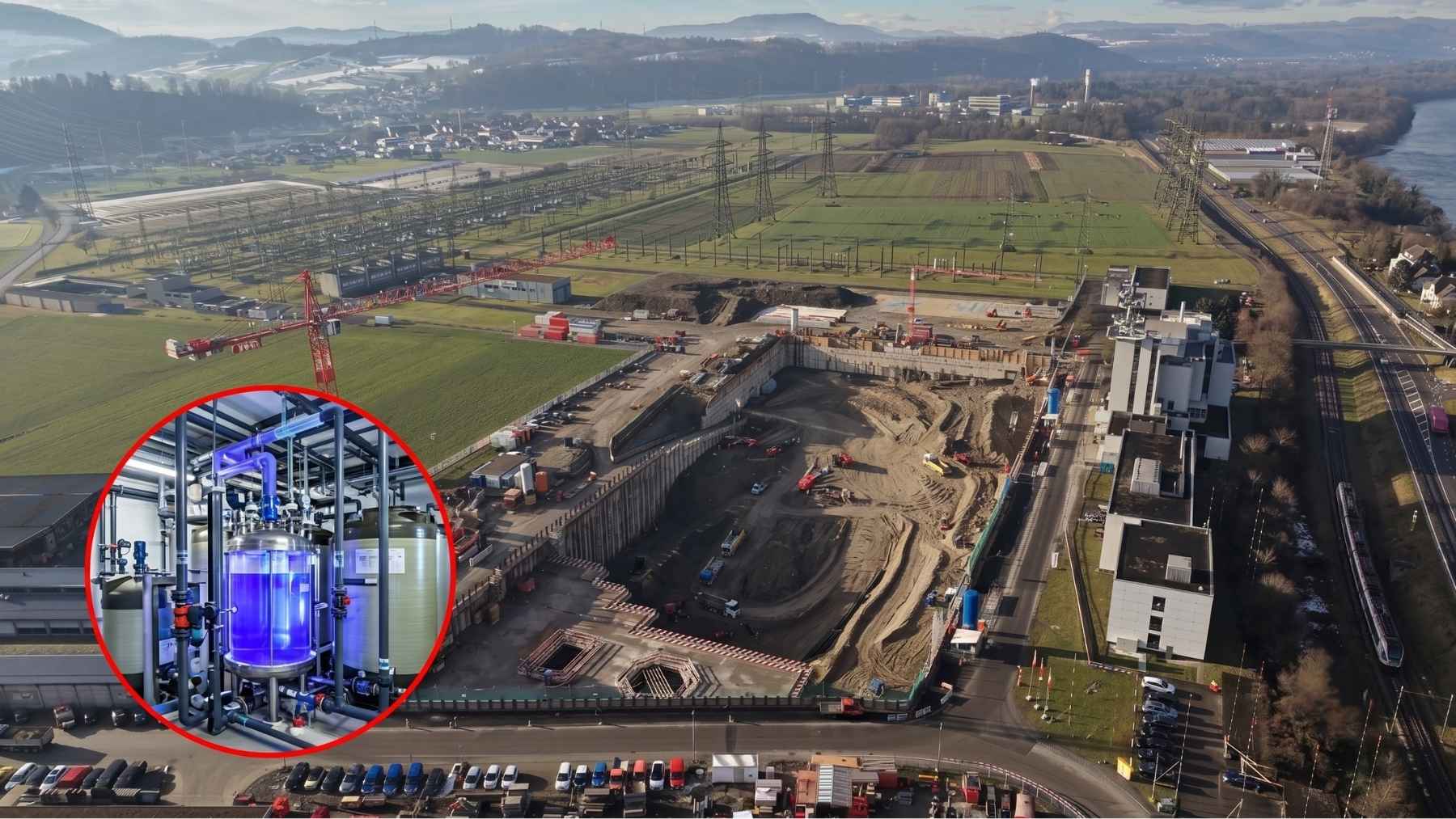

Lithium-ion batteries have quietly run the table. They’re in your phone, your laptop, your car, and increasingly the power grid, where giant lithium farms now soak up cheap solar at midday and sell it back at dinnertime when everyone gets home and turns on the oven. They’re very good at short, punchy bursts of power. What they’re not built for is pouring out steady electricity for hours on end without any risk of catching fire. A Swiss company called FlexBase is betting more than a billion dollars on that exact gap, and the proof is a hole in the ground in northern Switzerland that’s about 88 feet (27 meters) deep and as long as two soccer fields. When it’s finished, that pit will hold what the company and Swiss public broadcaster RTS are calling the most powerful redox flow battery in the world, and part of its job will be keeping an AI data center fed.
Liquid in tanks, not lithium in racks
A redox flow battery doesn’t look anything like the cell in your phone. Instead of packing energy into solid electrodes, it stores it in liquid. Two electrolytes, mostly water, sit in big tanks. To charge or discharge, pumps push those liquids through a stack of cells separated by a membrane, ions cross from one side to the other, and the change in chemical state locks energy in or lets it back out. On its project page, FlexBase describes its chemistry around vanadium, the most mature recipe for grid-scale flow batteries.
The upshot is a battery that’s hard to wear out and harder to set on fire. The electrolyte is water-based, so there’s no thermal runaway, no toxic smoke, and none of the fire-separation rules that keep big lithium installations at arm’s length from buildings. The charge cycles barely degrade it, which FlexBase says gives the system a practically unlimited service life, and the liquid is almost entirely recyclable when it’s done. That’s a very different proposition from a lithium grid battery like the wall of 448 Tesla Megapacks that just switched on in the Australian outback, which is excellent at fast response but lives and dies on lithium dug out of rock and refined mostly in China.
Power and energy are not the same number
Here’s the part that trips people up, and it’s the whole reason flow batteries are interesting. A battery has two separate ratings: how much energy it can hold, and how fast it can move that energy in or out. In a flow battery, those two are physically separate. Energy lives in the tanks, power comes from the cell stacks, so you can grow them independently by building bigger tanks or adding more stacks. A lithium pack bundles both jobs into the same cells, so you can’t.
FlexBase’s numbers show why that matters. The battery is designed to hold 2.1 gigawatt-hours, which the company estimates is enough to cover 210,000 households for a full day. Its peak power is something else entirely. Co-founder Marcel Aumer told RTS the system will inject or absorb up to 1.2 gigawatts (GW) of electricity in a few milliseconds, a figure he compared to the output of the nuclear plant down the road. He’s not stretching the comparison. Leibstadt is Switzerland’s most powerful reactor, rated at about 1,220 megawatts net, and it sits in the same canton on the Rhine near the German border. Do the math on those two numbers and you get a battery that, flat out at 1.2 GW, would empty in a bit under two hours, but can also trickle that same energy across a full day, or flip between charging and discharging almost instantly to steady a grid that’s wobbling.
Built in the same hole as an AI data center
The battery isn’t going into that pit by itself. It anchors a technology campus FlexBase is building near Laufenburg that will also house offices, labs, and a data center the company is pitching to hyperscalers as a “Sovereign AI Factory.” The waste heat coming off those servers is slated to warm Laufenburg and the surrounding area through a district heating network, which is a tidy way of turning a power-hungry liability into something useful.
That data center is a big part of why this is happening at all. AI workloads are pulling on grids faster than utilities can build new transmission, and operators everywhere are scrambling for power that doesn’t depend on a years-long interconnection queue. It’s the same pressure behind China’s claim that it bolted a small nuclear reactor onto a truck aimed squarely at the data centers eating the world’s power. FlexBase’s answer is less dramatic and more grounded: store the region’s surplus wind and solar in a giant tank of liquid, then hand it back, to the grid and to the servers, exactly when it’s needed. Swissgrid, which runs Switzerland’s high-voltage network, plans to plug into the Laufenburg site directly, and says that would be a first for the country.
The current record holder is also buried, in Xinjiang
For all the “world’s most powerful” billing, FlexBase still has to build the thing, and the current record holder is already running. At the end of December 2025, China switched on a 200-megawatt, 1-gigawatt-hour vanadium flow battery in Jimusar County, Xinjiang, paired with a gigawatt-scale solar farm, and it became the first flow battery of any kind to cross the gigawatt-hour mark. FlexBase’s 2.1 GWh would roughly double that capacity, and its 1.2 GW of power would be several times the Chinese plant’s output. Whether it actually gets there on schedule is the open question.
Aumer is candid that Europe is playing catch-up. He told RTS that Japan, China, and South Korea are roughly seven years ahead of Europe on this technology. And flow isn’t the only horse in the long-duration race. A silo of hot sand in a small Finnish town has been quietly doing a version of the same job for heat, with no lithium and no liquid electrolyte required.
Not everyone’s sold
There’s a real argument that none of this pencils out. Tobias Schmidt, who studies energy and technology policy at ETH Zurich, has been openly skeptical of the Laufenburg plan, telling Swiss broadcaster SRF that he wouldn’t put his own money into the technology and doesn’t think redox flow as designed there can win. His bet is on metal-ion batteries, lithium-ion today and especially sodium-ion next, because the manufacturing learning curve behind them, driven largely by electric cars, is brutally hard for any other chemistry to match.
The price tag does nothing to quiet that debate. The project is privately financed and carries an estimated cost of $1.2 to $6.2 billion (CHF 1 to 5 billion), and FlexBase is hoping it eventually supports around 300 jobs. The company is aiming to have the battery running in 2029. That’s a long way off, and the cost curves of competing batteries can move a lot before a pit in Switzerland is full of vanadium.
The bet, in plain numbers
FlexBase isn’t really wagering that flow beats lithium everywhere. That’s a fight it would lose. It’s wagering that there’s one specific, fast-growing job, holding hours of power steady for a wind-heavy grid and a data center that never sleeps, where a giant tank of fireproof liquid is a better tool than a wall of lithium that wants to be cycled hard and kept cool. It’s spending north of a billion dollars and digging a hole the size of two soccer fields to find out if it’s right. The chemistry behind it has been kicking around since 1879. The problem it’s aimed at is very much 2026.
 @sophiasaam ROOKIE2 weeks ago