
Most of us learned what a sunburn was sometime in grade school, usually after a long day outside and a bottle of sunscreen that didn’t leave the bag. Apples get them too. And an apple tree can’t exactly get up and move into the shade.
Apple sunburn basically happens when fruit soaks up too much direct sun and its skin gets hotter than it can handle. Depending on the variety and the weather, you’ll see anything from a bleached white patch to a dark brown burned spot, and apples that look like that aren’t worth nearly as much to the person who grew them.
Growers already fight it with shade netting. A survey of Washington State apple growers found 98% of them said they’d like to protect their trees from sunburn, so it’s safe to say growers there take it pretty seriously. Netting just sits there, though.
So what if that shade’s coming from a row of solar panels that can move?
The panels over these apple trees move
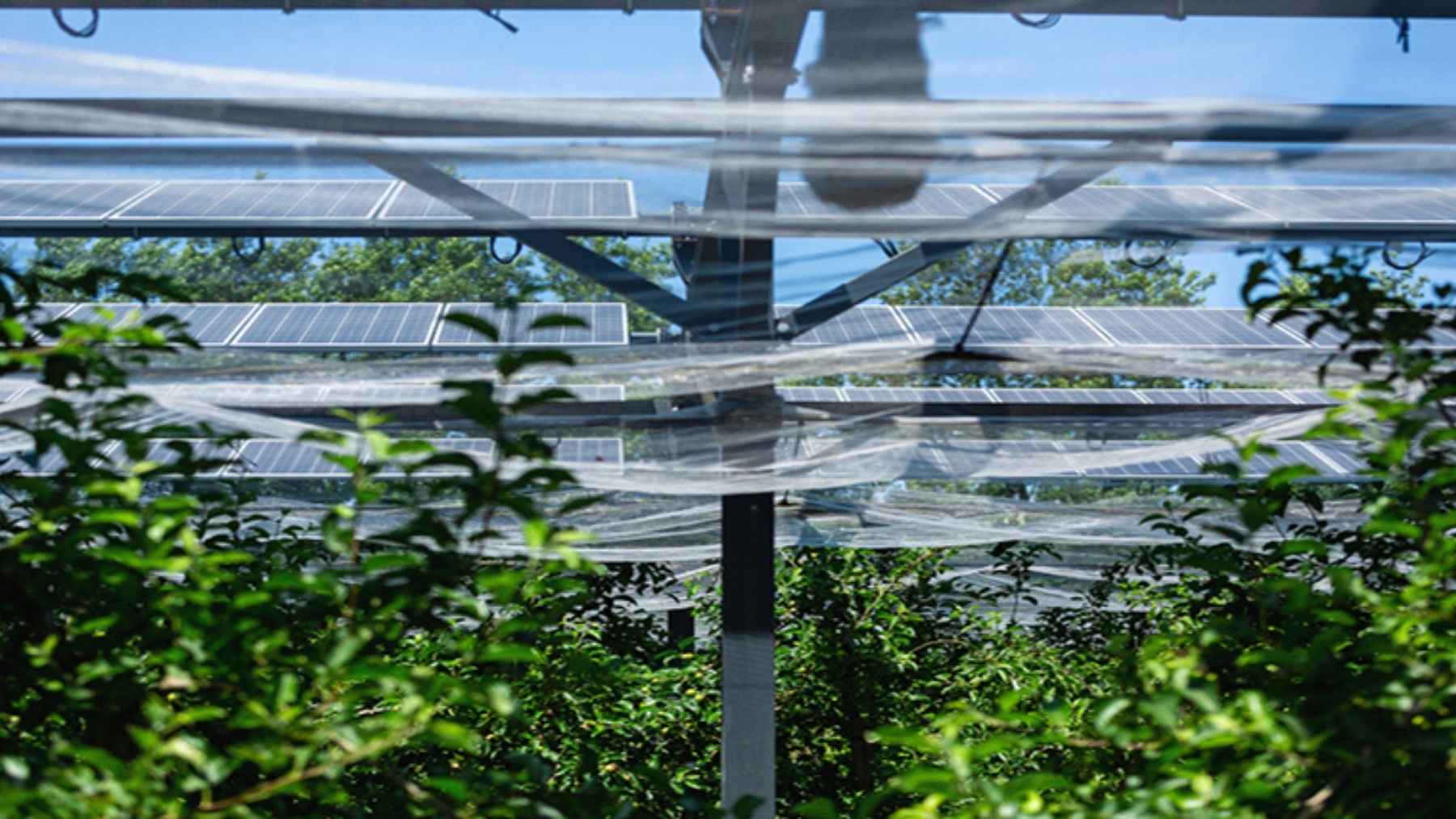
A fruit research station called La Pugère, in Mallemort in the south of France, has a block of Golden Delicious trees with a solar array built right over the top of them. The panels sit 17.7 feet up on a single-axis tracker. That’s a fancy way of saying each line of panels swivels on one long pivot, up to 90 degrees toward the east or the west.
It’s easiest to picture as a giant set of window blinds hung over the trees. Angle them into the sun and they shade the whole row. Turn them edge-on and most of the light gets through.
Laid flat, the strip of panels over each row is about 5.6 feet wide and covers 42.5% of the row. The covered block takes up about 7,912 square feet, and the researchers kept a comparison block about twice that size with no panels at all.
Both blocks sit under the same hail net, which cuts about 10% of the light by itself. I’m actually a fan of that detail, because it means both sets of trees already had some protection, and the panels are the only thing that’s different.
A weather station outside the orchard feeds the trackers. For both seasons in the study, the team set the system to shade the trees in the weeks before harvest, when sunlight and heat were peaking.
Did the panels actually stop the sunburn?
In 2022, the panels seem to have helped quite a bit. The team ran every apple from 10 trees on each side through a grading machine, and 13% of the apples from the trees without panels got thrown out because of sunburn. Under the panels, that figure was 2%.
The 2023 harvest wasn’t much of a test, because sunburn barely showed up anywhere. The comparison trees lost 1% of their apples to it, and the trees under the panels lost 0%. So I wouldn’t read a whole lot into that second harvest on sunburn alone.
Why the big swing from one year to the next? The researchers say it’s hard to link sunburn to a single season’s weather. Their weather data shows 2022 ran hotter early in the shading window, while 2023 saved its heat for the weeks closer to harvest. They also list things like how gradually the fruit gets used to heat and how much water the trees have as possible factors.
The apples under the panels ran cooler
Temperature’s where 2023 gets interesting. The team pushed thermocouples (basically tiny wire temperature probes) into 12 apples on each side, as close to the skin as they could get them, and logged readings through the hottest months of the year.
Once the panels started shading the trees, the daily light reaching them dropped by almost 50%, compared with the roughly 10% the structure blocked before that. On an average day, the hottest reading on an apple under the panels came in about 3.8°F below the hottest reading on an apple without them. The biggest gap the team recorded was 5.9°F.
A separate study on Honeycrisp apples found shade netting knocked about 4.5°F off the average daily high for the fruit. The French team takes that as a sign panels can do roughly what nets already do, and that’s a fairly modest claim for a paper about solar panels. I kind of appreciate that.
The apples didn’t shrink, either. The researchers measured 18 tagged apples on each side every week in 2023, and there wasn’t any difference in diameter. Counting every defect, sunburn included, the trees under the panels had 20% of their apples discarded that year against 39% for the comparison trees.
So what’s the catch?
There are a few, and the paper’s upfront about most of them.
The sample’s pretty small. Sunburn was graded on 10 trees per side, and the temperature data comes from two trees on each side. Apple diameter holding steady on 18 tagged fruit also isn’t the same as proving the whole block produced the same weight of apples, and the paper doesn’t report a total harvest weight.
Then there’s who wrote it. Seven of the nine authors work for Sun’Agri, the French company that builds this kind of moving solar array. The other two are from La Pugère. The paper also says its data is confidential, so you can’t go check the raw numbers yourself. Sun’Agri’s results could be spot on, and I’d still feel a bit better if an outside team repeated the test on more trees.
The orchard isn’t new to outside researchers, though. An earlier three-year study in Scientia Horticulturae, run under a research contract between Sun’Agri and INRAE (France’s national research institute for agriculture, food and the environment), looked at what the panels did to the trees’ water status, leaves and fruit set.
The sunburn paper in the AgriVoltaics Conference Proceedings also doesn’t say how much electricity the array produced over those two seasons, so I can’t tell you what the power side looked like.
Could you see this over American apple trees?
You’re probably not going to see one at a farm near you just yet. Cornell’s Hudson Valley Research Laboratory in Highland, New York, plans to break ground in late 2026 on a 300-kilowatt array over roughly 800 apple trees, with panels on single-axis trackers, according to Scenic Hudson. Jared Buono runs the lab, and he’s spent about two and a half years studying shade cloth over 300 Fuji trees as a stand-in for panels.
Europe’s been at this longer. We’ve covered a German grower whose apples ripen 10 to 12 days later under his panels, and a French kiwifruit farm in the Alps that went under a solar roof to keep rain off its vines. If you grow apples somewhere with long, hot summers, I’d guess a roof that shades on demand looks pretty tempting.
La Pugère now has a second array to study, too. CVE, a renewable energy company based in Marseille, inaugurated fixed, semi-transparent panels 14.8 feet above pear trees at the station on June 9, and it says researchers will follow three pear harvests there between 2026 and 2028.