
Here’s a fun fact about power plants: nearly all of them, whatever the fuel, are elaborate ways of boiling water. Coal boils water. Natural gas boils water. A nuclear reactor is, at its heart, a very expensive and very serious water boiler. The steam spins a turbine, the turbine spins a generator, and that’s where your electricity comes from.
Most fusion designs, the supposed endgame of energy, plan to do exactly the same thing. Take the hottest matter humans have ever created, several times hotter than the core of the Sun, and use it to make steam.
Helion, a fusion company based in Everett, Washington, thinks that middle step is a waste of perfectly good physics. Its machine is built to convert each fusion pulse directly into electricity. No turbine, no cooling tower, no kettle.
And June was quite a month for that idea. On June 4, investors handed Helion $465 million at a $15.5 billion valuation. Twelve days later, Washington State handed it the first regulatory licenses ever issued anywhere for a fusion power plant. The machine with no steam turbine suddenly has money, paperwork, and a deadline.
Every power plant you’ve ever seen is a kettle. This one is a battery.
The thermal cycle is fusion’s unglamorous secret. Even ITER, the cathedral-sized international project in France, is a proof of concept for a design class that plans to make electricity the old way: heat, steam, turbine. Every step in that chain leaks energy.
Helion’s approach recovers energy magnetically instead. When fusion happens inside its machine, the superheated plasma expands and shoves back against the magnetic field holding it. That push induces current directly in the surrounding coils. Faraday’s Law, doing the job of an entire turbine hall.
The company’s own comparison is regenerative braking in an electric car. Your EV recovers energy by letting the wheels push back through the motor instead of wasting it as brake heat. Helion’s plasma pushes back through the magnets instead of wasting its energy heating water.
The efficiency claim attached to this is the entire business case. Helion says it can recover electricity from each pulse at better than 95 percent efficiency, which would mean the fusion reaction only needs to top up the small slice that gets lost. “Fundamental to our technology is direct electricity recovery,” CEO David Kirtley told Scientific American. Even Troy Carter, who runs the Fusion Energy Division at Oak Ridge National Laboratory, called that Helion’s clearest technical edge in the same piece. With one very load-bearing caveat: if it works.
Two smoke rings colliding at a million miles per hour
The machine itself is nothing like the giant donuts most fusion headlines are about. Tokamaks like Japan’s JT-60SA, the world’s largest operating fusion machine, hold a steady plasma inside a cage of superconducting magnets. Helion’s device is a straight tube, about 60 feet long, and it works in pulses.
At each end of the tube, the machine forms a plasmoid called a field-reversed configuration, or FRC. Picture a spinning smoke ring that generates its own magnetic field and holds itself together. Then the machine fires both rings at each other at roughly a million miles per hour.
They collide in the center, magnets running at more than 15 tesla squeeze the merged plasma, and the whole thing gets denser and hotter until fusion kicks in. The plasma expands, the coils harvest the push as electricity, and the machine resets for the next shot. The entire sequence takes a fraction of a millisecond, quicker than a camera flash.
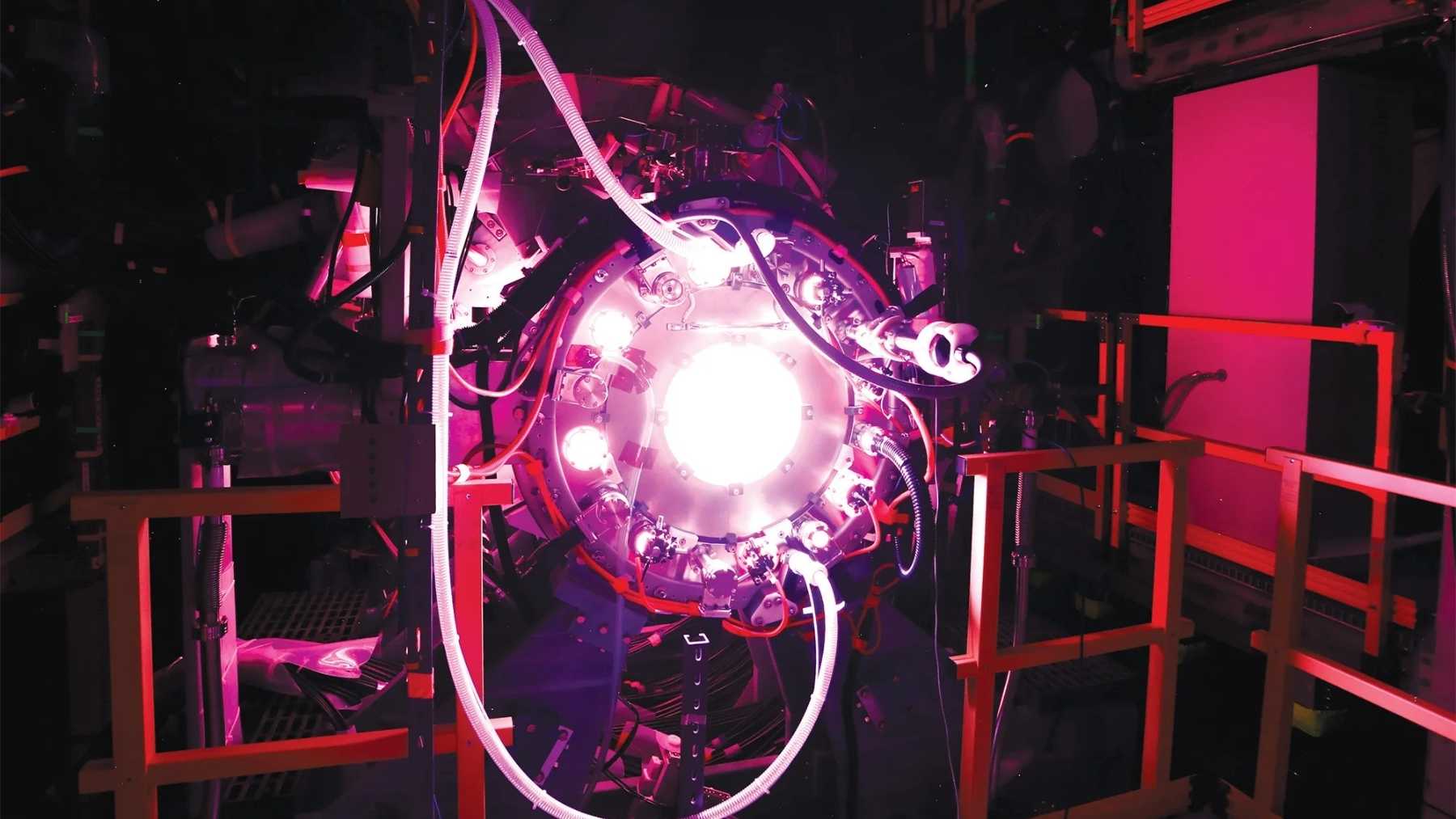
Polaris, the seventh-generation prototype running in a 30,000-square-foot building in Everett, is where the recent bragging rights come from. Its capacitor banks store 50 megajoules per pulse, using enough oil-filled capacitors to fill 150 shipping containers. This past February, the company says Polaris became the first privately funded fusion machine to run on deuterium-tritium fuel, and pushed plasma past 150 million degrees Celsius, a company record.
Helion isn’t the only outfit skipping the standard playbook. Commonwealth Fusion is betting on brute-force magnets with its compact SPARC tokamak outside Boston, and a Canadian company just proved you can heat a plasma by physically crushing it with lithium. But nobody else is trying to pull electricity straight out of the reaction.
The first fusion plant licenses on Earth went to a farm town in apple country
The money is only half of June’s story. On June 16, the Washington Department of Health issued Helion a Radioactive Materials License and a Radioactive Air Emissions License for its plant site, the first regulatory licenses for a fusion power facility anywhere in the world, according to GeekWire.
If you’re wondering why a state health department gets to license a nuclear technology, that’s actually the interesting part. In 2023, the U.S. Nuclear Regulatory Commission decided fusion machines have more in common with particle accelerators and hospital equipment than with fission reactors. So there’s no decade-long federal reactor review. There’s a state permit.
The Series G round tells you who’s buying the pitch. Thrive Capital led it, with newcomers including Lux Capital, Peak XV Partners, and Bill Ford, executive chairman of Ford Motor Company, personally writing a check for the machine that works like his EVs’ brakes. OpenAI’s Sam Altman remains the largest shareholder, owning roughly a third of the company by his own court testimony, though he stepped off Helion’s board in March.
Orion has a customer, a deadline, and financial penalties
All of this converges on a flat stretch of land near Malaga, Washington, a farm town in Chelan County apple country, just up from the Rock Island Dam on the Columbia River. That’s where Helion is building Orion, its eighth-generation machine and, if things go to plan, the world’s first fusion power plant.
Orion exists because of a contract. In May 2023, Microsoft signed the first power purchase agreement in fusion history: at least 50 megawatts from the Malaga plant, feeding a data center in central Washington, with initial operations targeted for 2028. The deal carries financial penalties if Helion doesn’t deliver, which is not a phrase fusion research has ever had to worry about before.
There’s a second customer lined up behind it. Steelmaker Nucor agreed in 2023 to develop a 500-megawatt fusion plant with Helion at one of its facilities, targeting 2030. The long-term vision is modular generators built in factories and shipped out like server racks, which is why the company now employs around 600 people, most of them technicians rather than physicists.
The co-founder who says the physics won’t cooperate
Now for the part the press releases skip. The sharpest critic of Helion’s design is John Slough, the University of Washington physicist whose decades of FRC research made the company possible, and who co-founded it. He has since split with Helion.
His objection, laid out in Scientific American in May, targets the core move: firing plasmas together at extreme speed. In Slough’s view, those collisions drive instabilities severe enough to bleed the plasma of its magnetic flux before fusion can produce the energy Helion is counting on. And he sees no path in the physics for the deuterium-helium-3 fuel Helion wants to run commercially, which needs around 200 million degrees.
He’s not alone. A group at Germany’s Max Planck Institute for Plasma Physics published formal comments in the Journal of Fusion Energy in February arguing that Helion’s 2023 physics paper underestimates how quickly hot ions dump their energy into electrons, making the real requirements much tougher than the company’s math suggests. Kirtley’s counter to both is speed: the pulses happen so fast, he argues, that many instabilities simply don’t have time to grow, and dated one-dimensional models miss that.
Two more grains of salt for the road. Helion publishes very little peer-reviewed data on its plasma performance, so outside physicists can’t fully check the claims. And Polaris was originally supposed to demonstrate net electricity by 2024; as of this writing, no published results confirm it has generated net power at all.
A bet with walls already rising
So that’s the wager, and it’s no longer theoretical. The walls at the Orion site are going up, the licenses are signed, and $1.5 billion of other people’s money says a pulsed machine can skip the kettle entirely.
Against that stand a co-founder who says the plasma will tear itself apart, a Max Planck group that says the math is optimistic, and a 2028 contract with penalties attached. One side of this argument gets settled in Malaga, on a startup’s schedule rather than a national lab’s. Either the smoke rings hold together or they don’t.