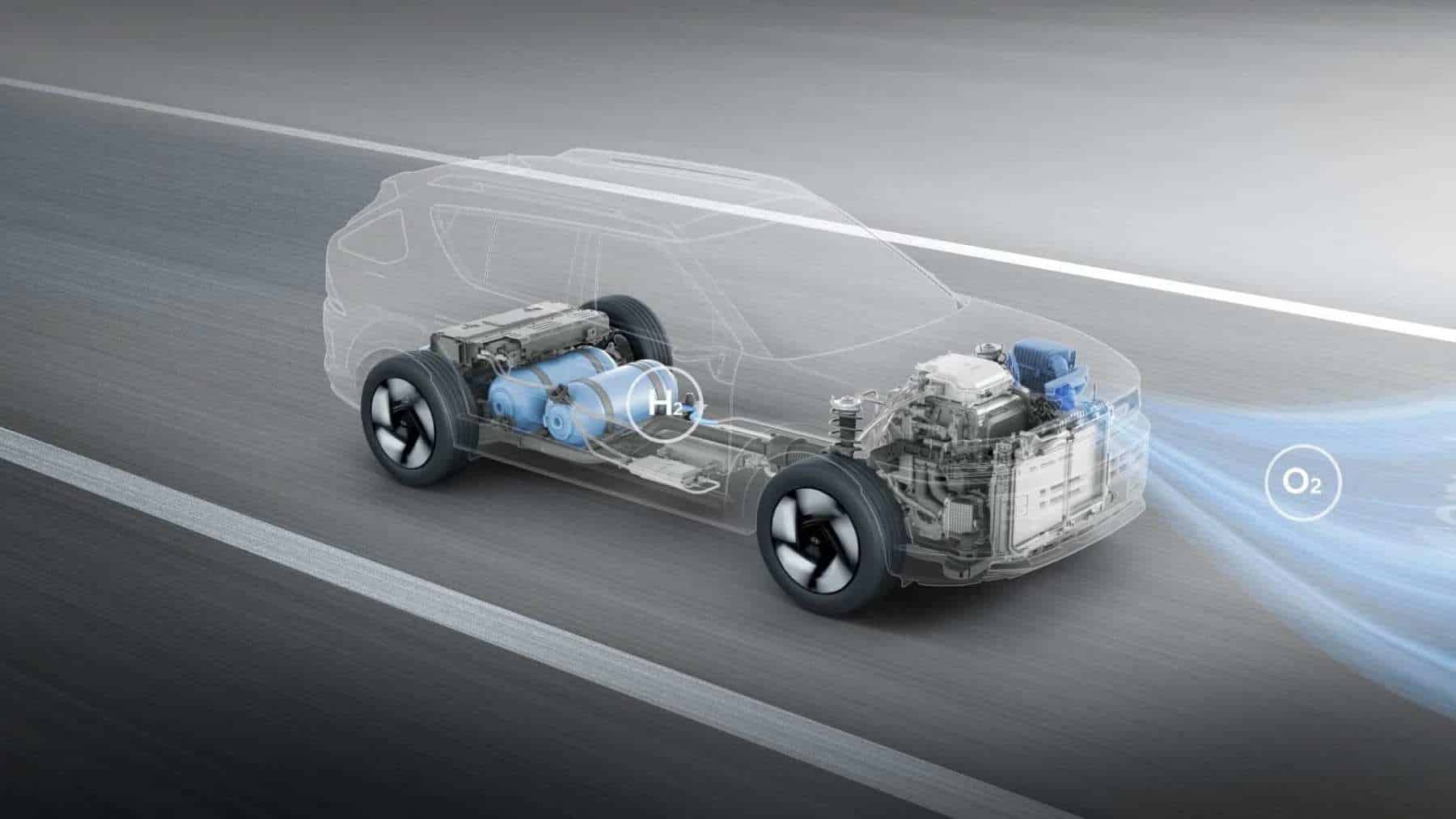

The Toyota Mirai is, by most measures, a perfectly good car. It has 402 miles of range, refuels in five minutes, emits nothing but water, and starts at $52,990. It is also one of the worst purchases you can make in 2026, and almost nobody buys one. The reason has nothing to do with the engineering of the car and everything to do with a problem nobody managed to solve: getting hydrogen to the pump. There are only a few dozen public hydrogen stations in the entire United States, nearly all of them in California, and the fuel runs around $36 a kilogram — roughly 50 cents a mile, about double gasoline. A joint team from Seoul National University and Stanford just published work that goes straight at the root of that distribution problem.
Their result, published in Science on May 29, is a platinum catalyst that releases hydrogen from a liquid carrier using one-tenth the platinum of today’s commercial versions — while lasting longer and producing more hydrogen, not less. And the reason it works overturns something the catalyst field assumed for decades.
The actual problem isn’t making hydrogen — it’s moving it
Hydrogen is the lightest element on the periodic table, which is exactly what makes it a logistical nightmare. As a gas it takes up an absurd amount of space; to go liquid it has to be chilled to minus 253 Celsius; compressed, it sits at pressures that make safety engineers twitchy. Shipping it the way we ship oil or LNG has been the bottleneck strangling the whole sector — and it’s the real reason hydrogen passenger cars never got the fueling network that battery EVs got in chargers.
One of the most credible fixes is a class of materials called Liquid Organic Hydrogen Carriers, or LOHCs. The idea is clean: chemically bond hydrogen onto a liquid organic compound, ship that liquid at room temperature through the tankers and pipelines the oil industry already built, then strip the hydrogen back off at the destination. The most industrially mature version pairs toluene with methylcyclohexane — pump hydrogen in and toluene becomes methylcyclohexane, which carries about 6 percent of its weight in hydrogen; pull it back off and you have toluene again, ready to cycle. Japan’s Chiyoda Corporation has already run that round trip across international waters.
The catch is the last step. Releasing the hydrogen — dehydrogenation — runs hot, eats energy, and depends on platinum-group catalysts that are expensive and degrade as carbon fouls them up. That release step is the line item that’s kept the LOHC pathway from penciling out. Which loops directly back to the Mirai: cheap hydrogen at the plant is worthless if unloading it at the far end of the supply chain costs a fortune. The pump price in California isn’t high because hydrogen is hard to make. It’s high because the entire chain that moves and dispenses it is.
The counterintuitive part: count the atoms, not the nanometers
Here is where the Seoul–Stanford work gets genuinely interesting, and it isn’t really the platinum savings on their own. Using a new electron-microscopy method, the team showed for the first time that two platinum clusters that look identical under the microscope — both about 1 nanometer across, roughly a hundred-thousandth the width of a human hair — can actually hold wildly different numbers of atoms, anywhere from 13 to 31, depending on how they were formed.
That matters because the field has spent years assuming particles of the same size behave the same way. This study says that’s wrong: the number of atoms in the cluster — not its apparent size — is what decides how much hydrogen you get and how long the catalyst lasts. Clusters with fewer atoms turned out to be more active per platinum atom but less stable; the trick was engineering one that hits both targets at once. That’s a design rule nobody had pinned down, and it’s the kind of fundamental result that earns a Science paper rather than a press release.
What they actually built
The catalyst is a 0.5-weight-percent platinum-on-alumina cluster catalyst. The synthesis strips the chemical ligands off the platinum atoms and bonds them straight to the alumina support, then locks them in place through a calcination-and-reduction process so the clusters stay anchored instead of clumping under heat — which is normally how these catalysts die. Run against methylcyclohexane in actual hydrogen-release reactions, it used a tenth of the platinum of commercial catalysts and still came out ahead on both output and lifespan.
The Seoul National team, led by Professor Park Jeongwon, handled synthesis, structural analysis, and performance testing; the Stanford group, led by Thomas Jaramillo and Matteo Cargnello, ran the atomic-level mechanism and adsorption calculations that explain why it works. “This research goes beyond simple catalyst size optimization to maximize hydrogen production performance through precision structural control at the atomic scale,” Park said, calling it “a core catalyst platform technology” for the hydrogen economy.
Where the cold water goes
The usual caveat applies, and it’s the same one that haunts every catalyst story. This is academic research, not a product. The team says it can already make the catalyst at the tens-of-grams scale in a single lab process and sees “no significant barriers” to mass production — but “no significant barriers” is a researcher’s phrase, and the history of catalysis is littered with materials that behaved beautifully at gram scale and fell apart at the tonne scale a real hydrogen terminal would demand. Coke build-up over thousands of real cycles, not a clean lab run, is what kills dehydrogenation catalysts, and that test is still ahead.
Cutting the platinum by 90 percent also doesn’t, by itself, resurrect the Mirai. The heat to drive the reaction, the round-trip energy losses, and the toluene cycling all still cost money, and the smart money in hydrogen has already shifted toward trucks, trains and industrial use, where centralized refueling sidesteps the distribution problem entirely. But the part of the chain that moves the fuel from where it’s made to where it’s burned just got cheaper to build — and it got there on a finding, atom count over size, that should ripple well beyond this one reaction. Moving hydrogen, not making it, is where the economics have been breaking. This is a real dent in exactly that spot.