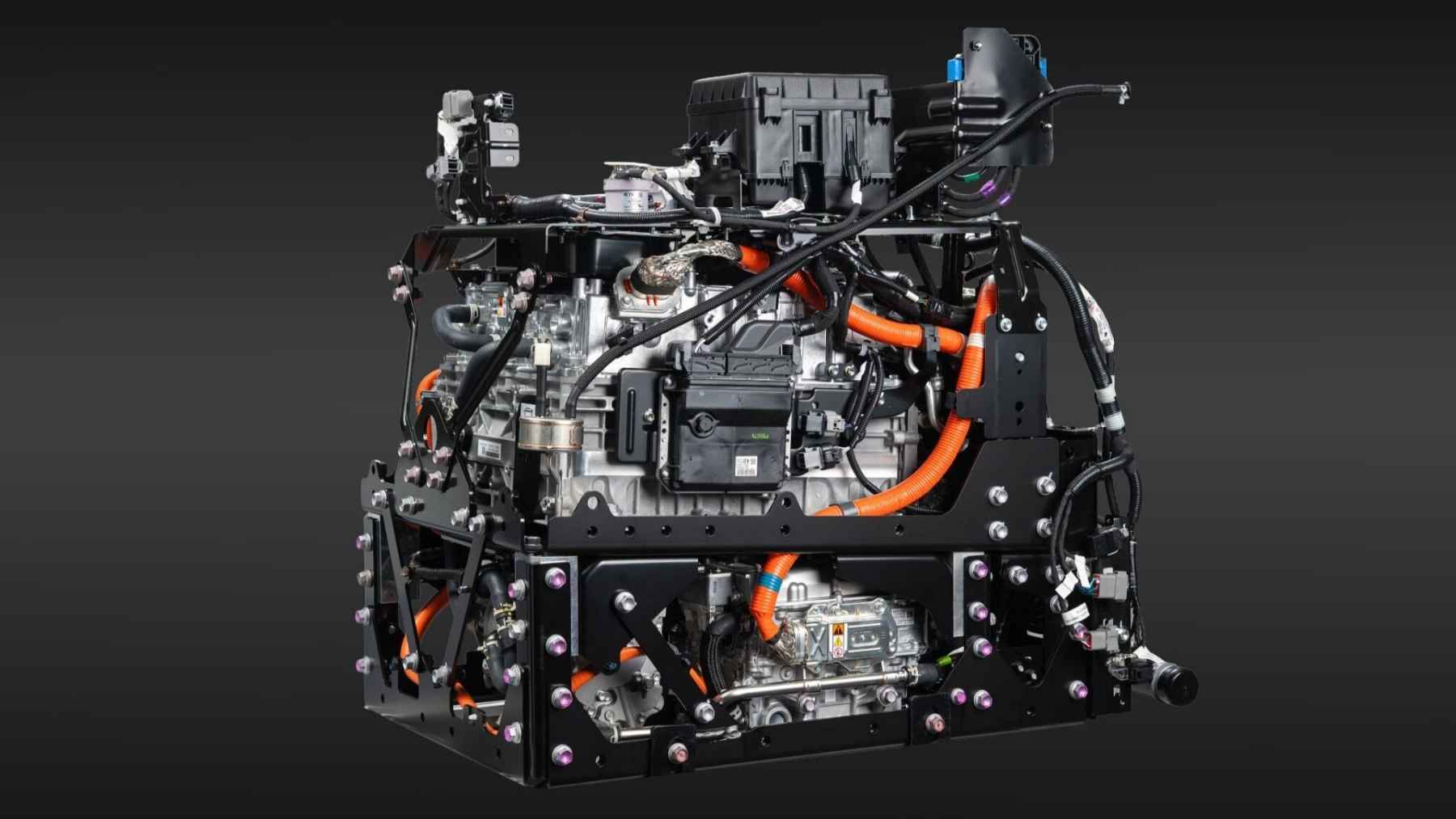

While Toyota struggles to sell a few hundred hydrogen-powered Mirai sedans a year in a country with fewer than 70 hydrogen filling stations, another Japanese giant has just sidestepped the infrastructure problem entirely. On September 30, 2025, Kawasaki Heavy Industries announced the world’s first commercial gas engine capable of running on natural gas blended with up to 30% hydrogen by volume — and it does it without forcing operators to replace a single pipe, tank, or storage system they already have.
The engine is industrial, not automotive. But the way Kawasaki is solving hydrogen’s deployment problem has direct implications for the future of hydrogen-powered cars in the United States, and for why companies like Toyota, Hyundai, and Honda keep losing money on technology nobody can actually fuel.
What Kawasaki Just Did
The new engine is called the KG-18-T.HM, an 18-cylinder reciprocating gas engine built on Kawasaki’s KG Series industrial platform. The 50 Hz version generates 7,800 kW; the 60 Hz version — the one relevant to American power grids — produces 7,500 kW. Both are designed for sites with constant, heavy energy demand: chemical plants, data centers, hospitals, automotive factories, and industrial campuses.
The KG Series itself isn’t new. Kawasaki has been selling natural gas versions since 2011, and the platform has received over 240 orders since then. What’s new is that the hydrogen co-firing ratio can be adjusted while the engine is running, starting from a 5% hydrogen blend and climbing to 30% as supply becomes available. According to Kawasaki’s own verification data, switching from pure natural gas to a 30% hydrogen blend reduces CO₂ emissions by approximately 1,150 metric tons per year, the equivalent of the annual carbon output of roughly 420 households.
The commercial launch followed an 11-month verification program at Kawasaki’s Kobe Works facility, running from October 2024 through September 2025. TechSpot reported that engineers spent that period validating seal integrity, hydrogen leak detection, nitrogen purge systems, and metal fatigue under real industrial conditions before Kawasaki was willing to start taking orders.
Why the Retrofit Angle Changes Everything
The bigger story isn’t that Kawasaki built a new engine. It’s that existing KG Series engines can be upgraded to hydrogen co-firing specifications with minimal modifications. A factory that bought one of these engines in 2015 doesn’t have to scrap it and buy a new one. It can keep the same generator, the same gas piping, the same supply contracts, and gradually shift its fuel mix toward hydrogen as supply ramps up.
That’s the kind of unglamorous detail that actually matters in heavy industry. The cleanest industrial machine is rarely the newest one. It’s the one that avoids turning a perfectly usable engine into scrap.
For a hospital, chemical plant, or data center already running a KG Series engine, the conversation goes from “spend tens of millions on a new hydrogen system” to “upgrade the engine you already have.” That difference is what separates announcements that sound impressive from technologies that actually get deployed.
This Is Exactly Where Hydrogen Cars Have Failed
The infrastructure problem Kawasaki is solving for factories is the same problem that has crushed hydrogen passenger cars in the United States.
Toyota sold just 210 Mirai sedans in all of 2025, down 57.8% from 499 units the year before. The 2026 Mirai is still on sale, starting at $52,990, despite virtually nobody buying one. Toyota throws in $15,000 of free hydrogen with every purchase. It still isn’t enough.
The reason is brutal and simple. According to the Alternative Fuels Data Center, there are roughly 56 to 70 public hydrogen stations in all of North America. Forty-nine of them are in California. Forty-five of those are clustered in San Francisco or Los Angeles. Buy a Mirai in Phoenix, Denver, or Atlanta and you literally cannot fuel it. Even in California, hydrogen costs around $36 per kilogram, which translates to roughly 50 cents per mile of driving — about $5,000 a year for a 10,000-mile commute, per an analysis by The Autopian.
The only other hydrogen passenger cars sold in the U.S. — the Hyundai Nexo and the Honda CR-V e:FCEV — are also restricted to California for the same reason. Toyota is currently facing a $5.7 billion class-action lawsuit from California Mirai owners who claim they were sold a car they cannot reliably fuel.
Why Kawasaki’s Approach Works Where Toyota’s Doesn’t
The contrast is stark. A factory running a KG-18-T.HM doesn’t need a new fueling network. It uses the natural gas pipes already feeding the building, with hydrogen blended in at a mixing unit on site. When hydrogen supply grows, the blend ratio increases. When it doesn’t, the engine still runs on pure natural gas. The factory never stops producing power.
A Mirai owner in Phoenix has no such option. There is no Phoenix hydrogen station. There never has been. And there’s no realistic timeline for building one given current passenger vehicle demand. Setting up a single retail hydrogen station costs far more than building an EV fast-charging site, and Shell has actually been closing California hydrogen stations rather than opening new ones.
This is why most serious hydrogen development is moving toward commercial vehicles and industrial applications, not consumer cars. Toyota itself is partnering with PACCAR and Kenworth to build hydrogen fuel cell Class 8 trucks, using fuel cell powertrain kits from Toyota’s Kentucky factory. Heavy long-haul trucks make sense for hydrogen — batteries are too heavy, charging is too slow, and centralized refueling at trucking depots solves the distribution problem.
Industrial and commercial use cases have something passenger cars don’t: a small number of high-volume sites that can be supplied directly, rather than millions of cars that each need a fuel station nearby.
Japan’s Bridge, America’s Cliff
Japan is treating hydrogen as an infrastructure problem to be solved gradually. Kawasaki and Japan Suiso Energy broke ground in late 2025 on the Kawasaki LH2 Terminal at Ogishima, Japan’s first large-scale liquid hydrogen import and storage hub, which will include a 50,000-cubic-meter cryogenic tank — billed as the largest in the world — when it opens in 2030. The country’s Green Innovation Fund, worth roughly 2 trillion yen (about $13 billion), is funding hydrogen development across road, sea, and air transport simultaneously.
The United States, by contrast, has 56 retail hydrogen stations and a federal policy that recently rolled back the $7,500 EV tax credit. Hydrogen passenger cars exist here essentially as compliance vehicles and lawsuit material.
The Kawasaki engine isn’t going to fix that. But it’s a reminder of how hydrogen actually gets deployed when an economy is willing to invest in the supply chain rather than just the end product. Toyota has been waiting for that to happen in America for over a decade. So far, it’s mostly been waiting alone.