
When scientists want a proper look at the seafloor, the job usually starts with a ship. Someone loads an underwater drone onto a research vessel, a crew sails it out to the right spot, the drone goes over the side, and everyone waits for it to come back. That’s fine when the spot’s close. It’s slow when the spot’s far offshore, and it’s a tough sell when the water’s somewhere you’d rather not send people.
Japan’s national ocean research agency, JAMSTEC, thinks an aircraft could get there a lot faster. More specifically, a flying boat with no pilot that flies itself out, lands on the water, slips a survey drone into the sea and picks it back up when the work’s done. It’s the same agency that’s working on a deep-sea drone to scout for rare earths, so it’s safe to say ambition isn’t the problem.
That aircraft doesn’t exist yet. But on April 9, JAMSTEC and ShinMaywa, the company that builds the big US-2 rescue flying boats for Japan’s Maritime Self-Defense Force, ran a test off Ashiya, near Kobe, that got two pieces of the system talking to each other. JAMSTEC published the results on June 9.
So what actually happened off Ashiya?
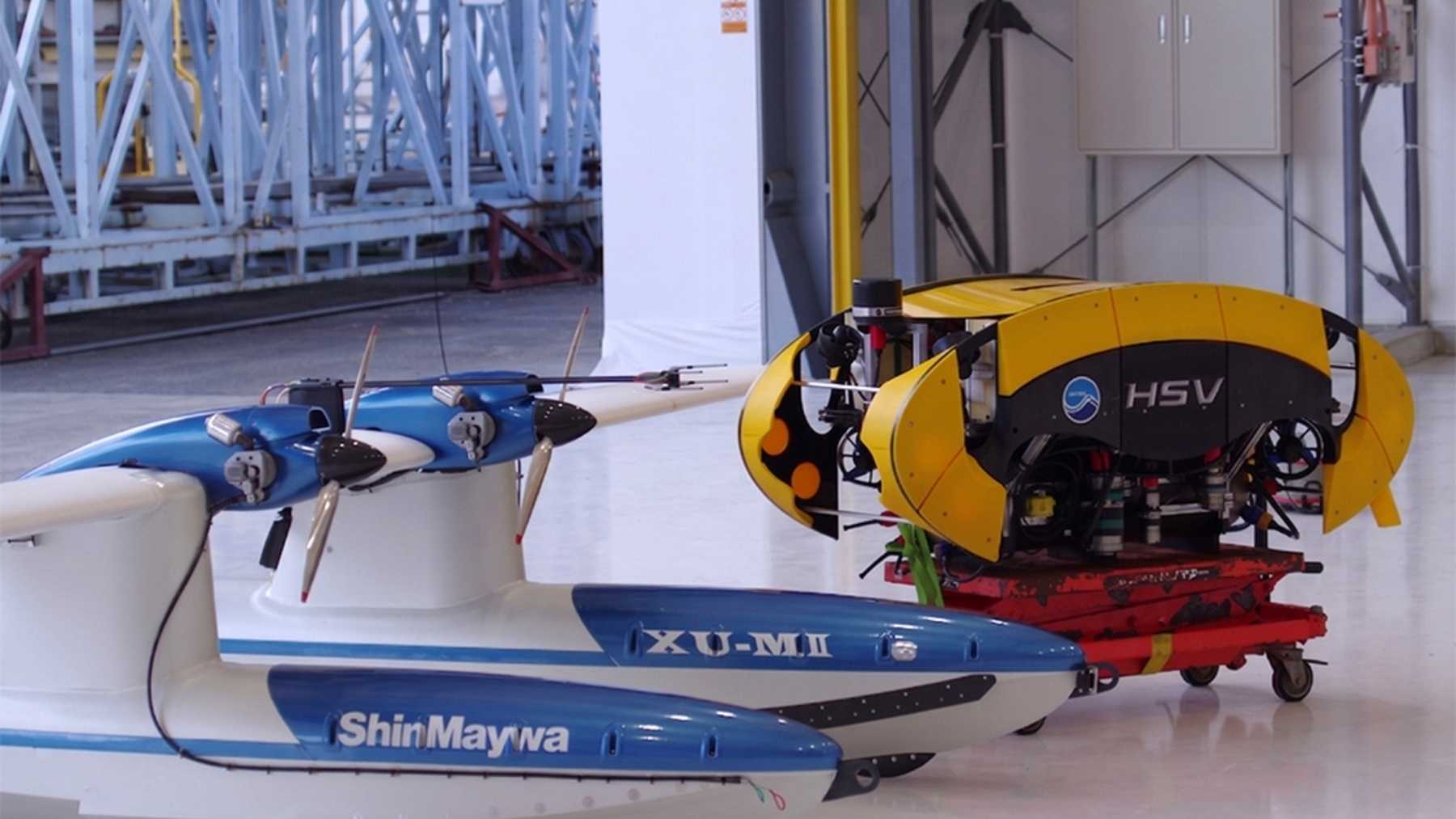
Two machines got wet. One was HSV, a small test-and-evaluation vehicle JAMSTEC owns, with a camera fixed to its underside and pointed at the bottom. The other was the XU-MII, a pilotless flying boat built at one-fifth scale.
A flying boat, if you haven’t run into one, is a plane whose body doubles as the hull, instead of a regular fuselage perched on floats. The XU-MII has two of those hulls side by side, so it’s basically a catamaran with wings.
HSV went down in water about 49 feet deep and hovered just above the seabed. It held its position, its heading and its height off the bottom on its own while it photographed the seafloor. It then sent those images, plus data on its own condition, to the XU-MII floating on the surface. The same day, the plane flew under automatic control and landed itself on the water.
That probably doesn’t sound like a big deal. Your phone does something similar every time it backs up a photo. Then again, your phone isn’t doing it from the bottom of the sea.
Why can’t it just use Wi-Fi?
Seawater soaks up radio waves. Outside of very short distances, a submerged robot can’t reach the surface by radio, so underwater machines talk to each other and work out each other’s positions using sound instead, as ShinMaywa’s version of the release explains. That page also has video of the test.
An acoustic modem basically turns data into sound and pushes it through the water, and a receiver at the other end turns that sound back into data. According to MONOist, a Japanese engineering site that covered the test in detail, this link used frequencies between 11 and 15 kilohertz. That’s within the range of human hearing.
So how fast was it?
Not very. MONOist reports the link ran at 0.5 to 4 kilobits per second, over a distance it put at roughly 100 feet. HSV sent about 2 kilobytes every 10 seconds.
If you remember dial-up internet, a 56k modem was 14 times faster than the top of that range. HSV wasn’t streaming 4K video of fish.
In fairness, this was a pretty rough place to try it. In shallow coastal water, sound bounces off both the surface and the seabed, so the receiver hears the same message arrive several times, slightly out of sync. It’s a bit like trying to follow a conversation in a parking garage. JAMSTEC and ShinMaywa described the conditions to MONOist as very harsh for underwater acoustic communication.
The hardware isn’t a toy, either. MONOist says the modem uses the same processing board as the acoustic gear on JAMSTEC’s crewed submersible Shinkai 6500 and its Urashima 8000 drone, and that gear runs at around 35 to 60 kilobits per second in deep water. So I wouldn’t read too much into the slow numbers from Ashiya.
The plane listens through its belly
You’d think the easy way to do this would be to dangle a receiver from the plane on a cable. The XU-MII does it differently. It carries its acoustic receiver on the bottom of the aircraft, under a streamlined cover that keeps it from getting damaged by the pounding of takeoffs and landings on the water.
MONOist says there’s little precedent for running underwater acoustic communication from a flying boat, and the teams still need to work out how the plane’s rocking and the noise from its airframe and propulsion affect the signal. Frankly, a small plane bobbing on the waves seems like a pretty noisy spot to put a microphone. The receiver also has to get smaller and lighter to earn its place on an uncrewed aircraft.
The test left a couple of things out. The two machines didn’t track where they were relative to each other, because of limits on the equipment they carried, and that’s planned for later tests with bigger aircraft. The release also describes automatic flight and an automatic landing, but I can’t find anything saying whether the takeoff was hands-off too. On the XU-MII’s first flight, ShinMaywa took it off the water and back down by remote control.
The weather was kind, too. MONOist reports the automatic landing happened in calm conditions with little wind or swell, and that the XU-MII has operated in winds of about 11 mph and waves of a foot or more. That’s fairly tame next to the open ocean, and a future full-size version is supposed to land out there on its own.
So what’s the end goal?
The finished system is meant to take off from the coast, fly itself out to a survey area and land. It then lowers a ramp to the surface and lets the drone slide off into the sea.
Getting the drone back is where it gets clever. The plane hangs a rope off the ramp with a sound source and a light attached. The drone homes in on the sound to get close, switches to its camera to find the light, grabs the rope and gets winched up the ramp into the plane. It’s supposed to do all of that a little below the surface, out of the waves. Then the ramp folds back up.
Recovery’s arguably the trickiest step, too. Picking a drone back up tends to be a lot harder than dropping it off, and drone boats that launch smaller drones keep running into the same headache. MONOist also says JAMSTEC and ShinMaywa haven’t decided whether the plane will just wait on the water during a survey or pull data off the drone while it works.
According to MONOist, the idea isn’t to replace research ships outright. Ships can carry heavy equipment and have a crew on hand to make calls on the spot, while an uncrewed aircraft is quicker to get somewhere and easier to send into risky water. That seems like a sensible split to me.
The full-size demonstrator is penciled in for Japan’s 2033 fiscal year. It’s supposed to pair a flying boat of about 57 feet with a 13-foot drone and reach survey sites 200 nautical miles (about 230 miles) out. That’s a long way off.
Before any of that, JAMSTEC and ShinMaywa plan to put a small prototype of the complete system through sea trials in Japan’s 2028 fiscal year, and ShinMaywa says it’ll keep modifying and testing the little XU-MII until then.