
Mines that close usually stay closed. The hoists get auctioned off, the workings fill with water, and the ore still down there stops being worth what it costs to go and fetch it. Bunker Hill, in Idaho’s Silver Valley, went a good deal further than that. Gulf Resources announced the shutdown on August 25, 1981, roughly 2,000 jobs went with it, and the valley then spent four decades as one of the largest environmental cleanups the federal government has ever run.
On July 31 a truck pulled out of Kellogg carrying the first concentrate that mine has produced in 45 years. It drove north, crossed the border, and delivered the load to a smelter in British Columbia.
Bunker Hill Mining Corp. announced the shipment that afternoon, alongside a $5 million drawdown on a standby credit line. Sam Ash, the company’s president and CEO, said the team had begun “generating revenue from the sale of concentrate” for the first time in more than 45 years. Full commercial production is targeted for the end of 2026.
The plant is brand new. The hole is 141 years old.
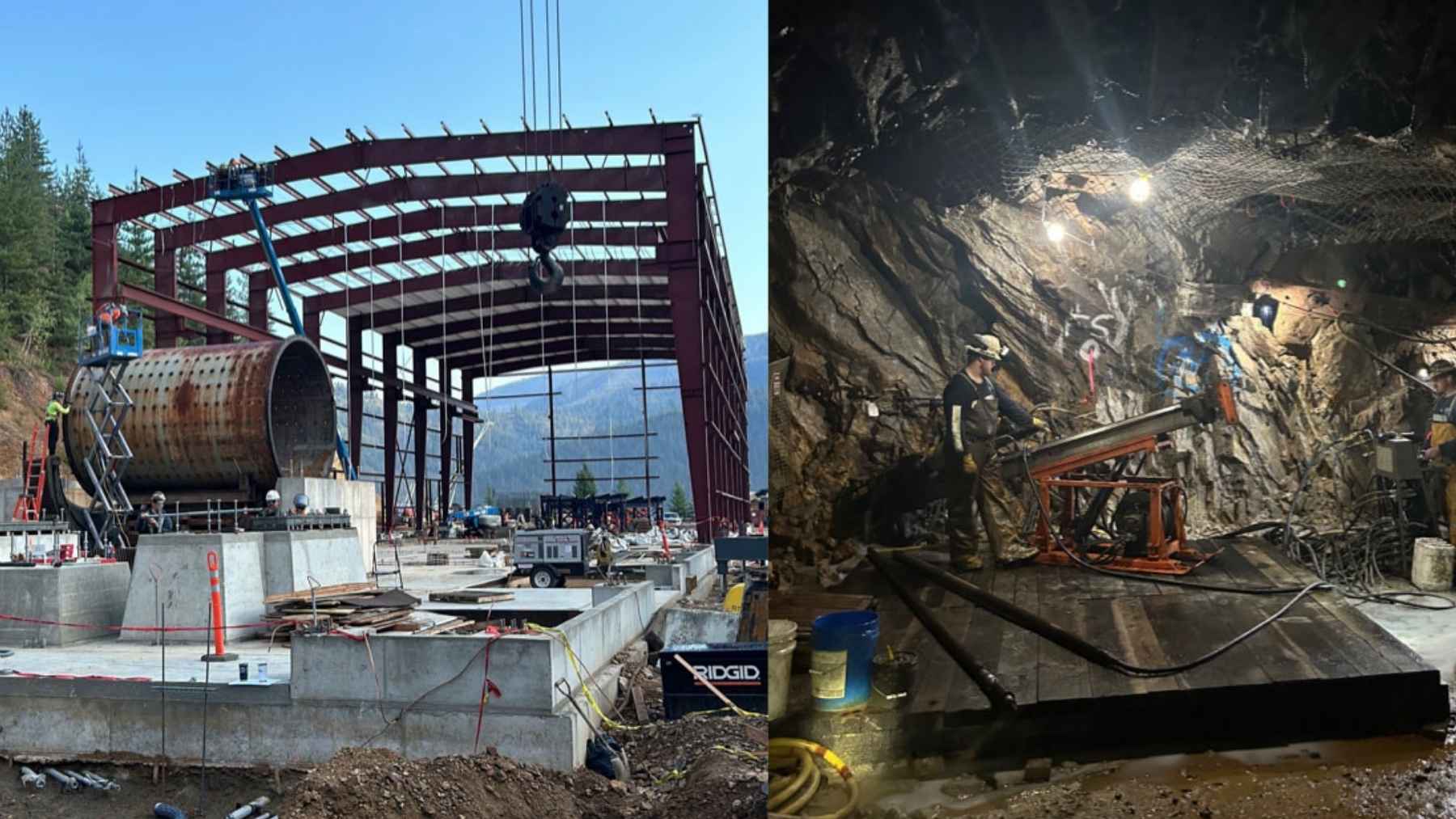
The mill sits in Kellogg, about 3.5 miles (5.6 kilometers) from the underground portal at Wardner. It takes 1,800 tons a day through crushing, grinding and differential flotation. Differential flotation is the step that matters. It pulls the lead and the zinc apart into two separate concentrates rather than one mixed product a smelter has to unpick at the other end.
Hecla’s Lucky Friday mill, a few miles up the same valley, runs 1,100 tons a day. Americas Gold and Silver’s Galena mill runs 500. Bunker Hill has designed the Kellogg plant so it can be stepped up to roughly 2,500 tons a day without starting over.
Tailings never see daylight here. A filter press squeezes the water out and the cake goes back down as paste backfill mixed with cement, or into a dry-stack storage facility on surface. Bunker Hill operates no tailings pond at all.
Noah Kellogg found the lead outcrop that started the whole thing in 1885. Across roughly 95 years the mine produced 42.8 million tons of ore at average grades of 8.4% lead, 4.5% zinc and 3.5 ounces of silver per ton, the figures the company published in its August filings. Underground, crews are running transverse longhole stopes in a primary-secondary pattern, filling each void with paste before they take the one next door.
America stopped smelting its own lead in 2013
Teck Resources takes the concentrate at Trail, British Columbia, about 140 miles (220 kilometers) from the mill, under an offtake agreement the two companies already had. Teck put $40 million of equity into Bunker Hill in a deal announced in March 2025 and closed that June, and Trail blends the Idaho material in with feed from Teck’s Red Dog mine in Alaska.
American lead concentrate goes to Canada because the United States has nowhere else to send it. Doe Run shut the primary lead smelter at Herculaneum, Missouri at the end of December 2013 under a 2010 settlement with the EPA and the state of Missouri, and described it at the time as the last primary lead smelter in the country. Secondary smelters still pull lead out of scrapped car batteries by the million. Not one plant in the United States turns raw lead concentrate into lead metal.
Zinc is thinner still. Clarksville, Tennessee holds the only primary zinc smelter in the country. Korea Zinc completed its purchase of that plant from Nyrstar on April 1, 2026, and has announced a $6.6 billion replacement complex on the same ground, with phased commercial operations beginning in 2029.
All three metals riding in that truck sit on the federal critical minerals list. The USGS published the final 2025 List of Critical Minerals in the Federal Register on November 7, 2025, running to 60 commodities. Zinc had been on it since 2022. Silver and lead were added that day.
So a mine reopens in Idaho to feed the domestic supply chain, and the first load leaves the country.
You see the same gap turn up in odd places. A NOAA program had to file a public waiver to buy a 15-pound survey drone, certifying on the record that nobody in the United States builds one.
The 45-year gap has a hole in it
The mine did not sit sealed for that entire stretch. New owners restarted underground work in 1988 and kept at it until 1991, when the operator filed for bankruptcy and closed the mine a week later. The US Bureau of Mines logged 16,323 tons mined in that final year, grading 1.76% lead, 5.26% zinc and 28 grams of silver per ton. Placer Mining held the property from 1991 until Bunker Hill Mining took it over.
Ash dates the gap from 1981, when the Bunker Hill Company and its smelter went down together. Counted from the last ore that actually came up the shaft, the mine has been quiet for 35 years. Either way, nobody working underground at Wardner today was on the payroll the last time concentrate left this valley.
Idled mining kit has a habit of outlasting the company that parked it. A 26-foot borer that cut 1.1 miles under a Queensland coal mine came to surface and sat for eleven years before anyone found it work in Arizona.
The cleanup is still going on around it
EPA put the 21-square-mile area around the old smelter on the National Priorities List in 1983 and filed it as the Bunker Hill Mining and Metallurgical Complex. Locally it is just “the Box,” and it takes in Kellogg, Wardner, Smelterville and Pinehurst. The site beyond the Box stretches across roughly 1,500 square miles and 166 river miles, from near the Montana line into eastern Washington.
Idaho’s own account of that era is blunt. The state records a peak blood lead level of 164 micrograms per deciliter in one child, and an average of 67.4 among children living within a mile of the stacks. EPA and Idaho DEQ have since installed protective barriers on more than 7,000 properties and planted two million trees across 2,290 hillside acres. Hecla Mining paid $263.4 million in 2011 to settle its share of the liability.
None of that is finished. EPA still lists unsafe lead levels as a concern in parts of the Basin outside the Box, and mine water coming out of the Kellogg Tunnel still goes to the state-run Central Treatment Plant.
Four days after the first stope blast, the company went shopping
On August 17 Bunker Hill announced the first production stope blast, the point where a mine stops being a construction site and starts being a mine. The company reported four consecutive years without a lost-time incident and one full year without a recordable one.
On August 21 it announced it was buying Silver47 Exploration.
That arrangement agreement is dated August 20. Silver47 shareholders get 0.1724 Bunker Hill shares for each of theirs, which values Silver47 at about $163 million (C$225 million) fully diluted and leaves them with roughly 43% of the combined company against 57% for existing Bunker Hill holders. Pro forma basic market cap comes to $326 million.
The merged business would be renamed Bunker Hill Silver Corp., stay listed in Toronto, and pick up silver projects in Alaska, Nevada and New Mexico. Bunker Hill also lined up a $10 million concentrate prepayment facility with Ocean Partners and drew another $1 million on the Teck standby line in the same announcement.
A company still commissioning its first plant is buying an exploration portfolio three states wide, and financing the ramp-up on prepayments against concentrate it has barely started making. Bunker Hill has also applied to list on the NYSE American, and says there is no guarantee it gets in.
Kellogg gets 200 of its 2,000 jobs back
Kellogg had 2,314 residents at the 2020 census. It had about 6,000 in 1960. Idaho’s own cleanup history describes the Bunker Hill Company as once the largest employer in the state. In February the company counted 45 employees and 65 contractors on site, and Ash told the Shoshone News-Press he expected to be past 200 by June, recruiting underground miners, process operators, mechanics, electricians, engineers and geologists.
The 1981 shutdown took roughly 2,000 jobs out of this valley. The restart is aiming at 200.
Big industrial sites keep coming back with a fraction of the payroll they had. An 865-megawatt coal hall in Tennessee is being handed to two machines that generate no power at all.
Bunker Hill is targeting commercial production by the end of 2026. Shareholders of both companies vote on the Silver47 deal no later than November 15.
Image credit: Bunker Hill Mining Company