
Sailing a boat into a working offshore wind farm is the kind of thing most captains actively avoid. The towers are the height of skyscrapers, the blades are moving, and the water between them has spent years as dead space on the chart. Too restricted for shipping, too cluttered for trawlers, good for pretty much nothing but waves.
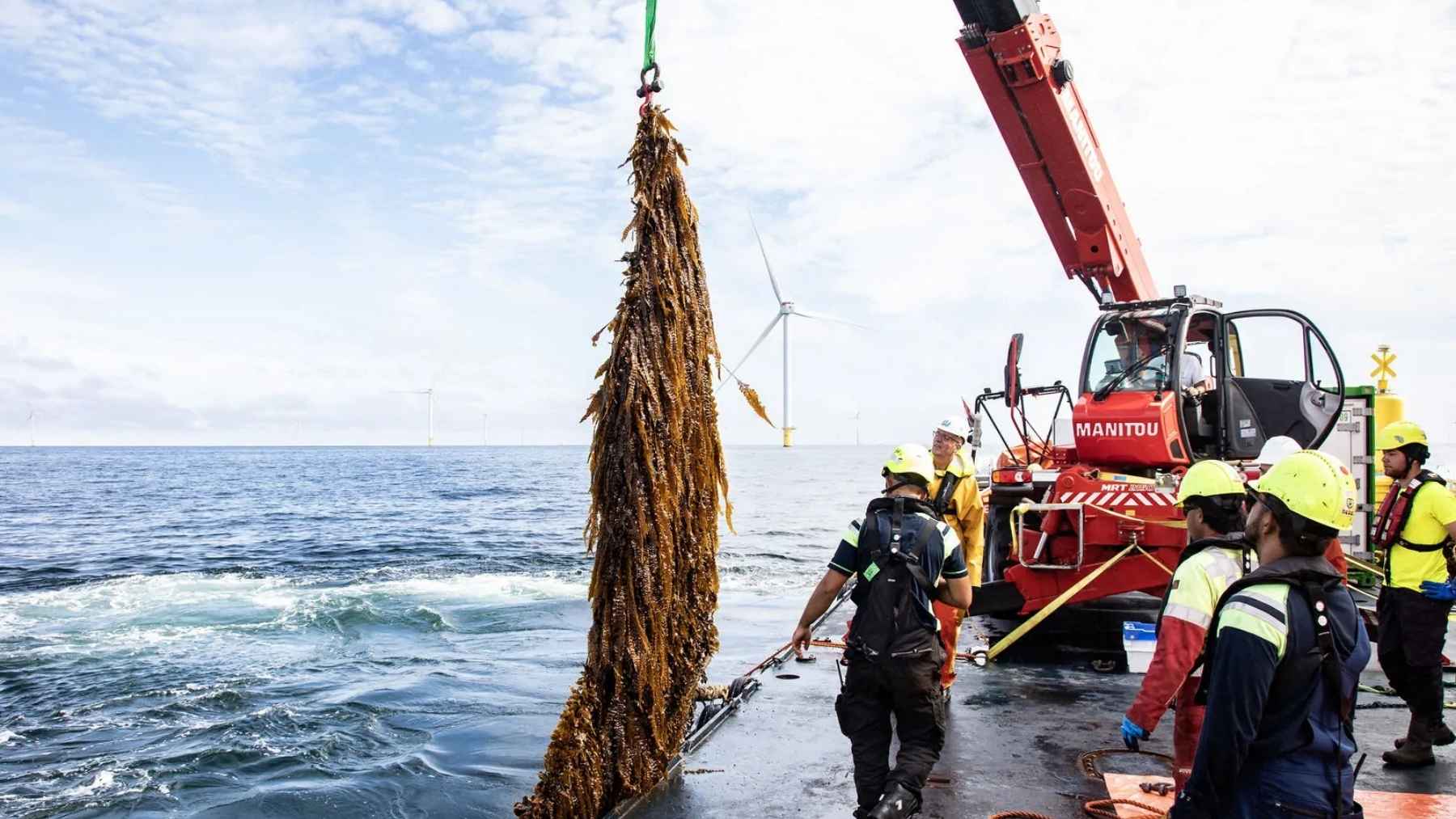
But in July 2025, a crew off the Dutch coast threaded a vessel between the 139 turbines of the Hollandse Kust Zuid wind farm on purpose. They came back with the first crop of seaweed ever harvested at commercial scale inside an operating wind farm, pulled off four nets anchored to the seabed about 11 miles (18 km) out from Scheveningen, the beach end of The Hague.
The operation is called North Sea Farm 1, and its developers describe it as the world’s first commercial-scale seaweed farm located between offshore wind turbines. The pitch fits on a napkin: one patch of sea, two harvests. The turbines make electricity up top, and the kelp grows in water the turbines were already guarding.
The wind farm makes power for 1.5 million homes
Hollandse Kust Zuid is not some test plot. It runs 139 Siemens Gamesa machines rated at 11 megawatts apiece, each swinging a rotor about 660 feet across, for a combined 1.5 gigawatts of capacity.
Vattenfall built it and operates it, with BASF and Allianz as co-owners, and King Willem-Alexander turned up to inaugurate the site in September 2023. Its production matches the electricity consumption of roughly 1.5 million Dutch households.
So this is serious industrial real estate, sitting between Scheveningen and Zandvoort with all the access restrictions you would expect. Which, as it turns out, is exactly what made it attractive to seaweed farmers.
Four nets, five hectares and one very careful boat
North Sea Farm 1 covers five hectares, about 12 acres, of open water inside the wind farm. The growing hardware is four large nets, each 164 feet long and 10 feet wide (50 by 3 meters), anchored to the seabed in the gaps between towers.
The crop is sugar kelp. The first seaweed went into the water in October 2024, the farm formally opened in March 2025, and the harvest came up in July 2025, three years after the idea was first sketched out in 2022.
Getting the crop out is the delicate part. According to North Sea Farmers, the job falls to a specially equipped vessel that picks its way between operating turbines to reach the nets, with crews using purpose-built gear to strip the kelp. Not a boat anyone improvises, given that every obstacle on the course is rated at 11 megawatts.
Amazon paid for it. The company’s Right Now Climate Fund, a $100 million pot it set up for climate and biodiversity work, put €2 million into the farm and the science bolted onto it. The Irish blue-economy firm Simply Blue Group led the cultivation through its seaweed arm, Óir na Farraige, alongside maritime contractor Van Oord and seaweed company Algaia.
“When I joined the company, I was asked a straightforward question: can we utilise the space between offshore wind turbines for seaweed cultivation? We now know the answer is yes,” said Gareth Murphy, project manager at Óir na Farraige, in Simply Blue Group’s announcement.
The turbines are the fence
Why grow kelp in the middle of a power plant? Because the North Sea is one of the busiest patches of water on Earth, and open space is the one thing a seaweed farmer cannot buy.
Shipping lanes, fishing grounds, cables, military exercise zones. A stand-alone farm would be arguing with all of them for room. Inside a wind farm, most of that argument disappears, which North Sea Farmers says was the whole point: the nets sit in water where commercial traffic is already kept out.
So the restricted zone that keeps freighters away from the turbines doubles as the fence around the vegetable patch. Nobody plows through your crop at 15 knots.
The Dutch have been treating their offshore zones as a lab for this kind of double use for a while now. At a separate North Sea Farmers test site off Scheveningen, SolarDuck’s elevated floating solar pilot has been riding the waves since July 2024. And at another Dutch wind farm farther offshore, the builders are hanging a 379-foot red blade on seven turbines to see if birds dodge them better. Kelp between the towers is the same instinct pointed underwater.
The researchers care more about the carbon than the crop
The kelp itself is almost the sideshow. The reason Amazon wrote the check is the research program attached to the farm.
Plymouth Marine Laboratory leads the science, working with Dutch institute Deltares and Silvestrum Climate Associates. The team watched the site for a year with satellite data and boat visits, and the harvest is what kicks off the real work: following the carbon from seawater into the kelp and out into the surrounding ecosystem.
The toolkit is thorough. Seabed cores, water sampling, on-site tracking of sea life, plus eDNA analysis to figure out which species are moving in around the nets. Deltares has its own niche in the program, modeling what happens to the kelp fragments that storms and harvesting tear loose.
The habitat question is not a box-ticking exercise either. Turbine foundations in the North Sea already work as accidental reefs, to the point that GPS-tagged seals have been recorded hunting along the rows. Whether a kelp farm adds to that effect or bends it in some new direction is exactly what the eDNA sampling is for.
North Sea Farmers’ managing director Eef Brouwers said the point is to show “that seaweed production within an existing offshore infrastructure is possible at a commercial scale,” per the harvest announcement. Proving what it does for the climate is the longer job, and the group has said the data will help set the upper scaling limits for farms like this one.
A million metric tons is the theory
The scale-up math is where this stops being a Dutch curiosity. North Sea Farmers estimates that the space inside current and planned wind farms could support up to 1 million metric tons of fresh seaweed a year by 2040.
Seaweed needs no land, no fresh water and no fertilizer, which is why so many industries want a piece of it. The first crop is being turned into product samples: packaging, food ingredients, textiles, a cosmetics texturizer and an agricultural biostimulant. Some of this kelp may end up in a moisturizer, which is a strange retirement for a plant raised under an 11-megawatt turbine.
Now the honest fine print. The partners have not published a tonnage figure for that first harvest, and the carbon numbers everyone actually cares about are still being worked through. The project’s lead scientist, Plymouth Marine Laboratory’s Ana M Queirós, has been clear that ideas like this need rigorous evidence behind them before anyone treats seaweed as a scalable climate fix.
And if this story crossed your feed in the past couple of weeks dressed up as breaking news, check the date on the press release: the harvest happened in July 2025. It keeps resurfacing a year later because working examples of two industries sharing the same patch of sea are still that rare.
Strip out the novelty and the result is refreshingly plain. The kelp grew, the boat got in and out between 139 spinning turbines, and the wind farm never had to stop making power. Whether that adds up to a climate tool or just a very well-protected garden is now a question for the lab.