
Killing a golden eagle in the United States is a federal crime, and the law does not care whether you meant to do it. The Bald and Golden Eagle Protection Act has no accident clause. Every bird a turbine blade hits counts as a violation unless the operator holds a permit saying otherwise.
Which is how a wind farm outside Casper, Wyoming became the first wind company in the country ever prosecuted for it. In November 2013 Duke Energy Renewables pleaded guilty to misdemeanor charges under the Migratory Bird Treaty Act over 14 golden eagles and 149 other protected birds found at two projects in Converse County.
It paid $1 million in fines, restitution and community service and went on five years of probation, according to the Justice Department. One of those two sites was called Top of the World.
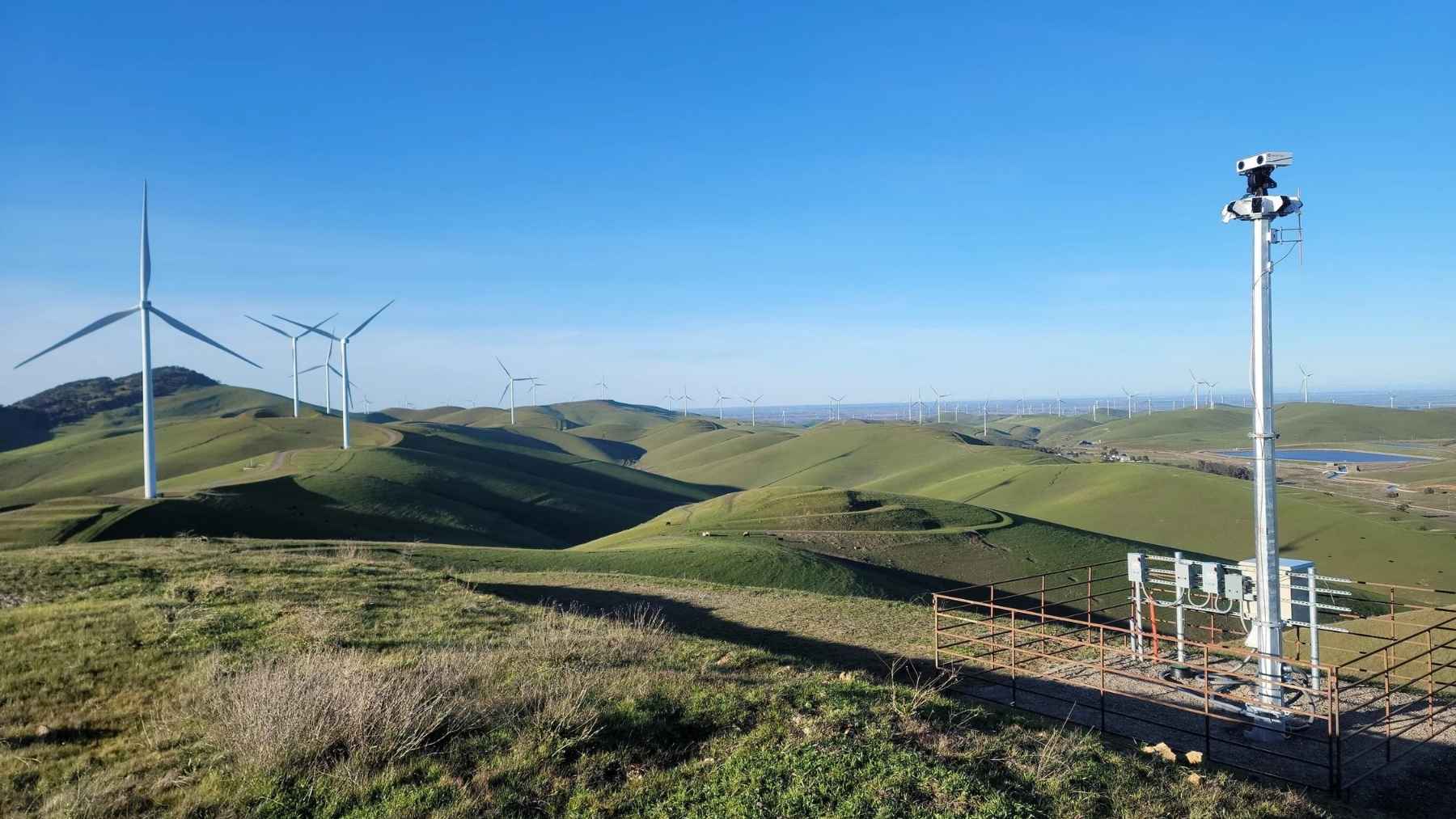
The fix that eventually went up at Top of the World was not paint and it was not a fence. It was 47 camera towers scanning the sky in every direction, wired into the wind farm’s control system so it could stop one specific turbine while the other 109 kept turning.
That system is called IdentiFlight, and the number attached to it, an 82 percent drop in eagle deaths, is quoted constantly. It is also the most argued-over statistic in this entire corner of science.
Each tower carries eight cameras and a second set that swings around to look closer
The hardware is not exotic. Each unit is a mast 23 to 33 feet tall (seven to 10 meters) with a ring of eight fixed wide-angle cameras around the top, constantly watching for movement against the sky.
When something moves, a pan-and-tilt mount swings a pair of high-resolution stereo cameras onto it and starts tracking. Stereo means two lenses a fixed distance apart, so the system can work out how far away the object is and therefore how big it actually is rather than how big it looks.
A neural network then scores the shape against roughly 200 measured attributes: wingspan, body length, posture, the way it holds itself in a glide. IdentiFlight says those steps take milliseconds, after which a base station decides whether to push a shutdown command down the wind farm’s SCADA network.
The peer-reviewed numbers on that are better than the marketing usually bothers to claim. In the original 2018 field test the median time from detecting something to classifying it was 0.4 seconds, and the median distance at which the system called a bird an eagle was 793 meters, a shade under half a mile.
The trade-off is deliberate. That same test logged a 6 percent false negative rate on eagles and a 28 percent false positive rate on everything else, because the software is tuned to miss as few eagles as possible and eat the cost of stopping for things that turn out to be hawks.
Two limitations are worth knowing. The towers cannot see anything flying below about one degree under horizontal, which matters a lot when you bolt them to a ridgeline.
The second is that the turbine does not stop the instant the camera decides. Engineers at the National Renewable Energy Laboratory, where the system was flown against two trained eagles in 2016, told CBS Colorado it could bring a turbine to a halt in as little as 30 seconds.
So the curtailment logic is built around that lag. The published study describes two nested zones around each turbine: a shutdown is always ordered when something classified as an eagle with at least 90 percent confidence enters the inner one, and between the two zones the system runs a time-to-collision threshold, originally set at 10 seconds and raised to 15 in September 2019.
The 82 percent everyone quotes is two numbers glued together
The study ran at Top of the World, using the 66-turbine Campbell Hill site about nine miles (15 km) away as an untreated control. Researchers from The Peregrine Fund, Western EcoSystems Technology and the U.S. Geological Survey compared carcass counts before and after, correcting for the bodies searchers miss and the ones scavengers carry off.
At Top of the World, fatalities fell 63 percent. At Campbell Hill, over the same window, they rose 113 percent. Stack those together and you get the 82 percent figure: not an 82 percent drop in dead eagles, but the drop at the treated site measured against what the control site was doing, as published in the Journal of Applied Ecology in 2021.
In birds rather than percentages, the site went from roughly 7.5 eagle deaths a year to roughly 2.5.
A follow-up in 2022 added more data and several methodological changes the authors had been asked for. That one put the reduction at 85 percent, with the fatality rate falling 4.91 eagles per year at the treated site relative to the control.
The authors were careful about what they had shown. Automated curtailment reduced fatalities, they wrote, but did not eliminate them, and on its own it is no cure.
Two other statisticians ran the same data and got 50 percent
In 2023 the Journal of Applied Ecology published a reanalysis by Manuela Huso and Dan Dalthorp, two of the authors of GenEst, the carcass-counting software the original study itself had used. Their title left little room for interpretation: reanalysis indicates little evidence of reduction in eagle mortality rate.
Their objections were structural. One year of post-treatment data. One treatment site and one control site, which is not enough to rule out that the two just drifted apart on their own. A before-and-after cut-off date they considered arbitrary. And an effect size inflated by assuming the control site’s swing would have been repeated exactly at the treated site.
Running their own correction, they got a reduction of about 50 percent with a confidence interval stretching from minus 159 percent to plus 89 percent. An interval that wide, crossing zero, is a statistician’s way of saying the data cannot tell you whether the thing worked.
The original authors published a rebuttal in the same journal, arguing the reanalysis threw out the control site data and ignored their pre-specified cut-off. Nobody has been able to settle it with a second site, because running the experiment properly means leaving turbines uncurtailed somewhere on purpose and counting the eagles that die.
That argument is still open. A paper published on July 2 of this year, in the same journal, on whether painted blade patterns help birds see a rotor at all, dispatches automatic detection systems in a single line: a common mitigation measure whose effectiveness remains unproven.
Same journal, same field, and the same unfinished argument the black-blade experiments keep running into.
In California the same system mostly stopped turbines for ravens
The other useful piece of evidence comes from a wind project in California, where researchers spent a year logging what an IdentiFlight installation would have done without actually slowing any blades.
The system correctly identified 77 percent of eagles and 85 percent of non-eagles. It generated 850 curtailment orders aimed at eagles, and 5,439 aimed at things that were not eagles, six times as many, according to the results published in PLOS ONE in 2023.
The main culprit was the common raven, which is dark, soars, and from 700 meters looks a great deal like a young golden eagle to a camera trained to err on the side of stopping.
Every one of those orders is a turbine coming off line. The authors were blunt that whether the system pays depends on the local bird community, how fast the operator can actually curtail, and what that operator is trying to achieve.
For comparison, a long-running shutdown protocol across 269 turbines at 20 wind farms in Cadiz, Spain cut deaths of large soaring birds by more than 60 percent while costing about half a percent of output, according to Yale Environment 360’s review of the field.
What actually decides whether an operator buys this is the permit
Since February 2024 the Fish and Wildlife Service has run a two-tier system. Projects that clear a low-risk bar get a general permit, and everyone else needs a specific one.
The bar means keeping every turbine at least two miles from a golden eagle nest and 660 feet from a bald eagle nest, regional eagle abundance below set thresholds, and compensatory mitigation bought as eagle credits against the hazardous volume of the project in cubic kilometers.
Those permits then became a political instrument. The Service stopped issuing eagle take general permits to wind facilities in early 2025 and issued none for roughly a year. Law firm Hunton, tracking the list on the agency’s own website, reported that 34 permits landed in a two-week period ending January 30, 2026, weeks after industry groups sued over the freeze.
The stakes underneath the paperwork are real on both sides. The Fish and Wildlife Service estimates roughly 30,000 golden eagles in the United States, a population that has looked flat for decades.
A 2025 modelling study in Biological Conservation put turbine collisions in the western states at about 110 golden eagles a year in 2013 and about 270 by 2024, with the authors themselves flagging wide uncertainty around both numbers.
A machine that stops one turbine for two minutes instead of a whole ridge for a season is, on paper, the way out of that fight. It is the same argument now playing out at Rye Park in New South Wales, where the operator of Australia’s deadliest site for wedge-tailed eagles wants camera curtailment and has to clear planning consent to install it.
Top of the World has changed hands since any of this was published. Duke Energy sold its commercial renewables arm to Brookfield in October 2023, and the business now trades as Deriva Energy.
What the towers do that no human can is not really in dispute. In the 2018 test they picked up 96 percent of the birds human observers saw, and 562 percent more on top of that, which is a polite way of saying people standing in a Wyoming field miss most of what flies over them.
What is in dispute is whether the eagles that would have died are actually alive. The honest answer is that the strongest evidence for it is still 110 turbines in Converse County and an unresolved argument about how to count bodies.
Wind farms keep rearranging what lives around them whether anyone planned for it or not, from seals hunting the turbine rows of the North Sea to eagles riding the updrafts over Wyoming. The cameras are the first serious attempt to argue back.