
Tiltrotors are one of aviation’s great awkward party tricks. Take off straight up like a helicopter, swing the rotors forward in mid-air, then cruise like a turboprop. The US spent decades and a mountain of money teaching the V-22 Osprey to do it reliably, and Bell is still grinding through the next generation with the MV-75. China has now decided it wants into that club too, with one twist: the machine Beijing is flight-testing right now has nobody inside it.
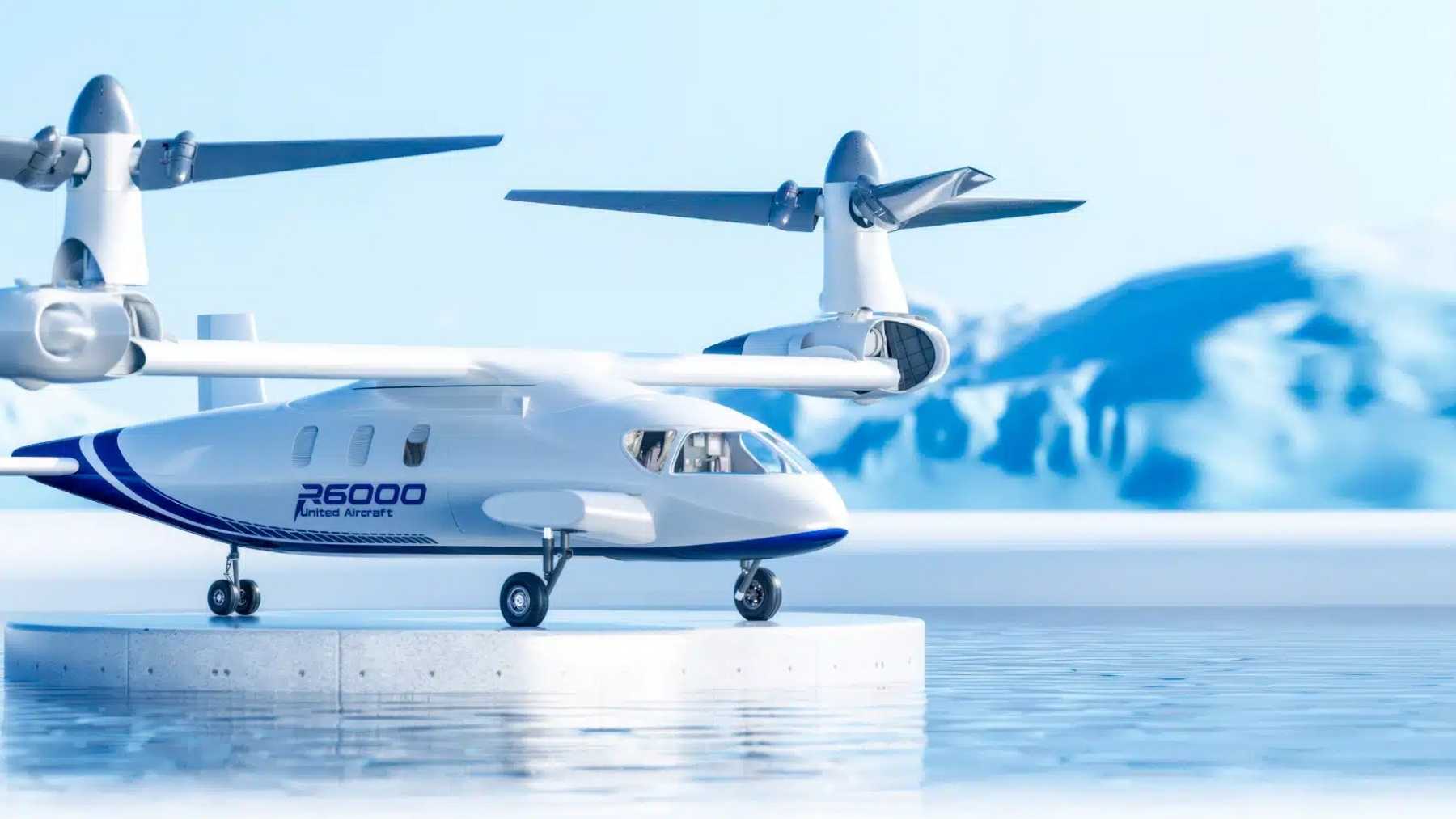
Video that surfaced on Chinese social media this week shows the R6000, a roughly six-ton uncrewed tiltrotor from Shenzhen’s United Aircraft, doing the one thing that actually counts for this class of aircraft: flying free, off the tether, and switching cleanly between hover and forward flight. Defense outlet The War Zone flagged the footage, and it matters more than the usual Chinese drone reveal because of what this airframe can theoretically do, and where it could theoretically end up.
What the new footage actually shows
Earlier this year the R6000 was still on a leash: ground engine runs, then tethered hover trials where it mostly proved it wouldn’t tip over. The new clips, dated June 15, are a different animal. They show the drone hovering, executing a pedal turn around its vertical axis, then pushing into cruise with both proprotors tilted all the way forward. That full hover-to-airplane transition is exactly where tiltrotor programs tend to come apart, which is why doing it untethered is the milestone, not the hover itself. The nacelle fairings are still off, exposing the engines, which usually means the engineers want easy access to their instrumentation.
This isn’t the maiden flight. That happened on December 28, 2025, near Deyang in Sichuan province, the world’s first flight of a six-ton-class tiltrotor according to United Aircraft. What’s new is sustained, untethered flight with that transition envelope being worked in earnest, the part of the flight regime that swallowed years of the V-22 program.
The mechanical choice that matters
Here’s the design decision worth understanding. The V-22 Osprey rotates its entire engine nacelle, engine, gearbox, rotor and all, swinging the whole 90-degree package. That’s mechanically savage, and part of why the Osprey’s safety record reads the way it does. The R6000 keeps the engines fixed at the wingtips and tilts only the rotor shafts. Bell’s MV-75, the production form of the V-280 Valor that won the US Army’s future-helicopter competition, uses the same trick. United Aircraft also pitches a side benefit: with the hot exhaust pointing aft instead of straight down, the layout spares ground crews and unprotected ship decks from the blast a tilting nacelle dumps below it.
Power comes from the AES100 turboshaft, built domestically by the Aero Engine Corporation of China, which matters enormously for any platform that might one day wear PLA markings. The catch is that the AES100 only entered mass production in mid-2025 and has logged very few flight hours, so its reliability is the single biggest question mark hanging over the program.
The specs United Aircraft is quoting
Performance figures for the R6000 are provisional and come straight from United Aircraft, so treat them like the brochure copy they are. The company lists a maximum takeoff weight of 6,100 kilograms (13,448 pounds), a payload of 2,000 kilograms (4,409 pounds), a cruise speed around 550 km/h (roughly 340 mph, about 300 knots), and a service ceiling of 7,620 meters (25,000 feet). The airframe runs 11.9 meters (39 feet) long with a rotor-to-rotor span of 17.4 meters (57 feet). Range claims have wandered, from an early figure of 1,500 kilometers (932 miles) up to as much as 4,000 kilometers (2,485 miles) in later quotes, depending on load.
Whether it hits any of those numbers is a separate matter. No manufacturer on Earth publishes pessimistic specs, and tiltrotors in particular have a long history of arriving heavier and slower than the slide decks promised.
Why Beijing keeps calling it a civilian aircraft
United Aircraft’s official line is air taxi, logistics, disaster relief and offshore-platform support, the same urban-air-mobility brochure language every eVTOL startup recites. Its product material describes the R6000, which it markets as the Lanying, as a six-ton tiltrotor pairing helicopter VTOL with fixed-wing cruise for efficient point-to-point transport, with cabins configured for six to twelve people. Project manager Zhao Fengming, quoted by China’s state-run Global Times, framed the program as proof that the country has “reached the forefront of the world” in tiltrotor aviation.
The civilian framing is working hard, though. Army Recognition noted back in 2024 that United Aircraft’s own website had displayed the airframe in PLA Air Force livery, and the company has form: smaller programs dressed up as civilian have quietly turned into military ones before. Uncrewed platforms are where the defense money is moving, and a clean-sheet VTOL with a two-ton payload bay is not an obviously civilian object.
The military read
Skip the marketing and the use case writes itself. A six-ton VTOL aircraft that needs no runway, carries no pilot, and can supposedly cruise near 300 knots is close to purpose-built for resupplying the small, isolated outposts China has been building across the South China Sea. The War Zone makes the link explicit, pointing to the PLA’s standing need to shuttle people and cargo between scattered island bases. A seagoing home is just as obvious: the new Type 076 amphibious assault ship Sichuan, the world’s first fitted with an electromagnetic catapult, was built to launch fixed-wing drones like the GJ-11, but its broad flat deck is exactly the kind of place a VTOL aircraft can work without touching the catapult at all.
Past pure logistics, a two-ton payload bay opens the door to surveillance pods, electronic-warfare gear, communications relay, or at the sharp end, weapons. None of that has been demonstrated. But the airframe exists and it flies, which is more than most paper programs can claim. It’s the same instinct behind China’s other audacious aviation experiments: build the thing, fly it, and sort the details out in public.
How it stacks up against the Americans
The natural comparison is Bell’s V-280 Valor and its uncrewed cousin, the V-247 Vigilant. The V-280 is crewed and already won the Army’s FLRAA contest; the V-247 is the uncrewed pitch and still lives in concept art. On size, the R6000 sits near the crewed Leonardo AW609 and well short of the Osprey, which tops out around 52,000 pounds. So this isn’t a one-for-one Osprey replacement. It’s a different category: uncrewed, roughly half the weight, aimed at the mid-range logistics mission that has always punished helicopters for being too slow and too thirsty.
What to watch from here
Free flight is the start, not the finish. Tiltrotors live and die in the transition corridor, the window where the rotors are partway tilted, the wing isn’t fully flying, and the control software has to blend rotorcraft and fixed-wing inputs on the fly. The V-22 took years to tame it and still has bad days. United Aircraft is in that grind now, with the added degree of difficulty of doing it with no one aboard.
The other thing to track is certification. Aviation International News reported the program is chasing Chinese civil-aviation approval, but regulators have never had to certify a six-ton autonomous tiltrotor, a category that doesn’t exist in the rulebook yet, and analysts who track Chinese drone timelines read operational service as more realistically a 2027 story than a this-year one. Whichever way that goes, the part worth remembering is that the airframe already flew, transition and all. Whether the PLA livery ever comes off the website is a separate question entirely.