
If you’ve ever flown a camera drone, you know the routine. You get maybe half an hour in the air, the battery warning starts blinking, and you bring it back down to swap packs before it drops out of the sky. That ceiling has defined commercial drones for the better part of a decade, and no amount of clever flight software has moved it much.
So a different kind of aircraft has been quietly climbing past it. Instead of a lithium pack, it carries a hydrogen fuel cell, and the gap it opens up isn’t measured in extra minutes. It’s measured in hours, sometimes most of a day. The endurance itself has been provable for a long time. What shifted over the past few months is the part that decides whether you ever see one of these working over an American pipeline or coastline: the fuel-cell supply chain firmed up, serious money arrived, and the FAA started writing the rulebook that would let a single operator run a fleet of them past the horizon.
Two things crystallized that shift. In February, a South African fuel-cell component was validated inside a commercial, aviation-grade stack built for drones. And in Washington, the FAA’s proposed Part 108 rule, the framework meant to make routine beyond-visual-line-of-sight flight legal at scale, kept inching toward a final version that still hasn’t landed. Put together, they explain why hydrogen drones are starting to look less like a science-fair trophy and more like a product line.
The 30-minute wall is a chemistry problem, not a software one
Lithium batteries are very good at delivering a lot of power for a short burst, which is exactly why a quadcopter can rip around the sky and exactly why it can’t do it for long. Most commercial battery multirotors are back on the ground inside 30 to 45 minutes, and a chunk of that flight time goes to hauling the weight of the battery itself. Stack on more cells and you mostly just carry more dead weight.
Hydrogen flips the math. A fuel cell turns compressed hydrogen and oxygen into electricity and water, and the energy packed into the hydrogen is in a different league from a battery of the same weight. The companies building around it lean on that gap hard. Denver-based Cellen H2 says its hydrogen drone covers three to five times the distance per flight of a battery equivalent, with refueling that takes a cylinder swap instead of a recharge. The only thing out the back is water vapor, the aircraft runs quiet because there’s no combustion, and it barely shows up on a thermal camera.
None of that is free. You’re now flying around with compressed hydrogen, a fuel cell, and usually a small backup battery for the power-hungry moments like takeoff. But for the missions where staying up beats going fast, inspecting hundreds of miles of power line, watching a stretch of coast, mapping a wildfire overnight, the endurance is the whole point. It’s the same reason the people building these keep landing on the same customer list, which we’ll get to. First, the ladder is worth seeing laid out.
Endurance figures are manufacturer or record claims and shift with payload, weather, and configuration. The Ion Tiger number is a one-off research record, not a commercial spec.
For more on how fuel cells stack up against batteries in this class of aircraft, we’ve broken down the core tradeoffs of hydrogen fuel-cell drones separately.
Dragonfly V stopped looking like a stunt
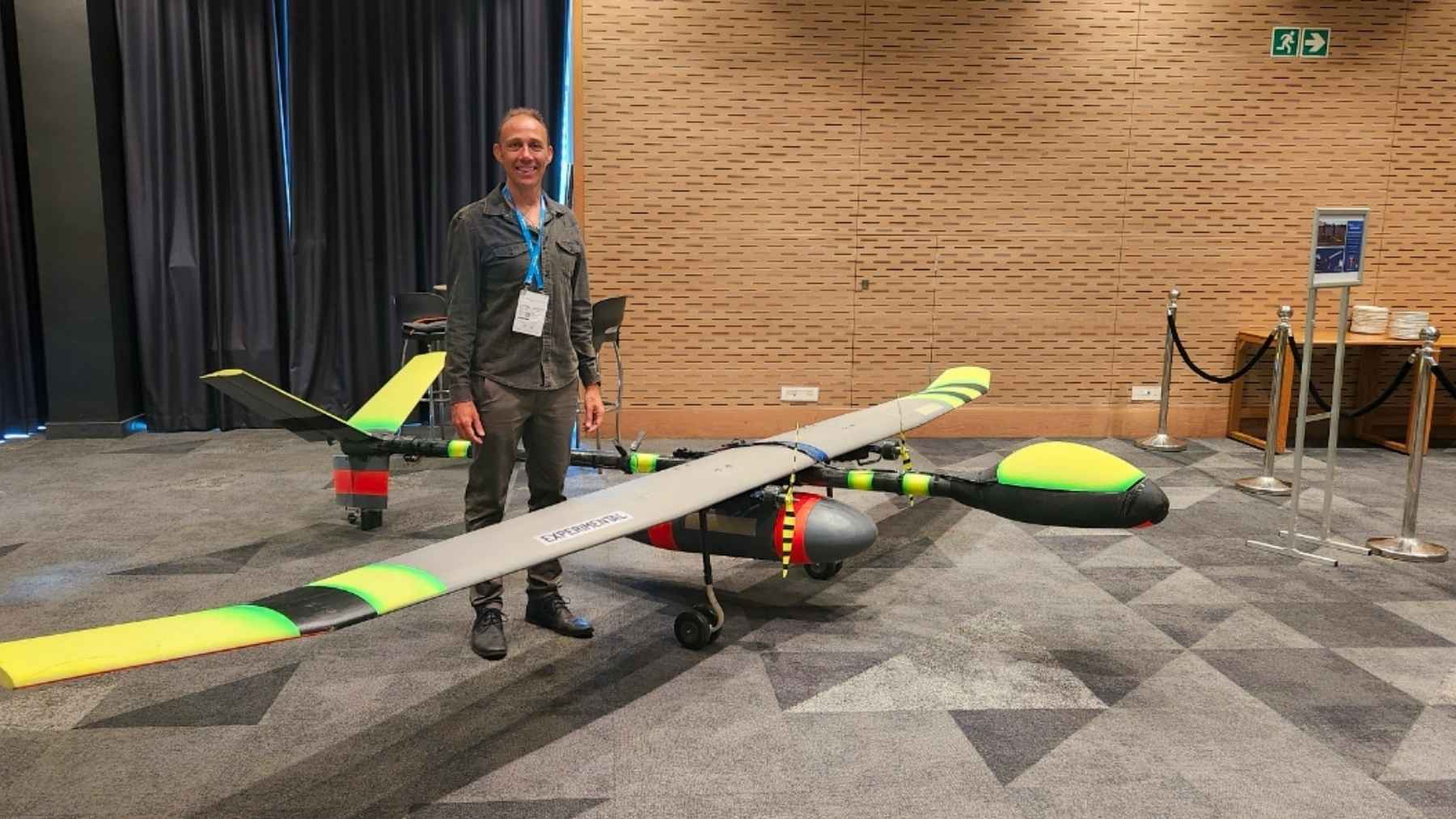
The aircraft that best shows where this is heading isn’t American. It’s the Dragonfly V from FlyH2 Aerospace, a Cape Town company, and it’s a genuinely big drone: a fixed-wing aircraft with an 18-foot (5.5-meter) wingspan and around 132 pounds (60 kg) at takeoff. FlyH2 says it can trade payload for time in the air, carrying up to 66 pounds (30 kg) of sensors or staying aloft for as long as 22 hours, with roughly 25 times the reliability of a small combustion engine. It was built from the start for beyond-visual-line-of-sight work, with room for heavy sensor pods, sense-and-avoid gear, and satellite comms.
The news that moved it forward came in February. A membrane electrode assembly, the part inside a fuel cell where the chemistry happens, developed by South Africa’s HySA Catalysis program at the University of Cape Town and Mintek, was tested inside a commercial UAV fuel-cell stack made by France’s Pragma Industries. According to FlyH2 and its partners, the locally made component matched and on some measures beat the incumbent materials. “Validating hydrogen propulsion in unmanned systems is the first step toward hydrogen-powered regional aviation in Africa,” said Mark van Wyk, FlyH2’s CEO.
This is also where a lot of coverage overshoots. That milestone validated a fuel-cell component on a test bench, not a finished drone rolling off a line. FlyH2’s own roadmap has the program moving next to a pair of 1.2-kilowatt stacks built around the new material, then to a full flight-ready propulsion pod, with airframe production lined up through South African manufacturer Alti Unmanned, pending the company raising the money to do it. The 22-hour figure is a design spec, not a shipping product. What February proved is that the supply chain underneath these aircraft is maturing, which is the unglamorous thing that decides whether an impressive number ever leaves the brochure.
The Americans aren’t waiting for the brochure
At the smaller end, U.S. hydrogen drones are already for sale. Cellen H2, out of Denver, builds the H2-6, a hydrogen hexacopter it bills as American-made and NDAA-compliant, with flight times up to about two and a half hours and field-swappable payloads for jobs like LiDAR mapping, methane-leak detection, and pipeline or wind-turbine inspection. It runs on the same open-source ArduPilot software a lot of commercial drones use, with a control link good for about 12 miles (20 km). In March, Cellen signed an agreement with the Oregon Department of Aviation to run real-world hydrogen BVLOS test flights with state agencies, the kind of pilot program that usually comes before wider deployment.
The money tells the same story louder. In December, Virginia-based Heven AeroTech closed a $100 million Series B led by the quantum-computing firm IonQ, a round that valued the hydrogen-drone maker at a billion dollars. Heven’s flagship Z1 is a fixed-wing aircraft it says flies more than 10 hours with a range past 600 miles, and the company has been blunt about who it’s building for: U.S. Special Operations Command, combatant commands, and allied militaries hunting for long-endurance aircraft that don’t depend on a battery swap or a fuel convoy. Heven moved its headquarters to Sterling, Virginia, a short drive from the Pentagon, and is standing up an engineering division to harden navigation for GPS-denied environments, a need the military flagged after Ukraine and Gaza.
That defense pull isn’t a side note. The reason persistence is suddenly worth a billion dollars is that a drone which can loiter for half a day, run silent, and stay cool is exactly what you want watching a border, a coastline, or a length of buried cable. It’s the same job FlyH2 designed the Dragonfly V around, and the same job that keeps dragging hydrogen into every conversation about protecting infrastructure. If you want the underwater version of that story, the race to guard undersea cables and pipelines with autonomous drones is running on a parallel track, and the hydrogen-powered Greyshark sub-drone out of Germany shows the same endurance logic playing out below the waterline.
Part 108 is the rule standing between them and the horizon
This is where the U.S. story hits a wall that has nothing to do with hardware. Under the current Part 107 rules, most commercial drones have to stay within the operator’s line of sight, and flying beyond it means applying for a waiver, one flight or one operation at a time. That’s fine for a roof inspection. It’s useless for a drone built to fly 22 hours over a pipeline corridor nobody can see the end of. Long endurance without the legal right to fly past the horizon is a sports car with the parking brake welded shut.
Part 108 is the proposed fix. The FAA’s draft framework, published as a 700-page proposal in August 2025, would replace the waiver system with performance-based rules for routine beyond-visual-line-of-sight flight, covering aircraft up to 1,320 pounds and, in the proposal, letting a single operator oversee multiple drones at once depending on the level of automation. Low noise, zero emissions, and the ability to stay up for hours map almost perfectly onto what the rule is meant to enable, which is why every hydrogen-drone maker keeps name-checking it.
The catch is that the rule isn’t real yet. A presidential order in mid-2025 told the FAA to finalize it within 240 days, then a 43-day government shutdown ate into that clock and pushed the target into March 2026. The agency reopened a narrow comment window on technical details into February, and as of late spring it’s still working through thousands of public comments with no final rule on the books. So the framework the entire U.S. industry is building toward is, for now, a very long proposal sitting in a queue.
The endurance was never the hard part
If all of this feels like it should have happened years ago, that’s because the flying part basically did. Back in 2013, when phones still had headphone jacks, the U.S. Naval Research Laboratory flew a hydrogen fuel-cell drone called Ion Tiger for 48 hours and one minute on liquid hydrogen, nearly doubling its own earlier record. Two full days in the air, on a fuel cell, more than a decade ago.
So the question was never whether hydrogen could keep a small aircraft up for a long time. It was whether anyone could build it cheaply enough, supply the parts reliably enough, and get permission to fly it routinely enough for the math to work as a business instead of a Navy science project. Cellen selling drones in Denver, Heven worth a billion dollars, and a South African fuel cell proving itself on a French test stand are all the same answer arriving from different directions: the boring infrastructure is finally catching up to the flying. The drone can already stay up for the better part of a day. The paperwork that lets it is the only thing still circling the airport.