
The usual way to pull electricity out of fast-moving water is to build something heavy, bolt it to the seabed, and trust that the current will respect your engineering. It rarely does. The Bay of Fundy, on Canada’s Atlantic coast, has spent close to two decades making that point in the most expensive way possible. Its tides are the highest on Earth, and the turbines companies have lowered onto the floor of its Minas Passage have a track record of shredding their blades, going bankrupt, or simply never coming back to the surface. One of them is still down there.
So the most interesting story in tidal energy this year is not the 680-ton machine off Scotland that keeps getting written up as a marvel, true as that write-up is. It is that the floating, towable successor to that machine has just been cleared to take on the exact stretch of water that destroyed everything anchored to its bottom. The design that lets a turbine leave when conditions turn ugly may be the one that finally lets a turbine stay.
The machine everyone keeps rediscovering
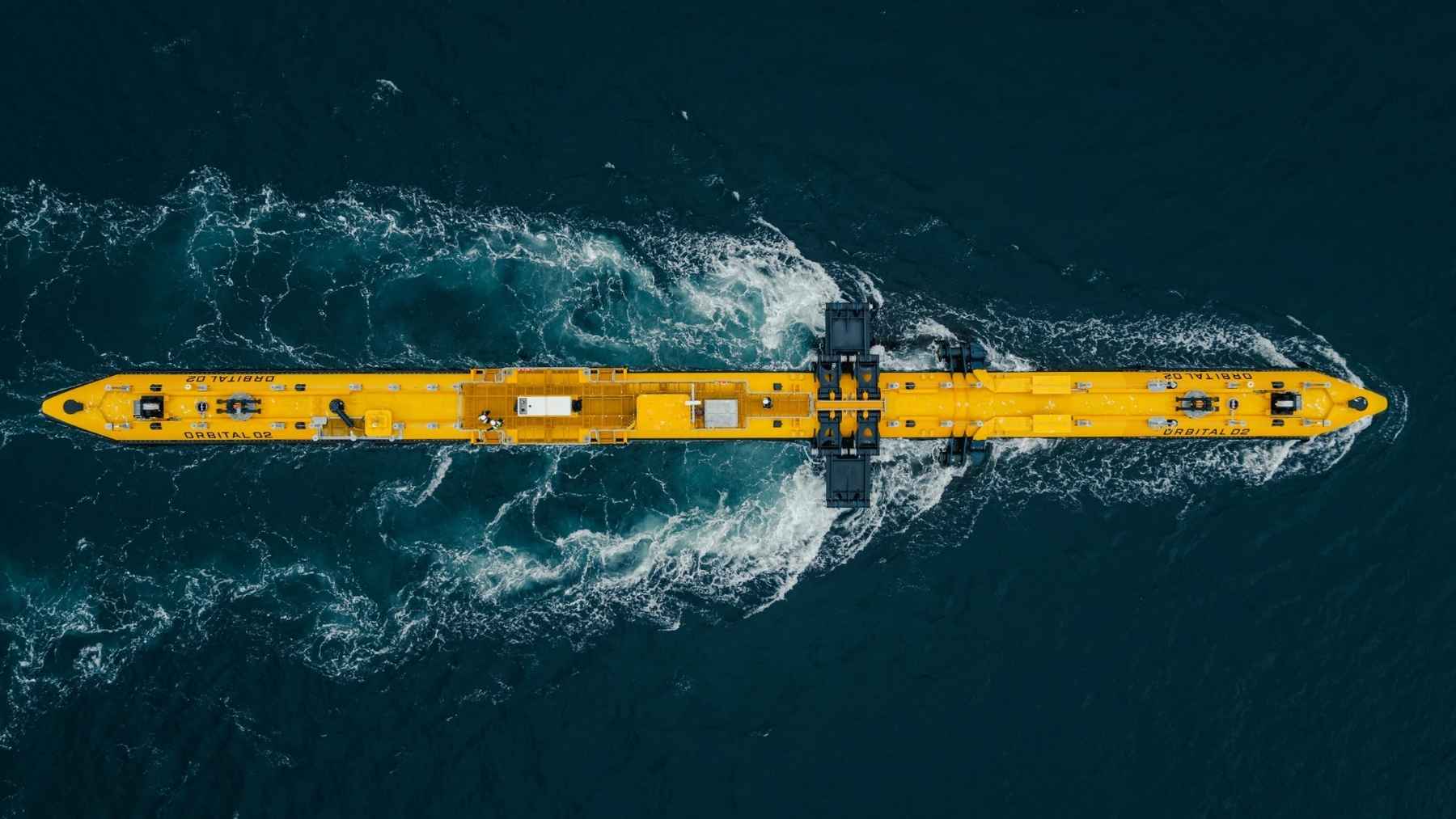
Start with the turbine doing the marvel rounds. The Orbital O2 was built by Scotland’s Orbital Marine Power and has been anchored since July 2021 at the European Marine Energy Centre in Orkney. It is a 74-meter (243-foot) floating steel structure weighing roughly 680 tons, with two retractable legs that drop a pair of 1-megawatt turbines into the tidal flow for a combined 2 MW. Orbital says it can cover the annual electricity demand of around 2,000 UK homes and offset about 2,200 tons of carbon dioxide a year. Some of its output has even gone to an onshore electrolyzer at the same site to make green hydrogen, which is a useful trick for a machine that is, at heart, a very reliable generator.
The clever part is not the power rating. It is that the whole thing floats. Instead of fixing a nacelle to the seabed and sending divers or heavy-lift barges out every time something needs attention, Orbital tows the O2 back to a harbor on the surface, the way you would bring a boat in. The rotors sit about 14 meters down on those articulating arms, and the platform rides a four-point mooring system. It is the same floating-platform logic China is leaning on with its skyscraper-sized floating offshore wind turbine in water too deep to anchor anything, just aimed at currents instead of wind. For a machine that has to survive water moving faster than 3 meters per second, being able to leave is a feature, not a flaw.
Bigger blades, and six more of them
The O2 is not the end of the line. Orbital is now building its next-generation turbine, the O2-X, rated at about 2.4 MW per unit, with six of them expected to go into the water in Orkney between 2026 and 2028. The pipeline is backed by two rounds of UK Contracts for Difference: the company won 4.8 MW plus 2.4 MW in the 2022 auction for delivery in 2026/27, then another 4.8 MW plus 2.4 MW in 2023 for 2027/28. Add it up and you get six machines. Orbital has also been working with Lloyd’s Register toward the certification a tidal turbine needs before it can move to serial production, picking up an IECRE feasibility statement in early 2025.
The blades are where it gets genuinely ambitious. Through a project called MAXBlade, Orbital plans to stretch its turbine blades from 10 meters to 13 meters, which it says will make them the longest tidal blades in the world. That increases the rotor swept area by about 70 percent, to more than 1,000 square meters. In a technology where the single biggest lever on cost is how much water each rotor can sweep, a 70 percent jump is not a tweak. It is the entire argument for why the next turbine should be cheaper than the last one.
The Bay of Fundy already has a turbine graveyard on its floor
Here is the context the explainers tend to skip. The Minas Passage, the narrow gap where Fundy’s tides funnel in and out of the Minas Basin, is not a friendly test site. It is about 5 kilometers wide and 150 meters deep, and at the height of the spring tides it carries more water than all the world’s rivers combined, pushing it through at up to 5 meters per second, according to Canada’s National Observer. The local tides swing by as much as 16 meters every six hours. This is not a place that tolerates mistakes.
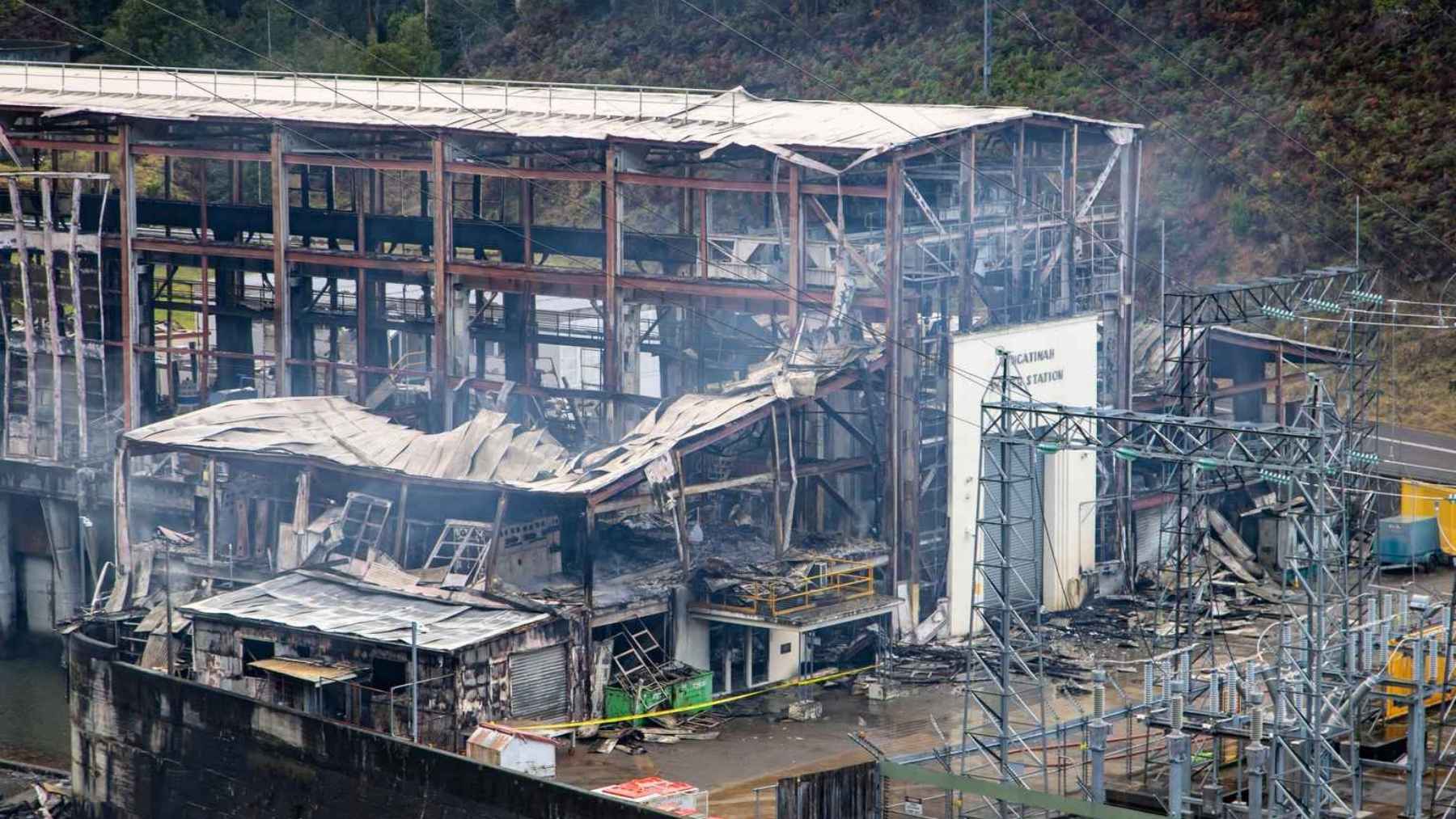
Machines bolted to that floor have learned this the hard way. The Irish company OpenHydro, then owned by France’s Naval Group, lowered the world’s first one-megawatt tidal turbine onto the seabed there in 2009, and the current destroyed its blades within weeks. A second, much larger OpenHydro turbine ran for a few months across 2016 and 2017 before being pulled for repairs. A third went into the water in 2018, six days before OpenHydro filed for bankruptcy. That roughly 1,300-ton machine never generated power and never came back out. As of early 2026, Nova Scotia officials still could not say when, or whether, they will manage to recover it. The Bay of Fundy did not gently discourage seabed turbines. It ate them.
Nova Scotia cleared three floating turbines for the Minas Passage
Which is exactly why a floating, towable design matters in this specific place. Orbital has partnered with the Canadian developer Eauclaire Tidal to put the O2-X into the Fundy Ocean Research Centre for Energy, or FORCE, the research operation that runs the berths in the Minas Passage. In November 2025, Fisheries and Oceans Canada issued an authorization allowing up to three floating O2-X turbines at FORCE, the first project to move ahead under Canada’s revised, staged approach to tidal permitting, which lets a developer start with a single device and add more as environmental monitoring comes in. The province of Nova Scotia has approved the Eauclaire and Orbital partnership for up to 16.5 MW in total, enough to support a planned six O2-X machines across the site. Orbital calls it its largest project anywhere outside the UK.
The pitch writes itself once you have seen the graveyard. A turbine you can unbolt is one thing. A turbine you can untie and tow home is another. Lindsay Bennett, executive director of FORCE, told Canada’s National Observer that the site has been “working with renewed vigour” since 2024, the year the streamlined process approved its first turbines since 2018. There is a deadline stapled to the optimism: under the licence terms, Orbital has to get a turbine in the water by December 2030 to lock in its 15-year power contract with Nova Scotia Power. The clock is part of the deal.
Tidal power is still expensive enough to hurt
None of this means tidal energy has won. The reason it leans on dedicated government contracts and long power-purchase agreements, rather than competing in the open market, is that it is still costly. In the UK’s most recent Contracts for Difference auction in 2024, tidal stream projects were contracted at £172 per megawatt-hour, around $225. That was the lowest price the sector had ever cleared, and it was still roughly three times the £58.87 that fixed offshore wind locked in during the very same auction.
What tidal has going for it is the one thing wind and solar cannot promise: it is predictable. The tides run on a schedule written by the Moon, not the weather, so a tidal turbine produces on calm nights and dead-still afternoons when panels and wind farms go quiet. That is the same case being made for river-current machines, like the swarm of small turbines Germany is anchoring in the Rhine to keep generating after the sun sets. Whether that predictability is worth paying triple for is the question every grid operator now has to answer, and it is the same one hanging over the wider UK tidal push, including the large Welsh schemes lining up in the Menai Strait.
Orbital now has the permits, a December 2030 deadline, and a seabed full of cautionary tales to study before it tries. The Bay of Fundy has the highest tides on the planet and a long record of humbling the machines sent to tame it. The floating design is the smartest answer anyone has brought to that problem yet. It still has to prove itself in five-meter-per-second water, where being able to leave might finally turn out to be the thing that lets a turbine stay.