
At the peak of Japan’s bubble economy, a membership at Koganei Country Club outside Tokyo cost more than ¥400 million, roughly $2.8 million at the exchange rates of the day. Not the club. One membership. Golf memberships traded like securities in late-1980s Japan, and the Nikkei ran an index tracking their prices the same way it tracks stocks.
Then the bubble burst, and the country found out it had built golf the way it had built everything else in 1989: on the assumption that the line only goes up. The Nikkei Golf Membership Index peaked at 948.17 in 1990 and sat at 57.79 by 2002, about one-sixteenth of its high. Courses have been dying ever since. Japan had 2,154 of them left as of April 2025, a net 306 below the peak.
That collapse left a very specific kind of real estate scattered across the countryside: enormous, sunny, cleared, graded, drained, and already connected to a road. In 2015, a Kyoto electronics company looked at one of those corpses and saw a power plant that hadn’t been wired yet. And as of this spring, a wave of new Japanese restrictions on where solar can go has quietly turned that ten-year-old idea into some of the smartest land strategy in the country’s energy playbook.
Japan built more golf courses than golfers could use
Japan crossed 1,000 golf courses in the early 1970s and kept building for three more decades, peaking above 2,400. The sport was less a hobby than a business protocol, and during the bubble a club membership doubled as a speculative asset with a resale market and a price ticker.
The players went away faster than the courses did. Participation peaked around 12 million and had roughly halved by the late 2010s, before a pandemic-era wave of new and returning golfers pushed it back above 8 million, per the R&A’s 2023 participation count. The demographic math is still brutal: the bubble’s golfers came from Japan’s postwar baby boom, born 1947 to 1949, and that entire generation crossed 75 around 2025.
The asset side never recovered either. That Koganei membership was trading at about ¥60 million as of 2025, some 15% of its peak. A functioning 18-hole course sold for an average of roughly ¥810 million in 2022, per data compiled by Yanolja Research, which works out to around ¥45 million a hole. So hundreds of operators over the years have faced the same spreadsheet: keep mowing fairways forever for a shrinking, aging clientele, or find the land another job.
A fairway is a power plant that hasn’t been wired yet
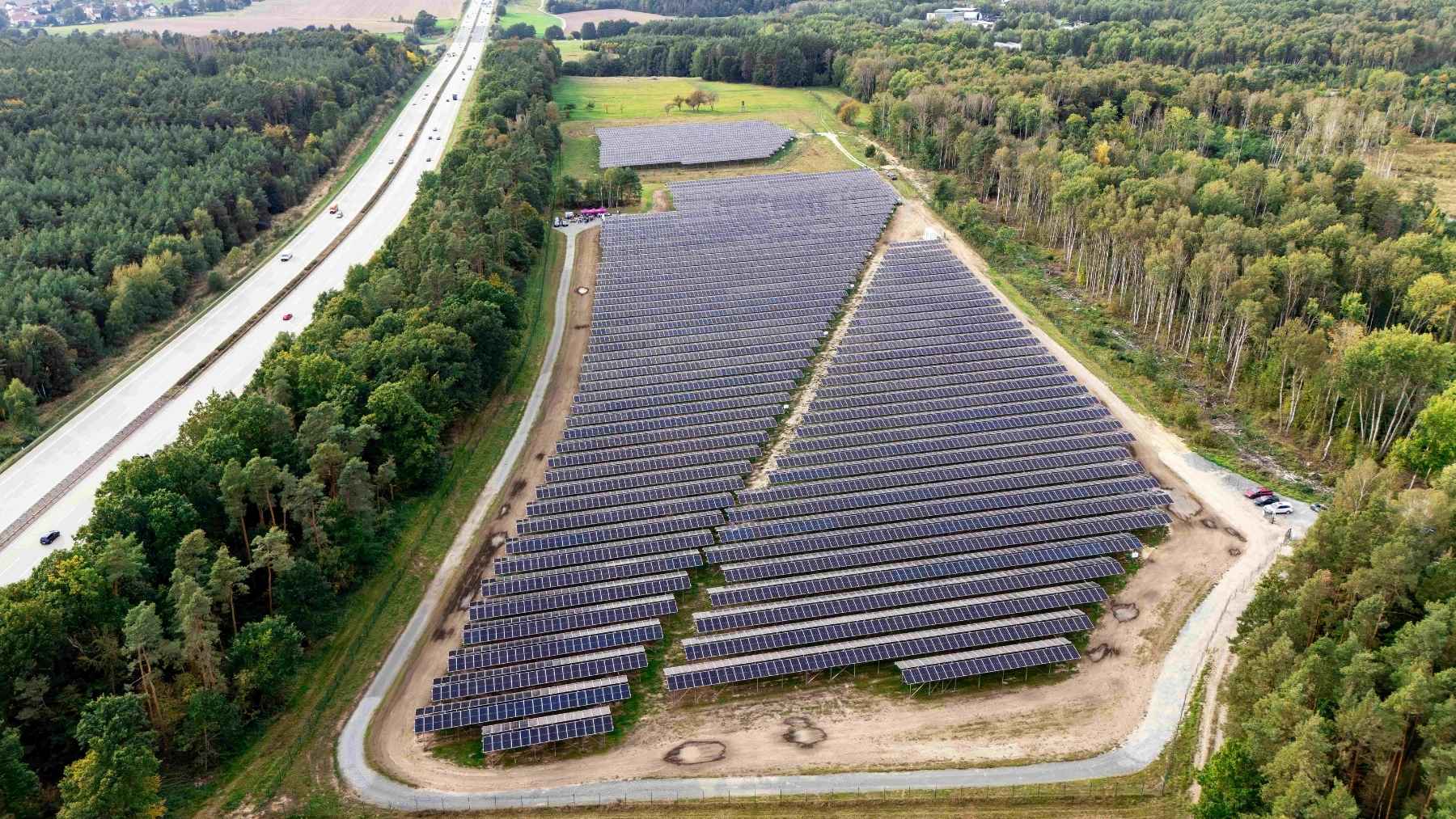
In June 2015, Kyocera TCL Solar, a joint venture between Kyocera and what was then Century Tokyo Leasing, started driving racking into an abandoned course in Fushimi Ward, Kyoto City. The plan called for roughly 90,000 of Kyocera’s 270-watt modules, 23 megawatts of capacity, and an estimated 26,312 megawatt hours a year, enough for about 8,100 typical local households, per Kyocera’s announcement, with the power sold to Kansai Electric under Japan’s feed-in tariff.
Kyocera’s own case for the land was that dead courses offer “expansive land mass, high sun exposure, and a low concentration of shade trees.” Which undersells it. A golf course is engineered ground: the fairways were graded and compacted on purpose, the drainage was designed by professionals, the trees were removed from the playing lines decades ago, and there are service roads to every corner of the property.
Anyone who has followed what that prep work costs elsewhere can appreciate the head start. On a capped landfill in Houston, crews have to hold every panel down with concrete ballast because a single driven pile would breach the seal over the garbage. In Arkansas, the biggest solar project in American history is consuming more than 400,000 steel piles on raw farmland. On a dead fairway, you can drive piles all afternoon into ground somebody else already leveled.
The Kyoto plant came online in 2017 as the largest solar installation in the prefecture, and by the time its own financing partner described it in early 2018, it had grown into a 25-megawatt plant. There was a bonus layer of symmetry, too: Fushimi is the same ward where Kyocera set up its first major solar research center in the mid-1970s. Forty years of lab work, and the field test showed up next door wearing golf spikes.
Kagoshima never even got to play its course
The bigger project sat far to the southwest, on land straddling Kanoya City and Osaki Town in Kagoshima Prefecture. That site was zoned for a golf course more than 30 years earlier and then abandoned before anyone teed off, a bubble project that died as a drawing. Planning for its second life began in January 2014, after the local community itself pushed to repurpose the ground.
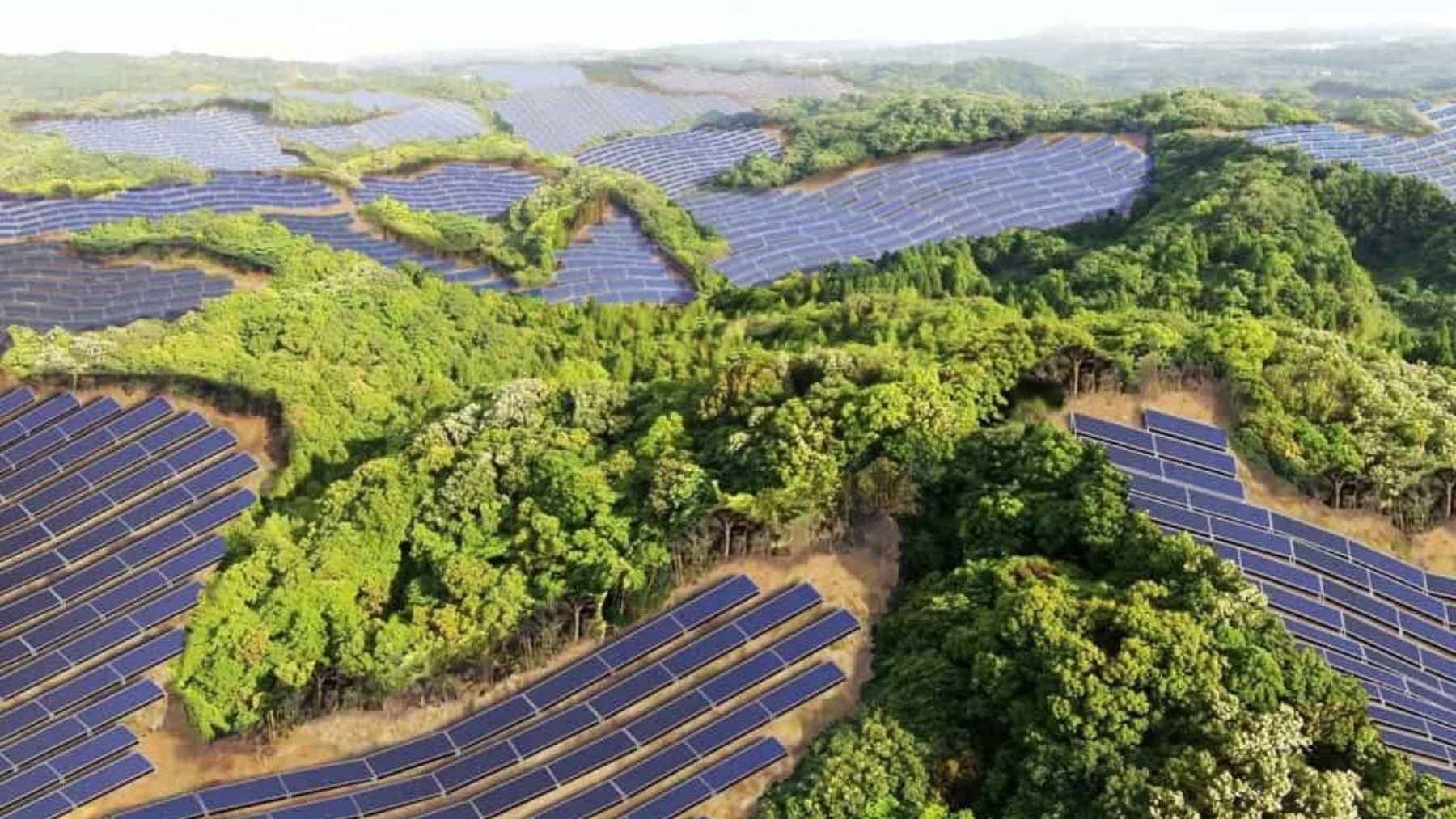
The announced version was 92 megawatts across 494 acres (2 million square meters), a footprint about the size of Monaco. The finished version, which began operation in May 2020, came in at 100 megawatts: 356,928 Kyocera modules, an expected 117,000 megawatt hours a year, and enough output for roughly 39,300 households by Kyocera’s estimate. Both golf-land plants finished bigger than announced, which is not a sentence anyone gets to write about construction very often.
It took real machinery to get there. Four companies, GF, Kyocera, Kyudenko and Tokyo Century, formed a dedicated operating company, the project cleared a year-long environmental impact assessment plus forestland development permission, and Tokyo Century arranged a syndicated loan with the Bank of Fukuoka and 17 regional banks. The result ranks among the largest solar plants on the island of Kyushu, sitting on ground that spent three decades as a paper golf course.
The model kept working after the internet moved on
The 2015 headlines faded, and the conversions kept going anyway. In April 2018, Kyocera TCL Solar completed a 29.2-megawatt plant in Yonago City, Tottori Prefecture, on 1.2 square kilometers of land originally designated for a golf course and other uses that never happened. 108,504 modules, an estimated 36,080 megawatt hours a year, power for about 12,000 households, all of it sold to Chugoku Electric.
Tottori was the harder test. It sits on the Japan Sea coast, with heavy snow and short winter daylight, terrain no one would call natural solar country. The company adapted the mounting design to the weather and built it anyway. A fourth site on the company’s repurposed-land list, a 27-megawatt project in Fukushima Prefecture, also sat on an abandoned course. With Yonago finished, this one joint venture counted 63 plants across Japan totaling roughly 215 megawatts since its founding in 2012, a chunk of it on land golf left behind.
Here’s the part with a twist of irony. Kyocera itself has since pulled back from making the hardware: it shut its Tianjin module factory in 2023 under pricing pressure from Chinese manufacturers, leaving a single domestic panel plant, and Nikkei reported the company had decided to retreat from the panel business. The fairway plants are on 20-year feed-in tariff contracts. They will likely outlast their builder’s panel division.
In 2026, Japan made this the only easy land left
To understand why this matters more now than it did in 2015, look at where the rest of Japan’s solar went. The feed-in tariff launched in 2012 rewarded output above all, and in a mountainous country with almost no spare flat land, cheap forested slopes got bulldozed for panels. According to economist Richard Katz, about 20% of Japan’s 9,200 utility-scale solar sites sit on formerly forested land prone to mudslides, and more than 230 accidents have occurred at such sites, one of which destroyed 120 homes.
Local governments revolted first. At least 175 cities, towns and villages passed their own ordinances restricting large-scale solar before Tokyo acted. Then the national government moved in one sustained push: a decision in October 2025 to rein in mega-solar by law, a Mega Solar Countermeasure Package adopted across ministries at the end of 2025, an amended Forest Act with tougher permits and penalties that took effect in April 2026, and a cabinet-approved bill on March 24, 2026 to tighten the Electricity Business Act on top of it.
Now hold that against the other half of Japanese policy. The 7th Strategic Energy Plan, approved in February 2025, wants solar delivering 23% to 29% of the country’s electricity by fiscal 2040, up from 9.8% in fiscal 2023. So Japan needs solar’s share of the grid to more than double, and possibly triple, while making it dramatically harder to build on forests and slopes. Every category of land that was already flattened, cleared and ruined for some other reason has become strategically precious. Golf courses are the largest single inventory of it in the country.
Nobody publishes a running national census of course-to-solar conversions, so the honest answer on the total is that documented projects span at least Kyoto, Tottori, Kagoshima, Fukushima, Hyogo and Okayama prefectures, and the closures that feed the pipeline haven’t slowed. The 306 courses already gone will have company.
The back nine pays the light bill now
The economics of the original plants are locked in for a while yet. Kyoto’s feed-in contract runs to 2037, Kagoshima’s to 2040, and the meters have been spinning through every policy fight described above, because nobody protests a solar plant on land that was scraped bare for leisure 35 years ago.
Japan is currently spending serious money hunting kilowatts in genuinely hard places, including a 330-ton turbine flying underwater in the Kuroshio current. Some of its cheapest new generating land, meanwhile, was sitting behind a clubhouse the whole time, pre-graded and pre-drained by the most expensive landscaping bubble in history. The 1989 boom built monuments to excess all over the country. The fairways are the only ones sending out an electricity bill.