
Everything that moves across the ocean has a feeding schedule. Container ships drink heavy fuel oil by the ton, patrol boats burn diesel, and the new generation of electric harbor craft heads back to a charger before dinner. Naval drones mostly live by the same rule: the mission ends when the tank does, or the battery does, whichever taps out first.
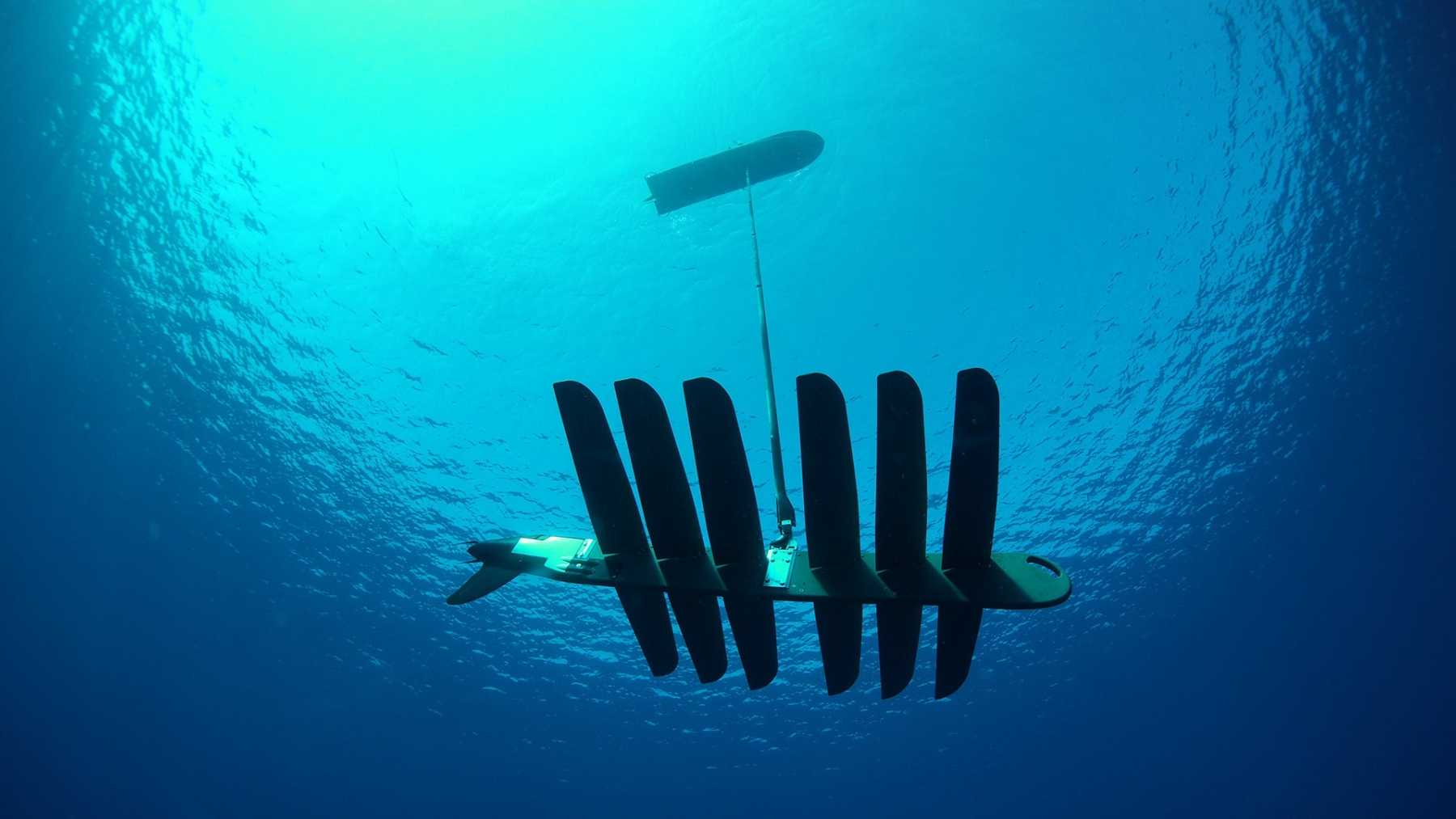
Liquid Robotics, a Boeing subsidiary, builds the exception. Its Wave Glider is a two-body machine with a surfboard-shaped float on top and a winged glider hanging below it on a tether, and the ocean itself does the pushing. This year the company launched its biggest version so far, the 18-foot SV6, and the platform landed a customer with a very particular job in mind. Japan is taking 20 of them through a $25 million US Air Force deal, to help figure out where things that fall over water actually land.
The wave does the pushing, the sun keeps the lights on
The trick behind the Wave Glider is that wave energy is strong at the surface and fades fast a few feet down. The float on top gets heaved around by every passing swell. The winged sub hanging below sits in calmer water, and as the tether yanks it up and down, its wings turn that vertical motion into forward pull.
No engine drives it and no fuel tank feeds it. According to Liquid Robotics, the platform runs exclusively on wave and solar energy and can stay at sea for up to a year with zero emissions. Solar panels on the float charge a battery bank that powers the computers, the satellite link and whatever sensors are bolted on, and the company fits an additional propulsion system that draws on that stored solar power when the sea goes flat.
The pace will not worry anybody. Wave Gliders move at around two knots, which is a relaxed walking speed. Slow has turned out to be the whole point, though. The company says its fleet has logged more than 3 million nautical miles and over 60,000 days at sea, and the longest single mission covered 9,380 nautical miles, about the distance of sailing from California to Japan and back.
The origin story is better than most defense hardware gets. Liquid Robotics says its founders were originally trying to build something that could sit off Hawaii and listen to humpback whales without a crewed boat idling overhead. Two decades and 550-plus vehicles later, the same architecture is doing homework for the Pentagon.
SV6 is the biggest one yet, and the first to run on 48 volts
The SV6, launched in 2026, stretches the float to 18.4 feet (5.6 meters), which puts it in bass-boat territory. Payload capacity climbs to roughly 990 pounds (450 kg) spread across 40 modular bays, more than six times what the workhorse SV3 carries. Solar collection quadruples from the SV3’s 225 watts to 900 watts, and onboard energy storage rises to 30 kWh. If that number sounds familiar, it should: Nissan put a 30 kWh pack in the 2016 Leaf.
The quieter spec is the electrical one. Per Liquid Robotics, the SV6 is the first Wave Glider designed to natively support 48-volt power systems and payloads. The sensors worth carrying these days, bigger sonars, radars, edge computers, increasingly want 48 volts, the same low-voltage jump parts of the car industry have been making. The new hull remains fully backward compatible with SV3 and SV5 payloads, so nothing in the existing toolbox gets orphaned.
Japan is buying 20, and the paperwork is unusually specific
The order surfaced in stages. A US Air Force contract announcement showed Liquid Robotics winning $25 million to supply 20 uncrewed surface vehicles for Japan under the Foreign Military Sales program, with the Air Force Test Center at Eglin Air Force Base, Florida, as the contracting activity and completion scheduled for February 16, 2028, as reported by Defence Blog. The announcement never named the vehicle type.
Then a procurement justification document filled in the blanks. As Defence Blog reported on February 19, the program is called Overwater Impact Location, OWIL for short, the platforms are SV6 Wave Gliders, and the requirement came from the 96th Test Squadron at Eglin. The name is the job description: the drones support test activities tied to tracking where objects hit the water, plus maritime instrumentation work, and the buy includes control software, payloads, and launch and recovery equipment.
The Air Force went sole-source, on the legal grounds that “only one responsible source and no other supplies or services will satisfy agency requirements,” per the document. There was a practical reason behind the legal one. Eglin already operates 14 Liquid Robotics vehicles from earlier contracts, and specialized payloads like thin-wire winches and towbodies are engineered around the Wave Glider’s architecture, so switching platforms meant new training pipelines and a redesign bill. Market research did look at alternatives, including Textron and Saronic Technologies, and the document says the competing systems fell short on endurance, communications, visibility or size, or were still developmental.
The schedule has teeth. The first unit is due within 360 days of contract execution and the last within 720, and Brig. Gen. Mark A. Massaro, commander of the 96th Test Wing, signed off on the acquisition in November 2025. The paperwork classifies the buy as operational rather than experimental, so nobody involved is treating this as a science project. The clock on 20 hulls is already running.
A loud year for a quiet company
Boeing bought Liquid Robotics in December 2016 and parked it inside its Defense, Space & Security division, where it spent most of the following decade making very few headlines. 2026 has been different.
In May, the company announced it will relocate its headquarters and manufacturing from Herndon, Virginia to a larger facility in Jessup, Maryland by the end of the year, explicitly to grow production capacity for the Wave Glider fleet. “Relocating to Jessup gives us the space and flexibility we need to support our next chapter,” said Shane Goodenough, CEO of Liquid Robotics. When a company that builds one product line moves into a bigger factory five months after booking a 20-unit order, the two facts tend to be related.
Then in July, a Wave Glider spent Exercise Lanternfish 2026 working as the communications middleman between underwater survey drones and operators on shore, in a US Navy demonstration run simultaneously off Monterey, California and Little Creek, Virginia, according to the July 21 announcement from the three companies involved. We have covered both ends of that exercise, from Anduril’s cable-free seabed listening nodes to Bedrock’s 132-pound survey drones, and the surface relay sitting in the middle of that whole architecture was this company’s product.
Strip away the architecture talk and the Japan order boils down to a simple bet. Twenty machines, no fuel logistics, two years of deliveries, and a test-range job that amounts to watching where things splash down and reporting back. Underwater autonomy still has an unsolved half, which is powering the drones that live below the surface, and there are American outfits building seabed nuclear batteries to fix exactly that. The surface half already has a machine that solved its power problem by never having one. It started out listening for whales, it now clocks in for navies and an air force, and the ocean has yet to send it a fuel bill.