
Everyone who has ever flown into Amsterdam has landed below sea level. Schiphol sits on the bed of a lake the Dutch pumped dry in the 1850s, and a good chunk of the country around it only exists because somebody keeps lifting water over a dike.
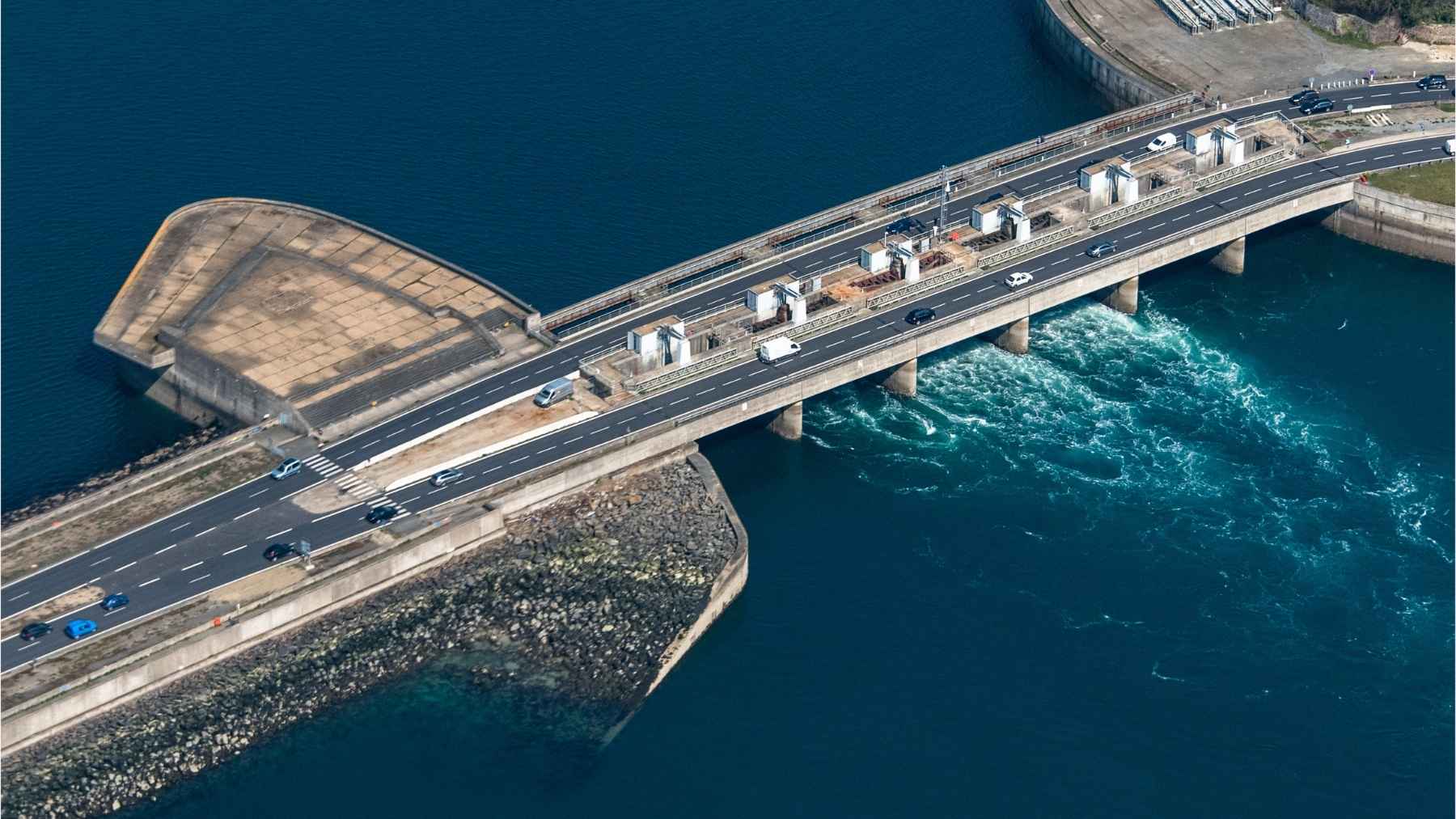
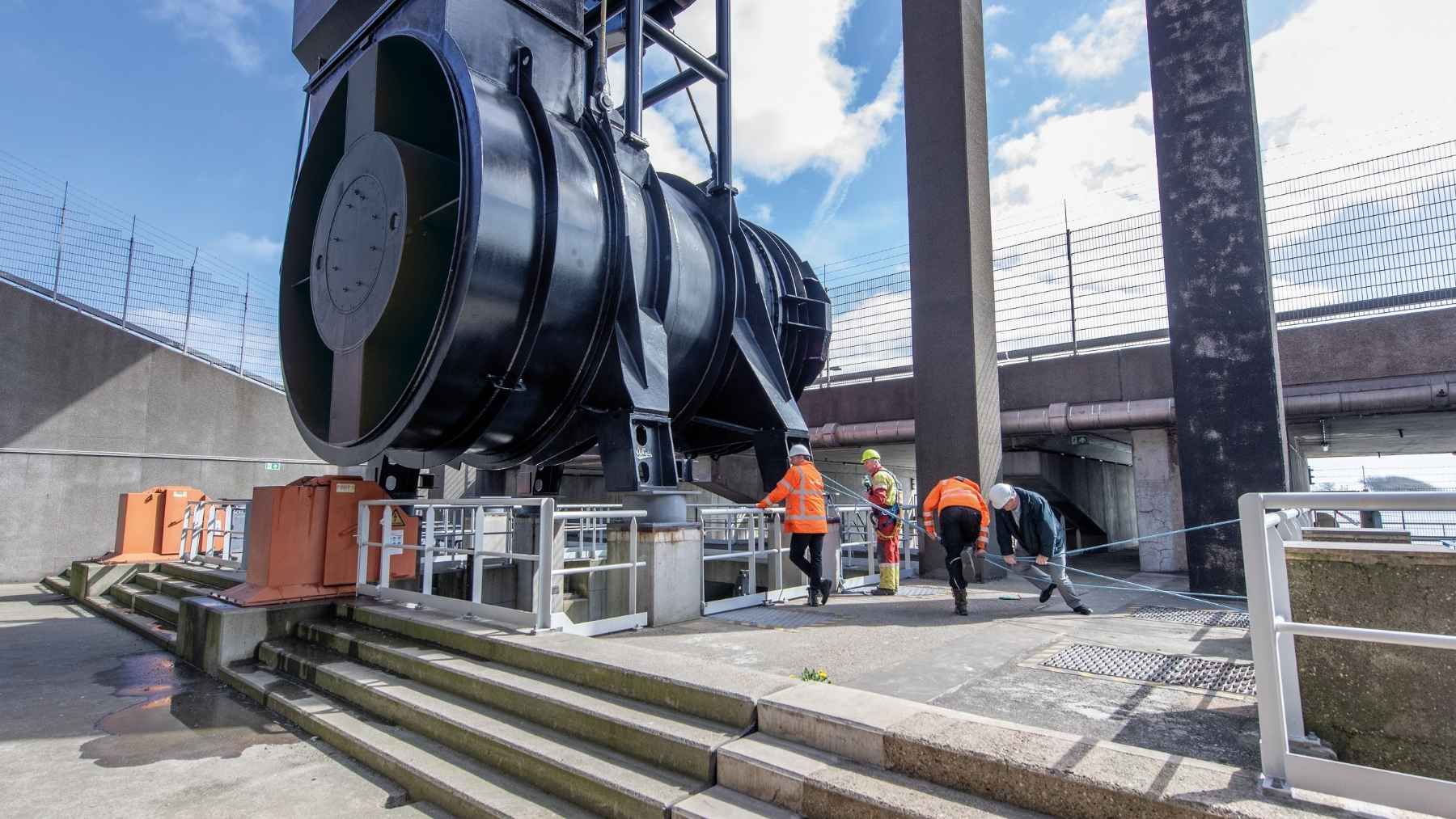
For the last half century, that somebody has mostly been a low concrete building at IJmuiden, the point where the North Sea Canal meets the sea west of Amsterdam. Inside sit the six pumps of the largest pumping station in Europe, and two of them are 120-metric-ton machines the height of a three-story building.
Running flat out, the six can throw 260,000 liters a second over the sea defenses, about 4.1 million gallons a minute. That has been enough since 1975. In February, Rijkswaterstaat, the Dutch national water agency, confirmed it will not stay enough: the replacement station now on the shortlist is rated for 410,000 liters a second, and all three finalist designs are new builds.
Gravity does most of the work, until it can’t
The system is simpler than it sounds. The North Sea Canal is held at a target level of about 16 inches (40 centimeters) below NAP, the Dutch datum that roughly tracks mean sea level. When the tide drops the sea below the canal, operators open seven big culverts in a sluice dating from 1940 and let the water run out on its own, up to 700,000 liters a second, for free.
When the sea sits higher than the canal, gravity is out and the pumps go on the clock. Electricity is the expensive part of this arrangement, so the sluice gets first call and the pumps handle whatever is left.
What is left is not small. According to Rijkswaterstaat’s own fact page, the complex sends about 3 billion cubic meters a year into the North Sea, just under 800 billion gallons. The agency’s preferred comparison is 137 Olympic swimming pools per hour, every hour, as a yearly average.
The catchment behind it covers about 888 square miles (2,300 square kilometers) directly, and more than 1,500 square miles (4,000 square kilometers) once you count the areas draining in through other locks. Amsterdam is in there. So are Utrecht, pieces of three provinces, and Schiphol. Canal operators everywhere are wrestling with this kind of water math right now; the Panama Canal is building itself an entire new lake over it.
Waternet, the utility that manages Amsterdam’s water, has spelled out what happens if IJmuiden falls behind. The canal’s level is watched to the centimeter, says Hilga Sikma, a senior water-system project leader at the utility, and in a bad enough scenario Amsterdam would have to seal off its famous canals with emergency barriers.
Two of the six hold a world record
The station opened in 1975 with four pumps and 160,000 liters a second of capacity, and it was already the largest in Europe on day one. In 2004, Rijkswaterstaat added two more, shipped across the IJsselmeer by barge from the factory in Genemuiden.
Those two are the record holders. Built by Pentair Fairbanks Nijhuis, each propeller pump moves 50,000 liters a second, roughly 13,200 gallons every second, through an impeller 13 feet (4 meters) across. Each unit weighs about 265,000 pounds (120 metric tons) and, with its motor housing, stands as tall as a three-story building. Pentair says the pair are listed in Guinness World Records as the largest-capacity water pumps in the world.
“With a capacity of 50,000 liters of water per second, you pump out an Olympic-sized swimming pool in 50 seconds,” Jan Willem Eindhoven, a Pentair project manager, said when the company described the machines.
You will find 60,000 liters a second attached to these pumps in the pump-trivia corners of the internet. The manufacturer’s own figure, repeated across its project pages, is 50,000. Go with the people who built the thing.
Machines this size do not come off a shelf, and the station has already had a scare. In the spring of 2020, pump 5 failed and took 50,000 liters a second of capacity with it, and the agency had to float in temporary pumps while it worked out a repair. It is the standing problem with every one-off giant, whether that is a record pump or the 4,350-ton borer currently under Sydney Harbour: the spare parts catalog is a phone call and a very long wait.
So by late 2022, Rijkswaterstaat stopped taking chances and ordered a third copy of the super pump from Pentair, this time to replace one of the 1975 originals. Gerard Scholten, who runs Pentair’s Winterswijk plant, was open about the reasoning: keep the station reliable until the planned renovation. Delivery was set for October 2023.
The world’s biggest sea lock made the water saltier
In 2022, right next door, King Willem-Alexander opened Zeesluis IJmuiden, the largest sea lock on the planet at 1,640 feet long, 230 feet wide and 59 feet deep (500 by 70 by 18 meters). It lets the biggest ships reach Amsterdam day and night, regardless of the tide.
It came with a catch. By Rijkswaterstaat’s count, every ship passage through the new lock carries about 10,000 tons of salt into the North Sea Canal, roughly 22 million pounds per transit. Salt is bad news for farmland, for nature and for the drinking-water production that depends on the canal system upstream.
The fix was a salt dam in the inner sluice channel, built to steer the heavy salty layer back out to sea through the pump complex. Then the fix grew a problem of its own. Salt water is denser than fresh water, only salt water collects behind the dam, and the level in that channel drops. Let it drop too far and the pumps themselves can be damaged.
So the dam’s movable gate is kept open part of the time to let fresh water back in, and ships are still being routed through the old Noordersluis to limit the salt load. By the agency’s own account, neither the record lock nor the salt dam is being used the way it was designed. The permanent answer in its plan is the new pumping station, with pumps set deeper in the water.
The replacement makes the record holder look small
The study for that station started at the end of 2024, for two reasons the agency does not dress up: sea levels are rising, which will eventually kill gravity sluicing altogether, and parts of the complex are at the end of their design life. Rijkswaterstaat worked through twelve designs in the fall of 2025. Four kept the old station and bolted on new capacity. Eight started from scratch.
In February, the agency announced that the three finalists are all clean-sheet builds, differing mainly in where they sit in the inner sluice channel and how construction gets staged. One of them would rise on the site of the current 1940 sluice.
The headline number is 410,000 liters a second of pumping capacity, about 108,000 gallons every second, a 58% jump over today’s record station. The winning design has to last 100 years, keep the water moving during its own construction, and treat migrating fish better than the current pumps do.
One preferred design is due later this year. Rijkswaterstaat’s February note pointed at the summer of 2026 for the end of this study phase, while Peer Groep, a consultancy working on the project, puts the pick at the end of September. After that comes a preliminary design, an environmental workup, and a very Dutch amount of paperwork.
Then there is the bill. Robert Tieman, the outgoing infrastructure minister, put the replacement at 1.4 billion to 2.3 billion euros, roughly $1.6 billion to $2.7 billion, with at least ten years of preparation and construction, according to trade outlet Infrasite. The funding decision belongs to the next Dutch cabinet.
The politics have already started. A D66 lawmaker said in February she expected the project to land high on the governing coalition’s infrastructure priority list. A ministry letter in March said the replacement could not start yet under current budgets, and the province of Noord-Holland and its delta-region partners publicly sounded the alarm over it, calling the station key to the safety of 4 million people. Nobody has signed a check.
There is a reason for the noise. Dutch water-sector journal H2O, citing an official evaluation, reported that Amsterdam only narrowly avoided serious flooding in November 2023, with the aging complex at the center of the story.
A 150th birthday and a deadline that almost match
One more date sits on the calendar. King Willem III opened the North Sea Canal on November 1, 1876, after 11 years of digging by thousands of workers, which makes this fall its 150th birthday. If the current schedule holds, the Dutch will pick the machine that guards its mouth for the next century within weeks of the anniversary.
Until then the job stays with the 1975 station: extra maintenance, a new control system on the way, and six pumps, two of them world-record machines, running whenever the tide says they have to. Four million people and one very large airport sit on the dry side of that arrangement.