
Most people picture the Panama Canal as a shortcut. Two oceans, one narrow country, a shipping lane that saves you the long haul around South America. All true. What usually gets left out is that the canal does not run on sea water at all, and every ship that crosses spends tens of millions of gallons of fresh water that it never gets back.
That water comes out of a lake. When the lake drops, ships have to ride higher and carry less, which is exactly what has been happening all summer. On August 6 the Panama Canal Authority told shipping companies it was cutting the maximum depth for its biggest vessels twice more, to 48.0 feet on August 26 and 47.5 feet on September 3. Those are the fourth and fifth cuts of the year.
The permanent fix is a second lake, in a valley about 20 miles west, behind a concrete dam roughly 330 feet tall. It is a $1.6 billion project, it is not scheduled to hold water until the early 2030s, and on August 3 around 300 people marched to Panama’s Supreme Court to try to stop it.
The canal spends water on ships and then throws it away
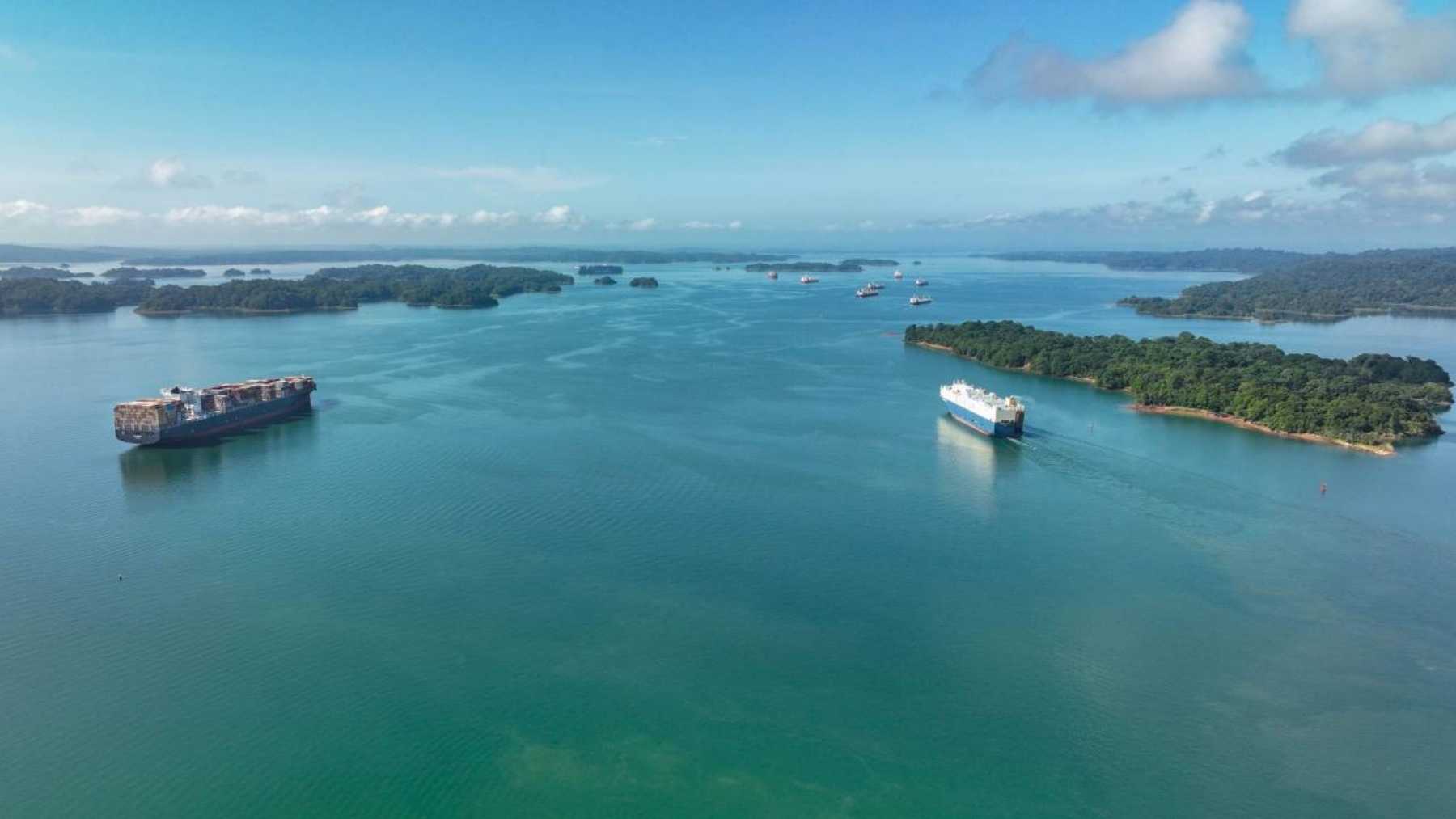
Gatun Lake sits about 85 feet above sea level, which is the whole reason the locks exist. To lift a ship from the ocean up to that level and lower it down the far side, the chambers fill and drain with lake water, and what drains out runs to the sea instead of back up the hill.
According to Engineering News-Record, a transit through the original Panamax locks runs through about 50 million gallons. Roughly 190 million liters, gone, per ship.
The 2016 expansion was supposed to soften that. Each Neopanamax chamber got three water-saving basins that catch part of the outflow and reuse it on the next lockage, recycling around 60% of the water in that chamber. It works.
The catch is that the new chambers are far bigger than the old ones. The canal’s own figure for the net saving is about 7% per transit against a Panamax ship, because recycling most of a much larger volume gets you back to roughly where you started.
There is a second cost that does not show up in the gallon count. Every lockage lets salt water in behind the ship, and Gatun is not just a shipping reservoir. It is where a large share of the country drinks from. Keeping the lake fresh enough to treat takes more water on top of the water the ships use.
The new lake is a tenth the size of Gatun and holds almost as much
The Panama Canal Authority’s own project page puts the Rio Indio lake at 4,600 hectares, about 18 square miles, which is roughly a tenth of Gatun’s 164. Storage is listed at 1,294 million cubic meters. The figure the authority lists for Gatun, for comparison, is 1,302 million.
That works because the valley is steep and narrow. The lake goes deep instead of spreading out, which is how 18 square miles end up holding what 164 square miles hold at Gatun.
Getting that water to the locks is the part that sold the project internally. Rio Indio is the closest basin to Gatun and it sits higher, so the canal plans to bore a tunnel about nine kilometers long, a little over five and a half miles, at roughly 16 feet across, and let gravity do the rest. No pump stations, no power bill, no pipeline running over the hills. You open a valve.
Anyone who has watched a water tunnel get dug knows that is easier to draw than to build. New York spent four months bolting together a 1,350-ton machine named Nora before she could start boring under the Hudson, and California had to push a borer 347 feet under a reservoir on a string of steel pipes to get around a dam it could no longer trust.
The dam itself is roller-compacted concrete, the method you use when you want a very large, very dull, very durable wall. John Langman, who runs the canal’s Water Projects Office, told Panamanian daily La Prensa in May that the main structure comes in around 100 meters tall at its highest point and about 900 meters long, with three auxiliary dams holding the rest of the lake in. The authority has been tendering for a project management firm ahead of the main design-build contract.
Ships are already riding higher than they were in July
None of that helps this year. Construction is not scheduled to start until 2027 and runs to 2031 on the canal’s own timeline, so the lake is a fix for the next drought, not this one. Megaprojects also have a habit of finding new dates, as Denmark discovered when its Baltic tunnel took 51 days to place a concrete element it had budgeted 12 for.
This one is already here. Gatun was just over 84 feet in early August, down close to a foot from July, and The Maritime Executive reports the canal expects roughly 83 feet by September. For reference, during the 2023 drought the lake sat just above 79 feet from June through October, and daily transits fell from the usual 36 to as few as 18.
The draft cuts have come in steps: 49.5 feet in early July, 49.0 on July 24, 48.5 on August 15, then 48.0 on August 26 and 47.5 from September 3. Every half foot is cargo a ship has to leave behind. gCaptain notes the canal has kept daily transit numbers untouched so far, and that NOAA’s Climate Prediction Center has put the odds of this El Nino reaching “very strong” by late 2026 at 81%.
So the schedule has an obvious gap in it. Whatever this El Nino does to Panama, it does before the dam exists.
The first town on the list is El Limon de Chagres
The lake covers 8% of the Rio Indio basin, and people live on it. The canal’s figures, cited by Mongabay, put the footprint at 38 farming communities and around 2,000 residents. These are rice, corn, cassava and plantain households, many of them without a health center or a paved road in.
Resettlement is expected to begin next year, starting with El Limon de Chagres, where the early works go in.
The cemeteries are inside the footprint too. Closing them means exhuming and moving the graves, and that is what put people on the street on August 3.
Around 300 marched from Plaza 5 de Mayo to the Supreme Court to file a nullity action against Executive Decree No. 26, the order authorizing the closures, according to Panamanian daily La Estrella de Panama. Attorney Tristan Santander confirmed the filing to Agence France-Presse. Maricel Sanchez, who speaks for the Rio Indio farmers’ assembly and comes from El Limon herself, told the crowd outside the court that residents would not leave “whether we’re alive or dead.”
The canal has not been ignoring the valley. It runs seven community relations offices in the basin, pays landowners $130 per hectare of forest per year to keep it standing, has been titling land that families have farmed for generations without paper, and started a household census back in August 2024 to build the compensation framework. None of which is the same as consent.
The farmers want Bayano, and the canal says it already checked
The counter-proposal has its own slogan: Rio Indio no, Bayano si. Bayano is an existing reservoir feeding the Pacific side, and expanding it would flood nobody. An independent review by Panama’s Society of Engineers and Architects called it viable.
The canal’s answer, per its published position, is distance. Bayano is more than 100 kilometers from the canal lakes, which means pumping water uphill forever instead of opening a valve, and the operating cost is what kills it. The authority says it looked at 12 configurations for Bayano and re-ran the comparison with the US Army Corps of Engineers before settling on Rio Indio.
The environmental impact study is the next real checkpoint. It is a Category III assessment, the most demanding tier Panama has, with mandatory public participation and a formal public forum, and the canal says it will be presented in the second half of this year. Opponents have separately argued the process falls short of the Escazu Agreement, the regional treaty on environmental consultation that Panama has been party to since 2018.
What the canal is really building here is a battery. Not for electricity, for water: fill it in the wet season, drain it through a tunnel in the dry one, and stop letting a bad rainfall year decide how deep a container ship can sit. The engineering case for that is strong, and the arithmetic on the lake is genuinely impressive.
The rest of it is a decision about who pays for the canal’s water problem, and right now the answer is 2,000 people in a valley, plus their dead. That question does not get settled by a feasibility study. It gets settled in a courtroom in Panama City, and then in the second half of this year, in a public hearing where the people being moved get a microphone.
 @derekbayslittle ROOKIE2 months ago