
If you have ever planned a fishing trip around a tide table, you already know something the energy business is now betting serious money on: the tide shows up exactly when the chart says it will. Not roughly. Twice a day, on a timetable written by the Moon’s gravity and published years in advance. No other power source on the planet can make that claim, and at the end of April, Wales quietly pushed one of the world’s biggest attempts to cash in on it another step forward.
On April 28, Natural Resources Wales, the country’s environmental regulator, approved a variation to the marine licence for the Morlais tidal energy scheme off Anglesey. That sounds like paperwork, and it is. But it is the specific paperwork that lets a wider range of underwater turbine designs go into one of the most energetic patches of sea in Britain, clearing the next phase of a project consented for up to 240 megawatts. The first turbines are due in the water in 2027, and the to-do list between now and then just got shorter.
The tides off Anglesey do not mess around
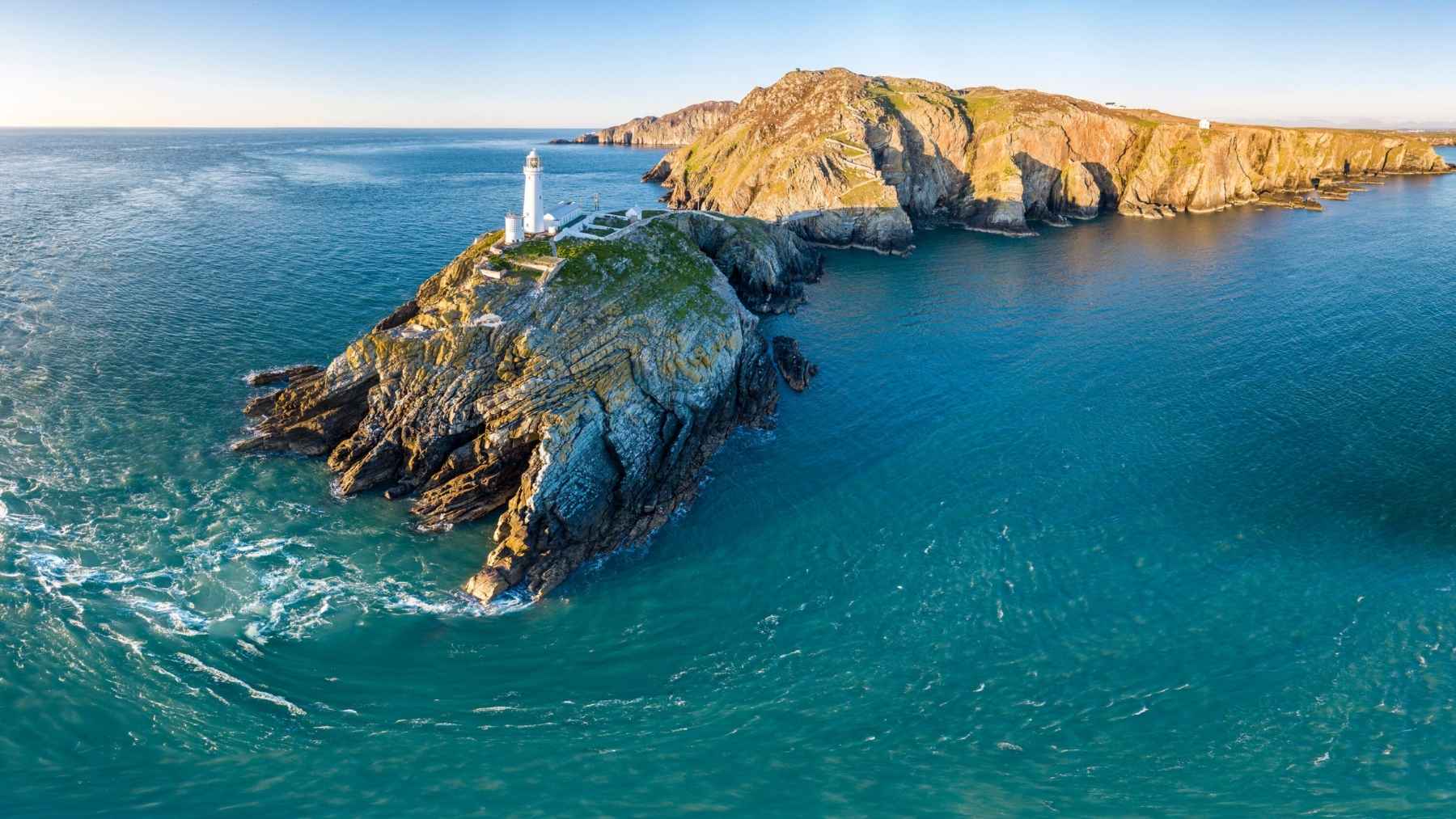
Morlais sits in the Irish Sea off Holy Island, the rocky outcrop on the northwest corner of Anglesey in North Wales. The currents there are genuinely violent. The waters around Holy Island rank among the strongest tidal races in the UK, and beneath the South Stack lighthouse the flow funnels past the cliffs at up to 7 mph (11 km/h). For water, that is moving. Seawater is roughly 800 times denser than air, which is why a 7 mph tide is a power source and a 7 mph breeze barely registers.
The site covers 13.5 square miles (35 square kilometers) of seabed, leased from the Crown Estate back in 2014 as a demonstration zone for tidal power. It is run by Menter Môn, a local social enterprise rather than a multinational, which means the profits are meant to stay on the island instead of leaving on the ferry. At full buildout the zone is consented for up to 240 megawatts, enough for around 180,000 homes, and it is billed as one of the largest consented tidal stream schemes anywhere in the world.
One seabed, one license, five developers
The clever part of Morlais is the business model. Instead of one company building one giant machine, Menter Môn sorted the seabed lease, the environmental consent, the $32 million (£24 million) onshore substation (opened in October 2023) and the grid connection once, then invites turbine developers to plug their hardware into the shared setup. Five developers have already secured capacity at the site through the UK government’s Contracts for Difference auctions, the scheme that guarantees a fixed price for the electricity they generate. The Welsh Government liked the model enough to take a $10.7 million (£8 million) equity stake last year to help strengthen the grid link at Parc Cybi, near Holyhead.
What the regulator approved in April extends that open-door policy to the machinery itself. The licence variation specifically clears devices from Tidal Technologies Ltd, a company founded in 2021 around a twin vertical-axis turbine it calls the TT2, designed to pull utility-scale power out of medium-strength tides. The firm plans to put a full-scale 3 megawatt demonstrator in the water at Morlais in 2027, with another 27 megawatts penciled in behind it. Jim Conybeare-Cross, one of the company’s founder directors, called the decision “an exciting and significant step forward” in comments reported by Nation.Cymru.
Andy Billcliff, chief executive of Menter Môn Morlais Ltd, was blunter about what the approval actually buys: the chance, in his words, “to get tidal energy devices in the sea.” Which is, after more than a decade of groundwork, the part everyone has been waiting for.
The Moon has never once called in sick
Here is the thing that separates tidal stream from every other renewable on the grid. Solar output depends on clouds. Wind output depends on weather systems nobody can forecast more than about a week out. Tides depend on the orbital mechanics of the Moon and the Sun, which is why port authorities print tide tables years in advance and nobody finds that remarkable anymore. The water off Holy Island will peak at a known speed, at a known minute, on some Tuesday afternoon in 2031, and an engineer can tell you today roughly how many megawatt hours that pull is worth.
The UK government made exactly that argument in February when it published the results of its latest renewables auction, known as AR7. The official statement to Parliament described tidal stream as “predictable, reliable power that complements intermittent generation from wind and solar” and noted that around half of the world’s operational tidal stream capacity sits in UK waters, with CfD-backed tidal now totaling 140 megawatts nationally. Four tidal projects won contracts in that round, covering 20.9 megawatts, and three of them are at Morlais: a 10 megawatt array from HydroWing, 5.5 megawatts from Môr Energy, and the 3 megawatt Tidal Technologies demonstrator. That brings the revenue-secured total at the Welsh site to 56.5 megawatts.
HydroWing’s winning project, by the way, is named Ynni’r Lleuad 3. That is Welsh for “energy of the Moon,” which is about as on-the-nose as energy project naming gets. Nobody names a gas plant after its fuel supplier’s delivery schedule.
It also slots Morlais into a small but growing family of generation that runs on physics rather than weather. Japan switched on Asia’s first osmotic power plant, pulling steady electricity from the salt gradient where fresh water meets the sea, and Germany is anchoring a swarm of 124 small turbines in the Rhine for a related reason: rivers, like tides, do not check the forecast before showing up for work.
Punctual does not mean cheap
Time for the honest part, because the gap is not small. In that same February auction, tidal stream projects cleared at about $355 (£265) per megawatt hour in 2024 prices. Solar cleared at roughly $87 (£65.23) and onshore wind at $97 (£72.24). So the grid’s most punctual power source currently costs about four times as much as its most popular one, and the main reason tidal projects win contracts at all is that the UK reserves a protected slice of the auction budget for the technology.
The bet is that the premium buys something the cheap stuff cannot deliver: firm output you can schedule into the grid years ahead, plus a head start in an industry where Britain already hosts roughly half the operating hardware on Earth. The price is at least moving in the right direction, with that $355 (£265) figure coming in 29% below the government’s own cap for the round. And every alternative for covering solar and wind’s quiet hours costs real money too, whether it is gas plants idling on standby or the billion-dollar flow battery Switzerland is burying in an 88-foot pit to bank renewable power for later. Storing electricity is expensive. Generating it on a lunar timetable is also expensive. Pick your poison.
What actually happens next at Morlais
The near-term plan is refreshingly concrete. First turbines go in the water in 2027, deployed in phases so regulators can track how marine wildlife responds before the next batch follows. Tidal Technologies has a 3 megawatt machine to build, 27 more megawatts queued behind it, and a freshly stamped licence saying the seabed is ready when it is. The 240 megawatt figure is still a ceiling rather than a promise, and the project has missed deployment dates before, so a healthy dose of skepticism is fair until steel actually hits water.
But the resource itself is the one variable nobody has to worry about. The tide charts for 2027 are already printed, accurate to the minute. Now the turbines just have to show up as reliably as the water does.