
Saudi Arabia is, by area, mostly desert. The Rub’ al Khali, better known in English as the Empty Quarter, is the largest continuous sand sea on the planet, an ocean of dunes about the size of France that sits within easy reach of every construction site in the country. So if there is one raw material a Saudi builder should never have to buy from a foreigner, it is sand. Except that is exactly what happens. Saudi Arabia imports construction sand, and so do the United Arab Emirates and Qatar, because the sand under their feet is close to useless for the single most important job in modern building: making concrete. The dunes are the wrong kind of sand. And the distance between how much sand the planet assumes it has and how much it can actually build with has grown wide enough that the United Nations now has a name for it.
The Grains Are the Wrong Shape
Concrete is mostly aggregate, meaning sand and gravel, held together by a thin matrix of cement paste. For that matrix to do its job, the grains have to lock against one another, edge to edge, so the cured block resists being pulled apart. River sand and crushed-rock sand are good at this because they are geologically young: broken off larger rock, jagged, angular, full of sharp faces that bite into the cement and into each other.
Desert sand is the opposite. Wind does not break sand, it polishes it. Grains that have spent thousands of years rolling and bouncing across the dunes get worn down into smooth, near-spherical pellets. Drop those into a wet concrete mix and they behave a little like ball bearings, sliding past each other instead of interlocking, leaving microscopic voids and weak seams through the finished material. You can build a garden wall with the stuff. You cannot build a supertall tower or a kilometer-long bridge.
Then there is the salt. Desert and beach sand often carry enough chloride to corrode the steel reinforcement inside concrete, which is its own slow-motion disaster for anything load-bearing. Engineers have spent years trying to make desert sand usable. A team out of Imperial College London developed a material called Finite, a concrete alternative made from desert sand, and there are patents for crushing and re-fracturing dune grains under enormous pressure just to give them edges again. None of it has displaced the simplest fix, which is to put good sand on a boat and ship it in.
The Sand Trade Runs Through a Handful of Countries
Buildable sand comes from a short list of places with lots of water-eroded reserves and the ports to move it economically. According to the Observatory of Economic Complexity’s sand trade data, the two largest sand exporters on the planet are the United States, which sold about $472 million worth in 2024, and Australia at roughly $268 million. Australia has held that number-two spot for years, and a chunk of what it digs up ends up in the Persian Gulf. Saudi Arabia, the UAE, and Qatar all buy graded construction and silica sand from suppliers in Australia, China, Belgium, and elsewhere.
The dollar amounts on the Saudi side are almost comically small. Trade data put the kingdom’s 2023 sand imports from Australia at around $140,000. That is not a typo and it is not a fortune; it is roughly the price of a mid-range pickup. The number is not the point. The point is that the line item exists at all, that a country sitting on one of the largest sand deposits on Earth has a budget line for buying sand shipped in from the other side of the world. Multiply that logic across every glass tower, every stretch of highway around Riyadh, and every dredged island, and the trickle of imports becomes the visible edge of a very large dependency. Ports like Jebel Ali and Dammam quietly handle sand the same way they handle containers of cars and electronics, and almost nobody notices.
An Island Built From Sand the Desert Couldn’t Provide
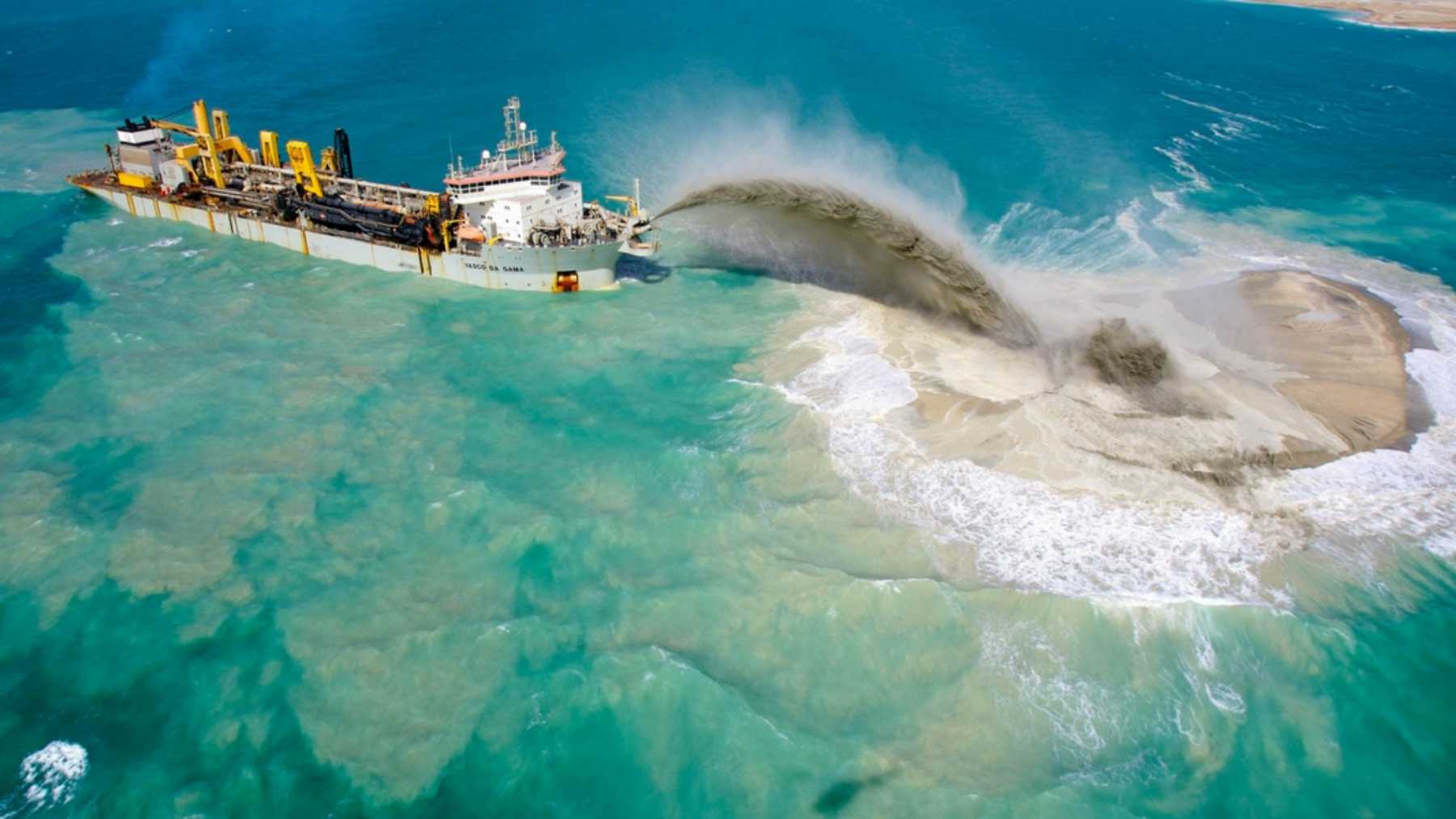
The clearest illustration is sitting off the coast of Dubai. The Palm Jumeirah, the palm-tree-shaped artificial island finished in 2006, was built almost entirely out of sand and rock, with no structural concrete in the reclaimed land itself. Putting it together took around 94 million cubic meters of sand, placed by GPS-guided dredgers using a technique called rainbowing, and that sand could not come from the desert a few miles inland. It was dredged from specific spots on the floor of the Persian Gulf where the grain size was right. Dutch and Belgian dredging firms ran the operation around the clock for years.
The Burj Khalifa tells the same story going up instead of out. The tower used roughly 330,000 cubic meters of concrete, and the sand in that concrete came from outside the UAE because the local dunes could not deliver the strength. And the Gulf is not slowing down. Saudi Arabia’s Vision 2030 megaprojects, including NEOM, the Red Sea developments, and Qiddiya, are some of the largest construction sites on the planet, each one hungry for exactly the angular, water-eroded sand the region does not have. The more ambitious the skyline, the longer the supply line standing behind it.
Fifty Billion Tons a Year, and the Gap Keeps Widening
Zoom out and the Gulf’s predicament is a sharper version of a problem the whole planet shares. In May 2026, the UN Environment Programme published the third edition of its Sand and Sustainability report, and the headline figure is hard to sit with: humans now pull about 50 billion tons of sand and gravel out of the Earth every year. That makes sand and gravel the most-extracted solid materials on Earth and, by the UN’s accounting, the second-most-exploited natural resource of any kind, behind only water. Demand for sand in buildings alone is projected to climb by as much as 45 percent by 2060. Nature replaces sand through erosion over geological time, far slower than we dig it out, and UNEP has a blunt term for the difference: the sand gap.
The report also draws a line between two kinds of sand that usually get lumped together. There is the sand that has been pulled out and locked into concrete, asphalt, and glass, gone from any natural system for good. And there is the sand still sitting in rivers, deltas, and coastlines, quietly filtering water, holding shorelines in place, and buffering storm surges. The two uses compete with each other, and dredging the living kind carries consequences that never show up on a construction invoice. “Sand is sometimes referred as the unrecognized hero of development,” said Pascal Peduzzi, who directs UNEP’s GRID-Geneva and coordinated the work.
That same material is the story hiding underneath a lot of what shows up on this site. It is the aggregate in the graphene-enhanced asphalt British engineers are testing to make roads last longer, the literal ground that traffic runs on. It is a close cousin of the crushed rock a Finnish town packed into a silo and heated to around 600 degrees as a sand battery, a reminder that the word “sand” covers wildly different materials doing wildly different jobs. The round grains in the Empty Quarter and the angular grains in an Australian quarry are both called sand, and only one of them can hold up a tower.
Why a Sea of Sand Still Buys Sand
The paradox of a desert nation importing sand gets passed around online as a fun bit of trivia, the kind of fact that sounds invented. It is not invented, and it stops being a paradox the moment you understand how sand actually forms. Wind makes beautiful dunes and terrible concrete. The same grains that make the Sahara and the Empty Quarter look endless are the grains that will not bond to cement, and no amount of having them changes the chemistry. So the Gulf keeps shipping in sand from rivers and quarries half a world away, the global tally keeps climbing toward and past 50 billion tons a year, and the most ordinary material imaginable keeps quietly turning into one of the stranger supply problems of the century.