
Blowing up a pair of coal plant chimneys is always going to draw a bigger crowd than a battery passing a reliability test. When AGL brought down the two 554-foot stacks at its old Liddell power station in Australia on May 26, dozens of current and former workers watched from across the lake, and about 6,000 more people tuned in live on YouTube, according to Renew Economy.
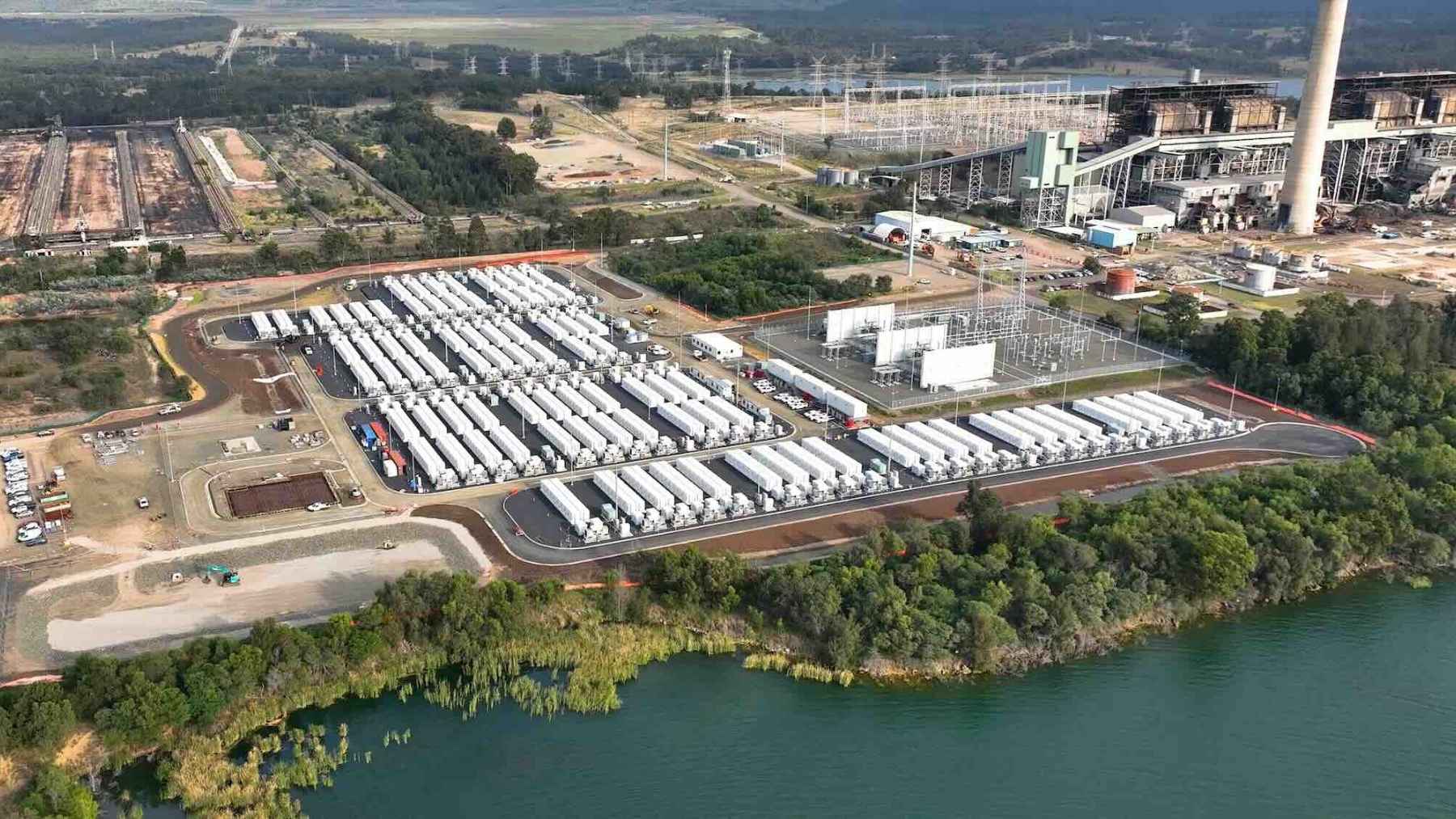
The news that came out of the same site this week won’t get anywhere near those numbers, but I’d argue it matters more. AGL says the Liddell Battery, a 500-megawatt, 1,000-megawatt-hour system in the Hunter Valley of New South Wales, is now fully operational. It finished its final reliability testing on Tuesday, September 15.
So what does 500 megawatts actually get you?
Think of it like a car. Megawatts are the horsepower, meaning how hard the battery can push at any one moment, and megawatt-hours are the size of the gas tank. Liddell can run flat out at 500 megawatts for two hours before it’s empty, and the figure that’s been attached to the project since March is about 200,000 homes for that stretch.
Liddell ran a few months behind schedule
AGL started commissioning the first 250 megawatts in March and said at the time it expected full commercial operation by June. Part of the battery did go into commercial service in June. Before the rest could follow, the Australian Energy Market Operator and Transgrid, the company that runs the state’s high-voltage lines, both had to approve how it behaves on the network, and then it had to get through that last round of reliability tests.
I can’t give you an exact date for that approval. Renew Economy says AGL put it at the end of July, while the Newcastle Herald reported it came in late August.
Still, June to September is a pretty mild miss by big-battery standards. The 850-megawatt Waratah Super Battery, also in New South Wales, was still waiting last week to have its full-power tests verified, more than a year behind its original schedule, after one of its transformers failed.
So why build a battery at a dead coal plant?
Mostly because the wires are already there. Liddell’s four coal units were rated at 500 megawatts each, and the plant fed the grid through a 330,000-volt switchyard next door. AGL shut the last of those units down in 2023, after 50 years. The switchyard didn’t go anywhere, and the battery plugs into it through an overhead line just under 1,500 feet long. When AGL chief executive Damien Nicks explained in March why the site made sense, the grid connection was the first thing he listed, ahead of water and land.
That’s arguably the smartest thing about the whole project. Hooking anything big up to a grid is slow even when the hardware’s in place, and if you’ve followed an American solar farm stuck in an interconnection queue, you already know how long that can drag on. AGL’s own grid connection report shows it took about 21 months to get from its connection application to having the battery registered with the market operator. And that’s at a site that already had the wires. I’d hate to see the timeline for one that didn’t.
The battery’s 500 megawatts is a quarter of the 2,000 the coal plant could make, and it runs dry after two hours. Its job is to soak up power when wind and solar are plentiful and send it back when demand peaks, which is usually in the evening.
It also sits right next to Bayswater, another AGL coal plant that’s still running and isn’t due to close until 2033. When the Liddell stacks came down in May, AGL held off until the wind was blowing away from both Bayswater and the new battery. Waiting on the wind seems like a pretty sensible precaution when each chimney’s getting 573 pounds of explosives.
What’s a grid-forming battery, then?
Liddell’s also one of the first batteries this big on Australia’s main grid to run in what engineers call grid-forming mode, according to the report. Grid-forming takes a little explaining.
Coal, gas and hydro plants spin enormous generators that are locked in step with the grid. All that spinning metal works a lot like a heavy flywheel on an engine, and if you’ve driven a car with one, you’ll know the revs don’t want to drop when you come off the gas. When a big power plant suddenly trips offline, that momentum resists the change and buys the rest of the system a little time before the frequency drops too far.
Most batteries and solar farms don’t have that. Their inverters, the boxes that turn a battery’s DC power into the AC the grid runs on, follow the grid’s rhythm instead of setting it. Liddell’s 172 inverters run software that makes each one act like a virtual spinning generator, setting its own voltage and frequency and reacting instantly when something on the network goes wrong. It’s basically a software impression of the machines Liddell used to run.
AGL also did something that sounds wasteful at first. It runs each inverter at about 86% of its rating in normal operation, so there’s spare current on hand to hold up the voltage when there’s a fault on the grid. The report admits that’s more expensive up front. Frankly, a bit of over-engineering seems like the right call on something plugged into a whole state’s power supply.
The catch is that the report only covers computer modeling. AGL published it through ARENA, the federal agency that put A$35 million into the project, and wrote it before the on-site grid testing started. It says field results will come in a later report, and I haven’t been able to find that one yet.
Liddell was the last of four
Liddell’s the final project to come online from the second round of a New South Wales program that hands out long-term contracts for what Australians call firming capacity. That’s basically anything that can fill in when the wind drops or the sun goes down. The other three were already up and running.
Orana, which we covered when its 448 Tesla Megapacks hit full output, stores 1,660 megawatt-hours to Liddell’s 1,000 but can only push 415 megawatts at once to Liddell’s 500. It’s horsepower versus gas tank again. The Enel X virtual power plant basically pools customers who can cut or shift their power use when the grid needs it.
New South Wales Energy Minister Penny Sharpe said in a statement that the four of them together can cover peak demand for about 400,000 homes. She added that they’ll be “helping keep the lights on during the hot summer to come.” Summer down there starts in December. The grid connection report rates Liddell at 500 megawatts at 104 degrees Fahrenheit and 463 megawatts at 122 degrees, so a scorching afternoon will cost it a little muscle.
AGL’s next one is already under construction. The 500-megawatt Tomago Battery, going up next to an aluminum smelter near Newcastle on the New South Wales coast, will hold four hours instead of Liddell’s two, and AGL is targeting completion in late 2027.