
Nobody spends two years getting ready for one day of work unless that day only gets one attempt.
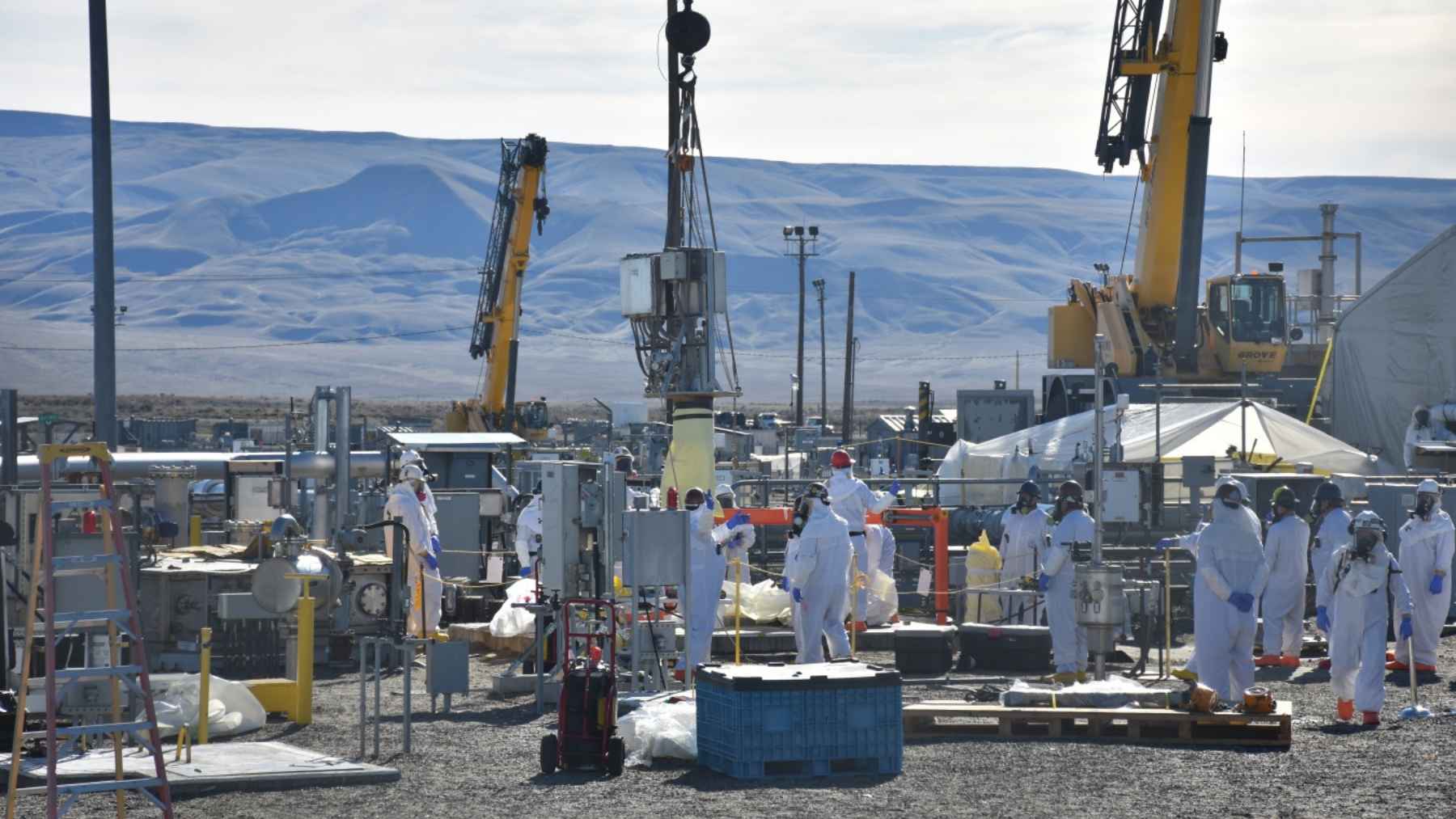
That was the setup at the Hanford Site in eastern Washington, where crews had to pull a mixer pump out of a tank of radioactive waste. The pump is about 50 feet long and weighs roughly 10 tons. It went into the tank in 1993 and stayed there, coated in the material it had spent three decades stirring.
The Energy Department announced the finished job on August 4, 2026, calling it one of the most technically demanding pump removals in the site’s history. Agencies say that sort of thing in press releases all the time. This one I think earns it, and the reason is which tank it came out of.
SY-101 used to burp
Some background, because this tank has a reputation.
If you have ever heard someone call Hanford the most contaminated place in America, SY-101 is a decent chunk of the reason why.
Hanford made plutonium for the American weapons program starting in the 1940s, and separating that plutonium out left 56 million gallons of radioactive and chemical waste in 177 underground tanks. 149 of those tanks have a single steel shell. 28 have two. Tank SY-101, out in the 200 West Area, is one of the double-shell ones.
SY-101 was filled in 1980 and turned into the most notorious container on the site. Chemistry and radiation in the waste generate gas, mostly hydrogen with some methane and ammonia along for the ride. In most tanks that gas works its way out on its own. In SY-101 the sludge at the bottom was thick enough to trap it, and eventually the trapped gas made that whole layer buoyant, so it floated up and let go all at once.
Crews called them burps. They arrived every few months. Some of them dumped enough hydrogen into the air space at the top of the tank to push it past its flammability limit for a few hours, which is how one tank ended up as Hanford’s headline safety problem for most of a decade.
Hanford’s answer went in during 1993: a jet mixer pump, adapted from a spare belonging to the site’s own grout program and lowered into the tank that July. Instead of waiting for the sludge to build up a charge and release it in one shot, the pump kept solids in suspension so gas came off continuously. The big episodic releases stopped.
The tank then found a second way to misbehave, growing a surface crust through 1997 and 1998 that stored gas on its own account, which forced another round of waste transfers and dilution between December 1999 and March 2000. Chuck Stewart, who wrote the Energy Department’s own history of the tank, puts the price of the entire SY-101 fight at as much as $250 million and dates the tank’s clean bill of health to January 2001.
So the pump won. And then it sat in there for another quarter of a century.
So why pull it out now?
Because it is in the way.
Hanford’s retrieval work has concentrated for years on the 200 East Area, where the largest and most radioactive volumes sit. The 200 West Area has seven tank farms and has never seen retrieval at scale. DOE said in April that crews are building the infrastructure out there more or less from scratch, including ventilation upgrades, new support buildings for SY Farm, and testing on a seven-mile pipeline that connects SY Farm to 200 East so waste can be moved if it needs to be.
SY Farm is the only double-shell tank location in 200 West, which makes it the staging ground for the rest. The next generation of retrieval equipment is supposed to go into SY-101. A 50-foot pump hanging through the riser meant there was nowhere to put it.
Andy Wiborg, who directs the Tank Farm Programs Division at DOE’s Hanford Field Office, said the pump had served its purpose and was “standing in the way of future work in SY Farm.”
Hercules pulled it, a robot drained it
Hanford Tank Waste Operations & Closure, the BWXT, Amentum and Fluor joint venture that runs the tank farms, built hardware specifically for this one job.
Start with the lift. The crew designed a hydraulic lift system, nicknamed Hercules, to break the pump loose from where it had settled and start it moving under control instead of hauling on it. Dustin May, the contractor’s project manager, told ENR that the size, the weight and the installation location all contributed to the difficulty, and that the removal was designed in phases with multiple size-reduction steps and a preliminary heavy lift to free the pump from its installed position.
How much can Hercules lift? I can’t tell you, because I have not found a published rating for it anywhere.
Washing came next. As the pump came up, jets on a cleaning system sprayed high-pressure water at it, stripping waste off the assembly on its way through. Everything that came off went back down into the tank, which is the entire point of doing it there rather than up top.
Then there’s the problem I would never have thought of, and you probably wouldn’t either. A pump that has been sitting in tank waste is also full of tank waste, so lifting it out means lifting a sealed 50-foot tube with liquid trapped inside it. The team’s answer was a robotic multi-tool that could “drill, hole punch, shear and roto root the pump as it was removed from the tank,” according to contractor project engineer Peter Griffin. Those holes let the free liquid drain back down as the pump rose. Nobody was standing over any of it, either, because Griffin describes the working environment as inaccessible to personnel, so operations ran remotely or through robotics from a safe distance.
Machines doing the jobs people cannot get near is standard practice in this industry now, from this multi-tool to the 4.6-ton robotic arm Japan folds through a 22-inch hole at Fukushima. The difference is scale, since Fukushima’s arm goes in after samples measured in fractions of a gram and Hercules was pulling 10 tons.
The rehearsal was most of the job
Before any of this went near the tank farm, crews assembled the real equipment into a full mock-up at HiLine Engineering & Fabrication, a DOE subcontractor in Richland, and ran the sequence until the order of work and the radio traffic both made sense. May credits the mock-up with sorting out exactly that.
Griffin’s team spent ten months designing the removal, ten more on planning and fabrication, and four months in the field, all for an operation that took one day.
That ratio looks ridiculous written down, and it is also pretty much the method. You cannot practice on the actual tank.
DOE says the pump came out and was packaged for disposal with no contamination issues and no operational upsets. Lisa Meredith, a field work supervisor for the contractor, told the American Nuclear Society that “we’ve been waiting for this day for a very long time.” Hanford is also where America’s biggest retired radioactive objects already go, including the 1,020-ton reactor vessel that came up the Columbia on a barge in 1999.
The waste still has to go somewhere
All of this is groundwork for the West Area Risk Management System, a modular treatment setup DOE wants to use in 200 West after proving the technology in 200 East. DOE’s own description of the pump removal ties it to eventually grouting 200 West tank waste, and grout is where the argument starts.
Under a 2025 agreement with Washington State and the EPA, low-level waste from 22 tanks can be treated, mixed into cement and shipped to disposal sites in Texas and Utah rather than turned into glass at the site’s $20 billion vitrification plant. DOE wants to expand that. Washington’s Department of Ecology signed the agreement and has been publicly cool on the expansion, with agency head Casey Sixkiller arguing it would pull staff and money off other priority work without treating more tank waste. The Government Accountability Office priced the grouting route in a May report at $480 million to $1 billion for roughly 24 million gallons, before transportation and disposal.
What I like about the pump story is that none of that argument reaches it. Whether the waste in SY-101 ends up as glass or as cement, something has to physically pull it out of the ground first, and until this summer that job was blocked by a machine installed to stop the tank from burping. A machine, as it happens, that started out as a spare from Hanford’s grout program.
The Energy Department announced the finished removal on August 4, 2026. The space that 50-foot pump used to occupy is where the retrieval equipment goes next, and the agency is taking public comment on its two grouting permit requests until October 9.