
Most drones don’t handle contact well. Clip a doorframe with an off-the-shelf quadcopter and you’re ordering replacement props by lunchtime. So when the Department of Energy needed to fly inside concrete vaults in Idaho that hold high-level radioactive waste, it went with a machine that’s built to bounce off walls and keep flying. On August 11, DOE said the approach worked: the drone’s laser scans filled in blind spots the fixed scanners couldn’t see, and engineers now have a complete 3D map of a vault’s insides.
The flights were run by Idaho Environmental Coalition, the cleanup contractor at the Idaho National Laboratory Site, and the haul came to several hundred million individual measurements. The fixed scanners had already delivered razor-sharp point clouds, but a laser mounted in one place always leaves shadows. The drone scanned along its entire flight path instead of from one spot, and the two data sets together gave the project a full picture of a bin set’s interior without a single person going in.
So what’s down there that’s worth all this trouble?
The vaults hold 155,000 cubic feet of nuclear waste
The stuff’s called calcine, and it’s basically radioactive sand. Decades ago, the government recycled used nuclear fuel at this site, and the liquid waste left over got dried down into granules. Those granules went into stainless steel bins, and the bins sit inside six concrete structures that look like silos, holding about 155,000 cubic feet (4,400 cubic meters) of the stuff between them.
Under a 1995 settlement with the state, DOE has to retrieve all of it, package it and get it out of Idaho by 2035. Nobody’s going in with a shovel. The radiation rules out human entry entirely, which is why every step of this project runs on machines: scanners, drones, and eventually a welding robot.
You may be wondering why they can’t just work off the construction drawings. The vaults date to the 1960s, and the original blueprints never had the detail needed to plan where equipment goes. Before anything cuts into a bin, someone has to know exactly what the inside looks like.
Why not just lower a scanner in?
They tried that first. According to Flyability, the drone’s manufacturer, the team once lowered a handheld lidar unit into a vault on a tripod, and the resulting map had gaps. A laser can’t see around corners. Park it in one spot and every pipe between the scanner and the wall throws a shadow, the same way your hand blocks a flashlight beam, so anything behind an obstruction just doesn’t exist in the data.
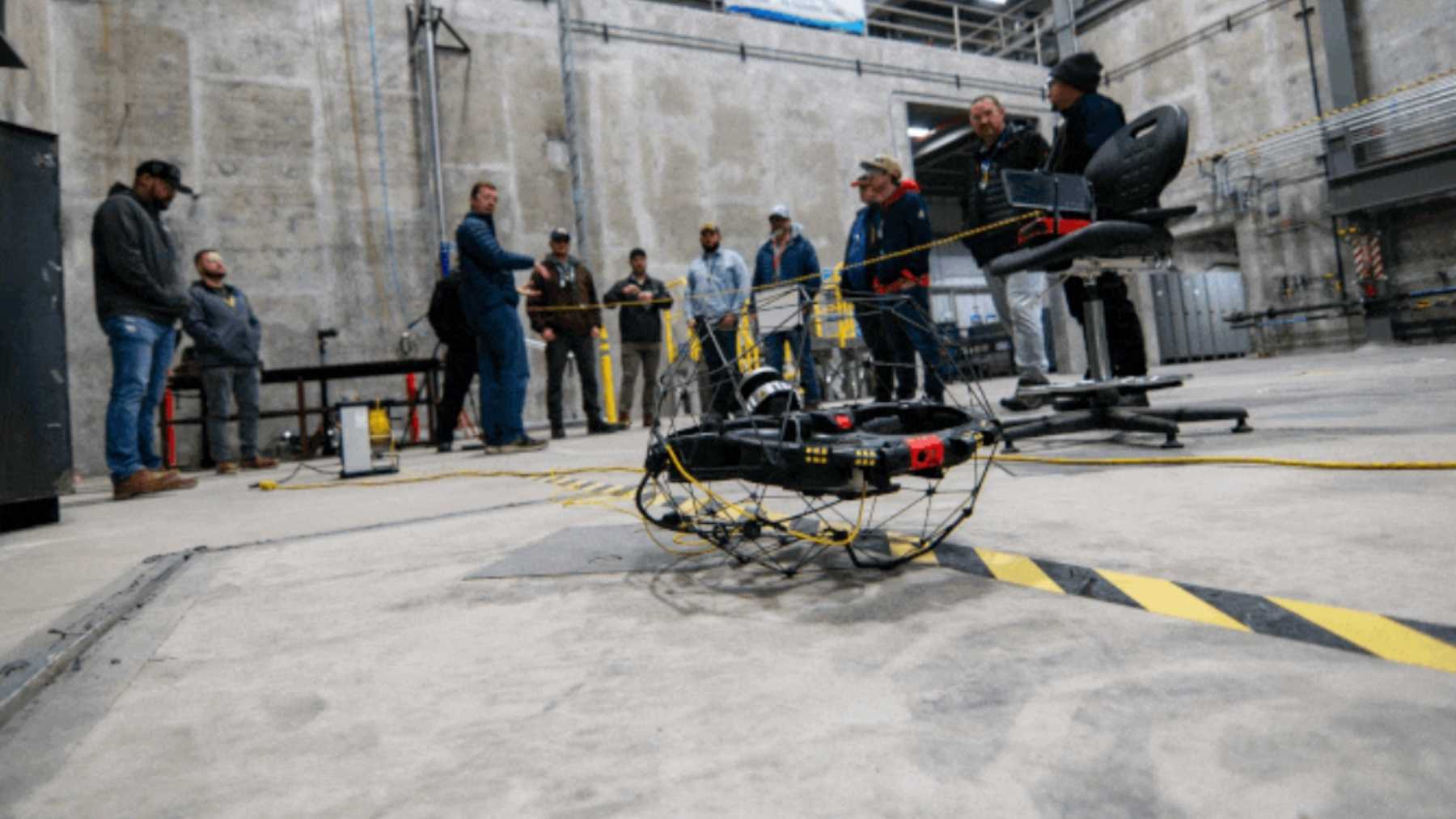
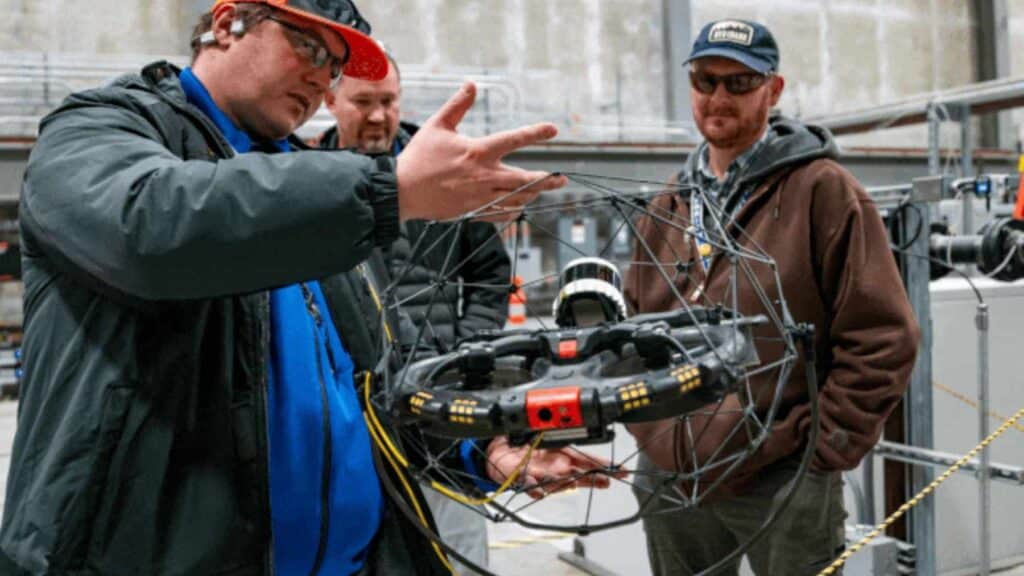
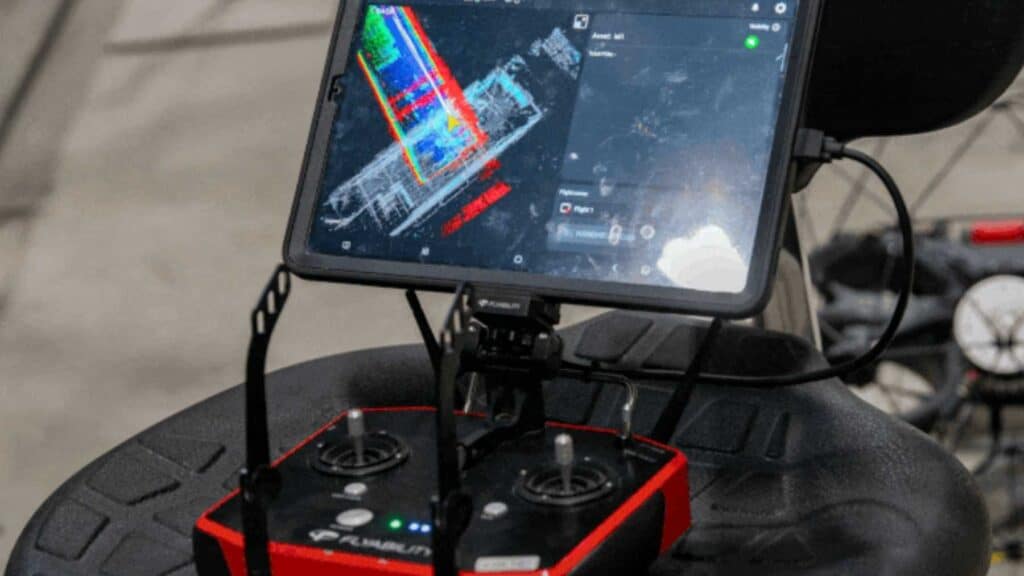
The drone gets around that by moving. It’s an Elios 3, a caged inspection drone that tolerates bumping into structures, carries lights rated at up to 16,000 lumens on the maker’s spec sheet, and it’ll fly up to 12 minutes on a battery. Before these flights, the team put an upgraded version through its paces at a full-size copy of a bin set, with an optional power tether, bigger battery packs and a new lidar unit that scans 25 times faster than the previous one. DOE says the data comes back with subcentimeter accuracy, which is frankly a wild spec for something that’s flying around a radiation field in the dark.
“Some of the biggest risks and schedule impacts to a project are the unknowns,” Valerie Kimbro, the contractor’s senior project manager, said when DOE announced the upgraded drone in March.
So why do the maps need to be this good?
Because a robot’s going to read them. The contractor’s engineers are developing a robotic welding system, and the machine needs exact bin geometry, where every weld goes, and clearance to move. The scans feed directly into designing its weld paths, 3D-printing custom fixtures for it, and validating the whole operation before it ever touches a real bin. Robots doing remote nuclear work is a growing field, and Japan has been down a similar road with the robotic arm built for Fukushima.
One of the six bin sets has a design problem: as built, there’s no way in. Crews have to install a pipe nearly 20 feet long and 8 inches across, which DOE calls an access riser. The robot welds that pipe onto the bins, then swaps its welding gear for cutting equipment and cuts an opening right where the pipe was just attached. The order matters, presumably so there’s a sealed path in place before anyone breaches a bin full of high-level waste. From there, the plan Flyability described has the calcine getting sucked out pneumatically through the pipes, pretty much the most serious vacuum job we’ll ever write about.
I went looking for a date on the robot’s first weld inside a real vault and came up empty. DOE hasn’t published one, and it hasn’t said which of the six bin sets got scanned in this round either.
The first drone is still down there
This project has history with drones. In late 2022, the team flew an Elios 3 into one of these vaults, the first drone flight anyone had ever made inside a vault storing high-level nuclear waste, as far as DOE knows. Around 50 people worked that mission, a crane lifted the concrete cover, and a tent went up over the opening so the flight would count as indoors under FAA rules. The first flight lasted seven minutes and collected every lidar point the team needed.
Then came a third, experimental flight with a radiation dosimeter strapped on. The extra weight was apparently too much. The drone couldn’t hold altitude, came down slowly onto the top of a bin, caught on a length of angle iron, and the crew couldn’t shake it loose. Before its battery ran out, it sent back one final reading: 7 grays per hour, or 700 rads, measured from where it sat on the bin. You don’t argue with a reading like that, and it’s exactly why the entire retrieval plan keeps every person outside the vault.
Experts reviewed the situation and concluded the stranded drone can stay where it is without endangering anyone or the bin under it. So it stayed. It’s up there right now, arguably the longest-serving piece of equipment inside the vault.
The new scans mean the stuck drone’s successors did their job, and the project moves on to welding, cutting and retrieval. Getting the waste out of the vaults still leaves the problem of getting it out of the state, and Idaho is already preparing rail equipment built for exactly that kind of cargo. DOE’s deadline hasn’t moved either way: under its 1995 settlement with the state of Idaho, every grain of calcine has to be packaged and out by 2035.