
Most of the heat American industry runs on starts as a flame. Cement kilns, mineral roasters, the furnaces that cook raw ore into something a battery plant can actually use, all of them are a burner with a pipe attached. Sunlight has never been much of an answer for that crowd, because concentrated solar plants were built to run steam turbines and top out well below what a kiln wants.
So GE Aerospace Research spent three years building a ceramic part about a foot and a half across to find out whether that still has to be true. Sandia National Laboratories built a test rig around it, put it on the solar tower outside Albuquerque and aimed mirrors at it.
The face of that ceramic reached 2,534 degrees Fahrenheit, and the air coming out the back of it left at 1,562.
So which of those two numbers does anyone actually care about?
The air. A cement plant or a lithium processor is buying a hot gas stream it can pipe into a process, and nobody in that business writes a check for how bright a part was behind a window. The Department of Energy knew which figure counted when it wrote the test up on July 8, 2026, because it led with 850 degrees Celsius, or 1,562 Fahrenheit, of delivered air and mentioned the surface temperature second.
So what is HOTSSTAR, exactly?
The name stands for ultra-High Operating Temperature Silicon Carbide matrix Solar Thermal Air-Receiver, which is the sort of acronym you get when a project title has to survive a grant review. GE designed it at its research campus in Niskayuna, New York. The Department of Energy’s Solar Energy Technologies Office put in $2.6 million against $900,000 of company cost share.
The shape is the interesting part. Air goes in around the rim, runs inward through a ring of silicon carbide sectors that preheat it on the way, and finishes at a central absorber sitting where the concentrated sunlight lands. Kamala Raghavan, the Department of Energy technology manager who oversaw the work, told SolarPACES that the preheater wedges and the central unit are assembled rather than cast as a single piece, which means the design grows by adding sectors instead of by printing one enormous disc.
Every one of those pieces came out of a printer. Binder jet printing spreads a thin bed of silicon carbide powder, glues one cross section of the part into it with a liquid binder, then drops the bed a fraction of an inch and does it again, so the component grows a layer at a time inside a box of loose powder. Molten silicon gets wicked into the printed skeleton afterward to fill the gaps and bond it into something solid. GE then laminated the finished parts with the same silicon carbide ceramic matrix composite that goes inside its jet engines. That material has been coming out of GE’s shops for years, and the solar receiver borrowed it. Metal alloys are what solar receivers normally get built from, and silicon carbide is the reason this one could go past where those alloys stop.
The air came out at 1,562, and the ceramic behind it sat at 2,534
A Sandia team led by Ken Armijo ran the module on-sun at the National Solar Thermal Test Facility and measured 1,390 Celsius, or 2,534 Fahrenheit, on the receiver. DOE put the surface at close to 1,400 Celsius, or 2,552 Fahrenheit, in its July write-up. The air left at 1,562 Fahrenheit, or 850 Celsius.
GE and Sandia were funded to get that air to 1,100 Celsius, which is 2,012 Fahrenheit.
It landed 450 Fahrenheit degrees short.
I’d call that a more useful result than a photograph of something glowing, and to their credit the team reported it as what it was. GE and Sandia signed up for a feasibility demonstration of materials, design, fabrication and testing, and they showed that a printed lattice of silicon carbide holds together through several hours of concentrated sunlight without coming apart. If you are shopping for industrial process heat, though, you are shopping for the gas stream, and this gas stream came in under target.
Aiming the mirrors took Sandia two days
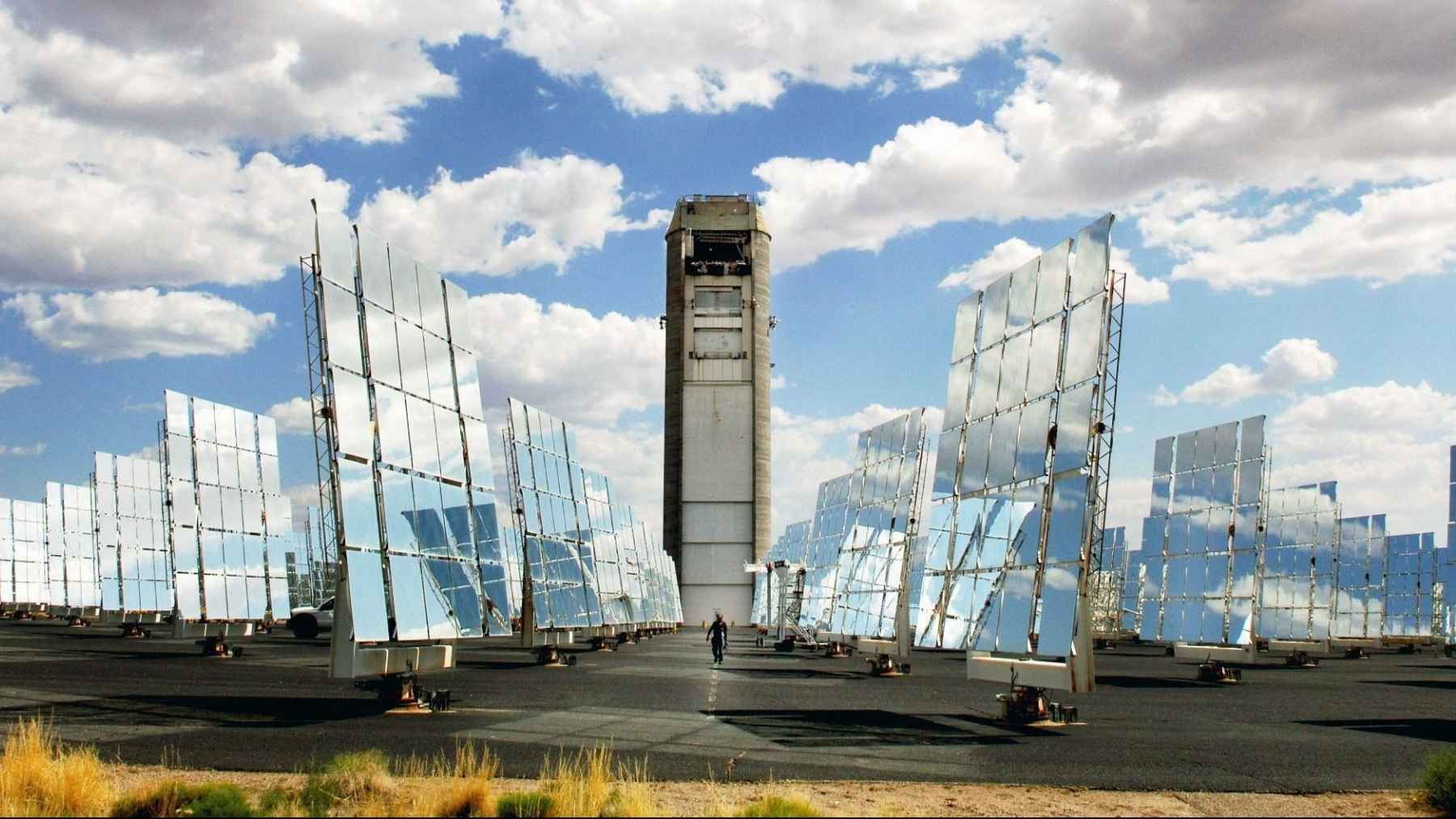
That receiver measured roughly 18 inches across. Hitting something that small from a field of mirrors is harder than it sounds. Sandia’s tower has been standing since 1978 with 218 computer-controlled heliostats around it, good for 6 megawatts of thermal power and a peak flux of 300 watts per square centimeter, and HOTSSTAR needed better than 200 watts per square centimeter landing on a disc the size of a large pizza.
“The accuracy is in millirads,” Raghavan told SolarPACES.
Sandia’s researchers spent two days getting the flux profile right, and an aim that missed by enough would have wrecked the part instead of heating it. If you have ever tried to keep a magnifying glass steady on one spot of a leaf, you have done the same job with one mirror rather than dozens of them, and you probably burned the leaf.
Sandia has been running the other bet in this argument on the same patch of desert for years, where a curtain of ceramic beads falls through the beam at 1,472 degrees instead of air moving through a printed lattice. Europeans have been pushing sunlight to extremes for even longer at the French furnace that has been melting tungsten since 1969. Neither design makes a watt of heat until the mirrors are clean and aimed, and that is why solar sites now hire robots that brush the glass dry after dark.
So what happens to it now?
Nothing immediate. Raghavan says no further work is currently funded to scale the receiver up. Three years took HOTSSTAR from technology readiness level 3 to level 5 on the government’s 9-point scale, and process industries generally want to see something near level 9 before they buy, which leaves a fairly wide canyon between a 50-kilowatt test module and a receiver bolted to a working plant. Her office funds research and feasibility work, and she has said the next move belongs to concentrated solar companies and to the process industries themselves.
Getting this far took some improvising. Heliogen, the American concentrated solar startup that signed on as industry partner in 2022, went under, according to SolarPACES, and DOE found the team a testing partner in Sandia rather than shelving the project. GE wanted the silicon carbide work for other applications anyway.
One number I cannot find anywhere in the public record is a solar-to-thermal efficiency figure for the module, and that figure decides whether any of this pencils out against a gas burner. Neither GE nor Sandia has published one, and until somebody does, the honest description of HOTSSTAR is a materials result rather than an economic one.
Germany’s DLR is the only other group Raghavan names with a ceramic receiver tested this hot, so the Americans are not out there alone. GE and Sandia’s performance evaluation of the 50-kilowatt module sits in the Department of Energy’s OSTI research archive as an ASME conference paper, DOE published its own account of the test on energy.gov on July 8, 2026, and SolarPACES published Raghavan’s account of the finished program on August 22, 2026.