
Deserts are just about the perfect place to put solar panels. The sun barely takes a day off, land is cheap, and there’s not much standing around to cast a shadow. They’re also the single worst place on the planet to keep anything made of glass clean, and the traditional fix, washing it with water, runs into the obvious problem that you’re in a desert.
The industry calls the dirt problem soiling, and it’s not a rounding error. Annual energy losses from dirty panels run around 7% in parts of the US and can reach 50% in dusty regions like the Middle East, according to the National Renewable Energy Laboratory. After a single dust storm, losses can spike as high as 80%.
So the solar industry did something that sounds like science fiction and is actually just good plumbing-free engineering. It put fleets of autonomous robots on the panel rows themselves. They live up there permanently, wake up after dark, brush the glass dry, and park themselves back at the end of the row to recharge off their own solar panel. No water, no crew, no truck.
The dust doesn’t just sit there. It sets.
Here’s the part that makes desert soiling genuinely nasty. Panels cool down overnight and attract morning dew, and that little bit of moisture reacts with the minerals in the dust sitting on the glass. NREL calls the process cementation, and the name is not a metaphor.
“Once it goes through the cementation process, it can become much more difficult to remove to where even a strong rain won’t remove it,” says Lin Simpson, a senior scientist at NREL who co-led a $6 million Department of Energy research effort into soiling. His prescription is blunt: brush the dust off every day or every other day, before the dew gets to it.
Which immediately kills the traditional approach. A one-time cleaning of a 10-megawatt solar farm costs an estimated $5,000, per NREL. That’s one pass. The dust starts coming back the next morning, and nobody is sending a water truck and a crew into 110-degree heat every 48 hours.
Then there’s the water itself. Large solar plants tend to sit exactly where rain doesn’t, and researchers are literally testing whether a big enough solar farm can manufacture its own rainfall, which tells you how scarce the natural kind is out there. Hauling millions of gallons into that landscape just to rinse glass was never going to scale.
The robots live on the rows and only come out after dark
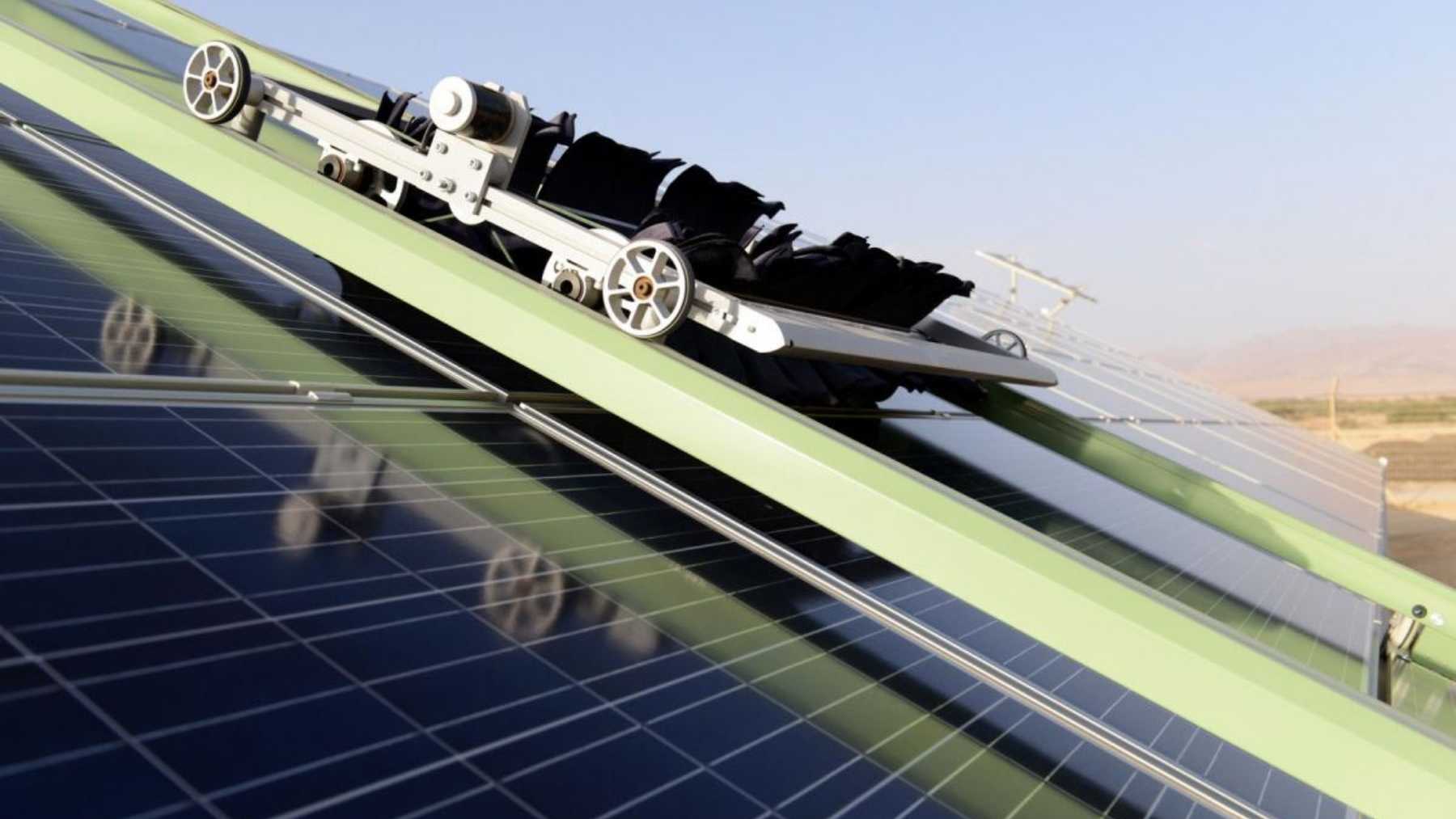
The machines that solved this don’t look like much. Picture a slim gantry that spans a row of panels, rides along the frame edges on small wheels, and carries rotating microfiber cylinders plus a controlled flow of air that pushes dust down and off the bottom edge. No liquid anywhere in the system. Each unit has its own small solar panel on top, so it charges itself during the day and works at night, when the plant isn’t producing and the dew hasn’t formed yet.
The biggest name in this business is Ecoppia, an Israeli company founded in 2013 that builds several versions of the machine. The T4 is a lightweight unit for single-axis trackers that can cross between neighboring rows over dedicated bridges using onboard sensors. The H4 cleans in a spiral motion the company calls Helix, works in both directions, and covers up to 2 kilometers of panels per robot. The firm says the machines remove about 99% of accumulated dust, and that nothing rigid ever touches the glass, just the microfiber.
If you want the peer-reviewed version of the concept, a team of Italian engineers published the design of an autonomous desert-cleaning robot in the journal Mechatronics: a half-tracked unit with two helical brushes spinning at opposite angles, ultrasonic sensors handling position and speed in real time. Different hardware, same conclusion. In a desert, cleaning has to be waterless, constant, and unmanned, or the math doesn’t work.
One important distinction while we’re here: these are not the same machines as the robot fleet that recently clamped down 100 megawatts of panels in the California desert. Those install. These maintain. The panels get bolted down once and then dusted roughly 10,000 times over their working lives, so if anything, the cleaning robots got the longer contract.
Fifteen billion panels, if you take the company’s numbers
The proving ground was the Middle East. One of the early flagship deployments was Ketura Solar, a 40 MW plant on the Israel-Jordan border jointly owned by EDF Renewable Energy and Arava Power. The site sits in the Arava desert next to dust-heavy farmland, gets hit by regular sandstorms, and sees virtually no rain. If a dry-cleaning robot was going to fail anywhere, it was there.
It didn’t, and the fleet went global. In 2021 the company completed an installation at an AES solar site in California, billed at the time as belonging to the largest private owner of operating solar assets in the US. That matters because California’s Central Valley is one of the places Simpson singles out, where soiling rates run high enough and rain low enough that frequent cleaning pays for itself. A 2023 deal with Matrix Renewables then took the robots to four plants in Spain and Chile, the Spanish sites being the company’s first in that country.
The cumulative numbers are the kind you have to attribute carefully, because they come from the manufacturer. Ecoppia says its fleet operates across more than 35 large-scale sites, has cleaned over 15.7 billion panels to date, and has saved nearly 1.8 billion gallons of water by never using any. Those are company figures, not audited ones. But even discounted generously, that’s a lot of glass wiped by machines nobody supervises.
Not every desert soils the same, and not every robot is gentle
Two honest footnotes before you conclude the problem is solved. First, soiling varies wildly by location, even within one desert. A year-long study across Chile’s Atacama measured annual energy losses peaking at 39% on the northern coast while high-altitude sites in the same desert lost 3% or less. So the “dust eats a third of your farm” scenario is real, but it’s a worst case with a specific address, not a universal rule.
Second, automated cleaning isn’t automatically harmless. A study by German testing house PI Berlin, reported by PV Tech back in 2015, found some automated cleaning solutions had the potential to damage module performance, though it made no reference to Ecoppia’s system. Ten thousand brush passes over 25 years is a durability question the industry keeps having to answer, which is exactly why the serious players lean so hard on soft microfiber and air instead of anything stiffer.
Still, step back and the picture is hard to argue with. Robots now put the panels in the ground, robots keep them clean for decades, and when the modules finally wear out, a plant in Georgia strips them back down to silver, copper and glass. Somewhere in the middle of all that, a small solar-powered machine finishes its nightly run across a dark field in the Arava, rolls back to its docking station, and starts charging for tomorrow. It’s the one shift in the energy business nobody ever calls in sick for.
 @richardweinstei ROOKIE2 months ago