
Most solar panels you’ll ever see are sitting on something flat. A house roof, a carport, a field with a few hundred sheep wandering around underneath. That works great on a ranch house. It’s a lot less useful on an office tower, where the roof is tiny next to the walls below it and a good chunk of it is usually spoken for by mechanical equipment.
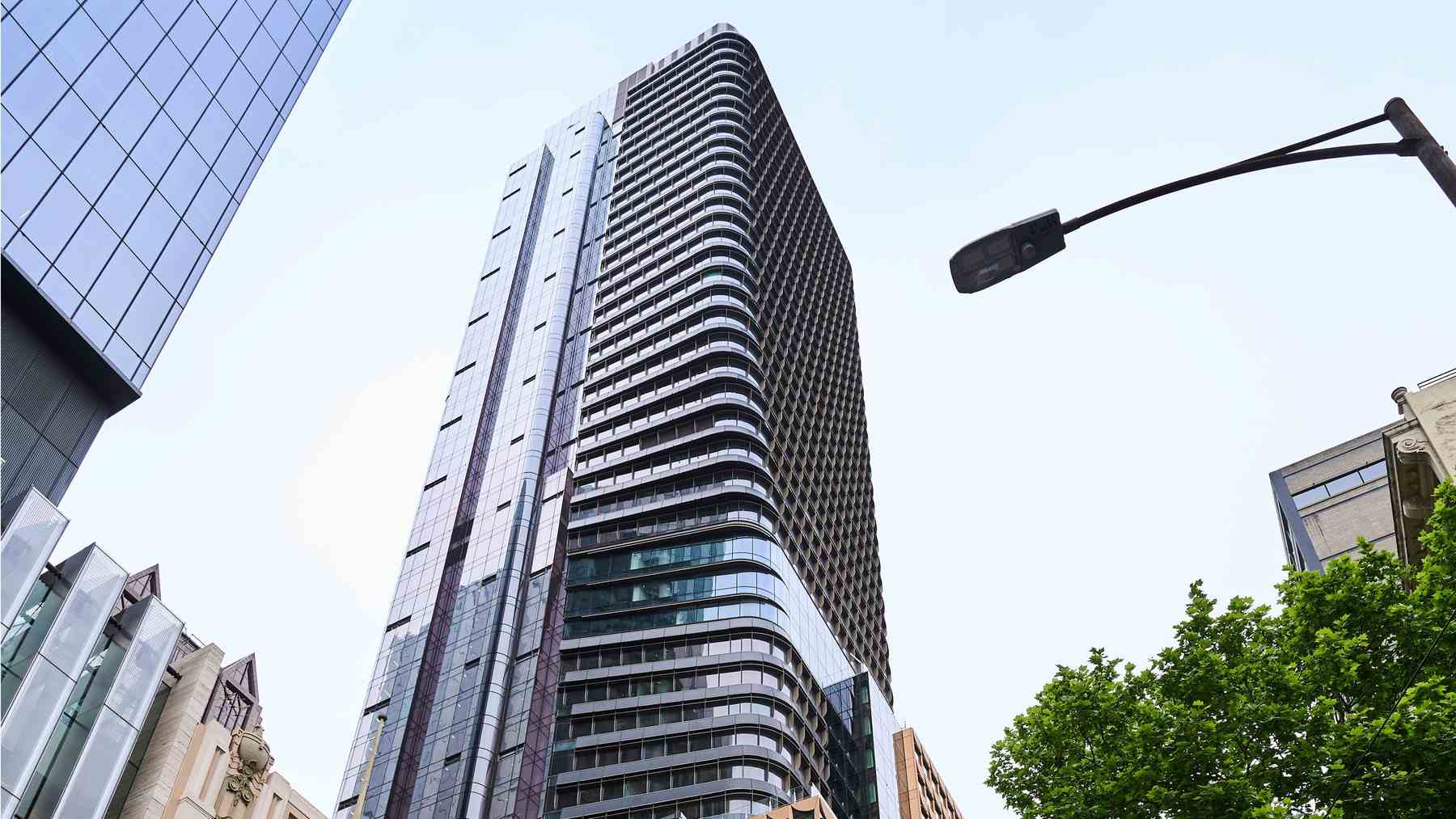
So a new office tower at 435 Bourke Street in Melbourne, Australia, went for the walls instead. Cbus Property, the developer, said on November 9 that installation had wrapped up on what it calls a “solar skin,” which is 1,391 solar panels spread across the facade, the crown and the rooftop of a 48-story building in the middle of the city.
Put together, the panels cover about 28,800 square feet and are rated at 375 kilowatts peak, according to Multiplex, the builder. Design modeling says they should supply up to 20% of the tower’s base building electricity once the system is switched on. The rest is meant to come from an off-site renewable energy deal.
If you’re wondering what “base building” means, it’s basically the landlord’s side of the power bill. Elevators, lobby lights, the big heating and cooling plant, that sort of thing. It doesn’t include the laptops, monitors and coffee machines tenants plug in on their own floors.
So is a fifth of the base load a lot?
Honestly, it’s a pretty modest share for something this visible. But you have to remember what you’re comparing it to. As far as I know, the vast majority of office towers make close to zero electricity on site, because a roof that small can’t hold enough panels to matter. Stacking them up the side of a building is pretty much the only way a skyscraper gets into double digits.
The panels are sunshades too
The architect, Bates Smart, calls the panels solar “leaves,” and its project page describes them as bifacial. A bifacial panel can make power from both faces. So on top of direct sunlight hitting the front, it can pick up light bouncing off the street and the buildings around it on the back.
In selected areas, the same panels also shade the office floors behind them. Cbus Property CEO Chris Kakoufas told pv magazine the facade works as a sunshade that keeps heat out, which in turn cuts the electricity the building needs for cooling. That’s a pretty neat double dip. The panel makes power and saves some at the same time.
I did some quick math with Multiplex’s figures, and the average panel works out to about 21 square feet and roughly 270 watts. A typical new rooftop panel is about the same size and is rated quite a bit higher. I’d assume that gap comes down to what these things have to be. Back when the tower was still a set of renderings, Bates Smart director Cian Davis described the skin as translucent, vertical glass panels, and a panel that has to let some light through and hang straight up is going to give up some output. Melbourne gets plenty of sun, but a vertical panel rarely faces it at the ideal angle.
Which is also why that 375-kilowatt figure is best read as a ceiling. It’s what the panels make together at full sun under ideal conditions, and a wall almost never gets those. Cbus hasn’t published an annual output figure in kilowatt-hours, and as The Good Builder pointed out, the 20% is modeled rather than measured. We won’t know the real number until the meters have run for a while.
Walls that make power are a bit of a headache
The tower itself is about 597 feet tall at its topped-out height, according to Build Australia, with roughly 667,000 square feet of office space inside. Getting 1,391 panels onto a shell like that wasn’t simple. Ross Snowball, Multiplex’s regional managing director for Victoria and South Australia, called it “one of the most challenging aspects of delivering the project.” BG&E, the engineering firm, apparently built mockups of the skin to try out before the job went out to tender, according to Cbus Super, the retirement fund that owns Cbus Property.
Then there’s the building code. The Good Builder, an Australian construction news site, dug into this. Australia’s National Construction Code generally wants external walls on offices three or more stories tall to be non-combustible. Solar modules aren’t. The plastic layers that hold the cells in place, usually materials called EVA or PVB, can burn, according to RMIT University research the site cited. So a solar panel on a facade has to pass as a wall and as an electrical product at the same time.
The usual way around that is something called a Performance Solution. It’s essentially an engineered case showing a product meets the code’s safety goals, even though it doesn’t check the prescriptive box. The Cbus announcement doesn’t get into which route this tower took. There’s also a firefighting wrinkle you might not think about: solar panels don’t stop producing while the sun’s up, and you can’t really switch off the sun, so the DC voltage on the wall stays live during an emergency.
Melbourne already has a smaller solar wall
Despite the “world’s first” language floating around, this isn’t Australia’s first building to make power from its own walls. 550 Spencer Street in West Melbourne, an eight-story office building designed by Kennon, has 1,182 facade panels, according to its architect, and was finished about two years ago. The Good Builder says the Bourke Street system has more than double that building’s reported capacity. Cbus itself goes with “one of the world’s first large-scale solar facades on a commercial office tower,” which is a more careful way of putting it, and frankly a fair one given the size gap.
We’ve covered a couple of other buildings that make power from their outer walls, like a Danish school skinned in 12,000 sea-green solar tiles and three towers at a BMW plant that got their solar film rolled on by hand. Neither one is an office tower, though.
Davis seems pretty confident it’ll catch on. Now that the tower has proven the concept, he told pv magazine, “I think you will see more like it.” He’s probably right, though I suspect the code paperwork will decide how fast that happens as much as the panels do.
Commonwealth Bank has already begun moving onto levels one through 11 after the first stage of the tower was finished in April, and Cbus says the full building is on track for practical completion late this year.