
When a city starts writing its press releases in all caps, you can safely assume the week isn’t going well. Pacifica, the coastal town just south of San Francisco, sent one out Wednesday evening telling residents and visitors to “STAY AWAY FROM OUR BEACHES.” Frankly, I’d listen.
That warning went out a few hours after the outer end of the Pacifica Municipal Pier fell into the ocean. By Friday, though, most of the work had moved back to the shoreline, to the seawall that runs along Beach Boulevard.
In an update Thursday, the city said its crews and contractors had filled one hole in that wall completely and gotten about 90% of a second one done during an overnight shift. While they were at it, a third hole got bigger. NBC Bay Area reported Friday that heavy equipment was still working along the wall and crews were still on the third one, but the city hasn’t said when it expects that repair to be finished. With more rain and another round of king tides in the forecast, that’s a pretty tight race.
So what’s a seawall void?
A seawall is basically a concrete barrier built along the top of the beach, so the waves hit it instead of the road, the sidewalk and the houses behind it. In Pacifica’s case, it’s what keeps the Pacific out of Beach Boulevard and the Sharp Park neighborhood.
A void is a hole that opens up in or behind that wall. Waves find a crack or a gap at the bottom, push seawater through, and pull the sand and soil behind the wall back out on the way down. Do that enough times and you end up with an empty pocket under the sidewalk, which is pretty much what the city described a few years back, when a void opened under the sidewalk next to the pier.
So why is a hole in a wall such a big deal?
Because the wall only works if there’s solid ground behind it. Once that ground washes out, the concrete has nothing holding it up, and the next big wave gets to hit dirt instead. That’s why the city’s been filling these as fast as it can, and why a void that grows overnight is a real problem.
According to CBS San Francisco, the worst of the damage is on Beach Boulevard by Sharp Park Beach, in the stretch between Santa Maria Avenue and Montecito Avenue. Parts of the wall collapsed there on Wednesday, and the city has fenced off and barricaded the damaged sections since then.
The pier was already closed
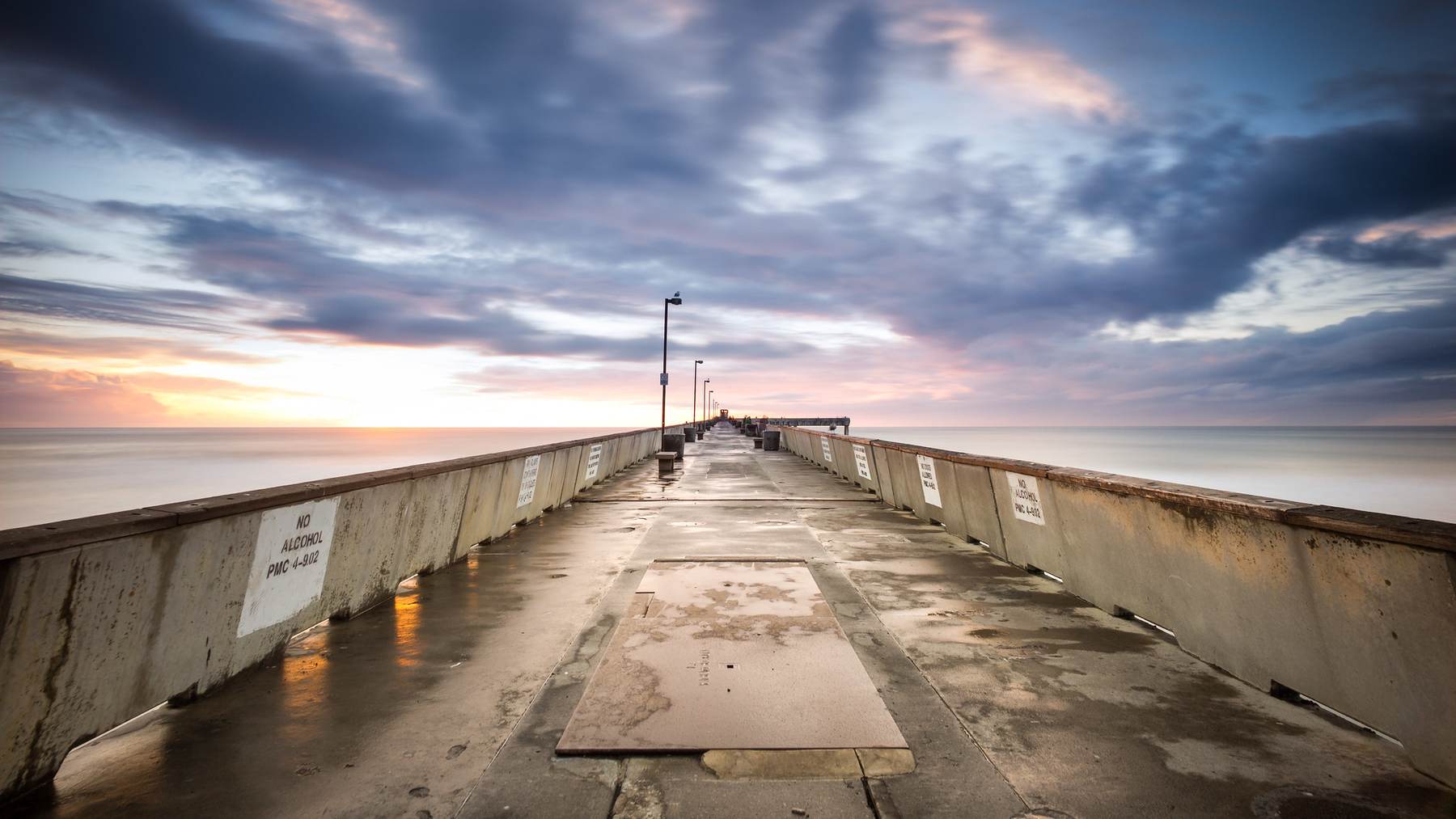
Here’s what fell. The Pacifica Municipal Pier is a concrete pier shaped like an L and standing on concrete piles. It’s 1,140 feet long (a bit shy of a quarter mile), and it’s been sticking out from Sharp Park Beach since 1973. According to the history on the City of Pacifica’s pier page, it was first built to hold up an outfall, a pipe that carried treated wastewater offshore. That’s presumably why it goes out so far. Anglers and crabbers have used it for decades.
The National Weather Service had a High Surf Warning out for the coast on Wednesday, with breaking waves of 20 to 30 feet, and the king tide peaked that same morning. At around 11 a.m., a wave slammed into the L at the far end, and the outer section buckled and went into the water. If you’ve seen the video, you know it doesn’t take long.
Luckily, no one was hurt. The city closed the pier back in June, after inspectors found the concrete cracking and shifting near its base, and it’s been off limits ever since. The Chit Chat Cafe that stood at the foot of the pier was torn down that same month.
If you’re not from the coast, a king tide is just the nickname for the very highest tides of the year. They show up a few times each winter, when the sun and the moon end up pulling on the ocean in the same direction, so the water is already sitting higher than usual before a single wave arrives. A National Weather Service forecaster told the AP on Tuesday that Wednesday’s Bay Area tide could peak 2.8 feet above normal. Stack 20- to 30-foot waves on top of that and the ocean basically gets a running start at the shoreline.
Pacifica wasn’t the only place those tides went after. Down in Orange County, the same week’s king tide washed out the railroad that runs along the sand in San Clemente.
The water got a long way inland
Water came over the wall and kept going. On Wednesday, the city closed every street west of Palmetto Avenue, and an evacuation warning went out for the Sharp Park Beach area. The San Francisco Chronicle reported Friday that seawater had poured into Clarendon Road, Paloma Avenue, Palmetto Avenue and Beach Boulevard every time the tide came in since Wednesday, soaking ground floors and crawl spaces as it went.
One resident, who gave NBC Bay Area only his first name, Andrew, said the water got within a couple of inches of coming into his apartment. His garage, laundry room included, took about 2 feet. A city worker told the Chronicle it was the worst flooding in more than 20 years on the job.
The damage isn’t confined to Sharp Park, either. At the north end of town, waves broke up a stretch of road next to the Pacific Skies Estates mobile home park, which the Chronicle identified, with some hedging, as Fourth Avenue. Someone answering the park’s after-hours line confirmed the road was damaged and closed, and city officials taped off the homes once parts of a nearby seawall started falling apart.
There’s also a detail in the state paperwork that I think is pretty relevant here. Back in June, when the pier started failing, the city moved about 300 big rocks (roughly 900 to 1,000 cubic yards) off the beach and piled them around the base of the pier to prop it up. Those rocks act as a kind of bumper in front of the seawall, soaking up some of a wave’s energy before it reaches the concrete. According to a public notice from the San Francisco Bay Regional Water Quality Control Board, moving them left that stretch of wall with less armor and raised the risk of waves topping it, erosion and flooding. The city asked to bring in about 300 new boulders, and the Chronicle says the regional board gave that work the go-ahead starting Nov. 16. The city’s pier page said on Nov. 13 that the contractor had started mobilizing and expected to finish all 300 boulders by early December, which suggests the work was still under way on Wednesday.
So what happens to the pier now?
We don’t know yet. Pacifica hasn’t put a price on fixing or replacing the pier, and it hasn’t said how long any of that would take. City officials say engineers are inspecting what’s left and that the city is working with local, state and federal agencies on next steps.
Right now, the beach and the water near the pier are closed, along with what’s left of the pier itself. The city has also warned that debris from the collapsed section is probably sitting underwater where you can’t see it, and that it can move around every time the surf does. Which means that even if the sun comes out this weekend, you’ll want to skip the beach.
San Mateo County Supervisor Ray Mueller told the Chronicle this week was a “dress rehearsal” for December and January, which probably isn’t what anyone on Beach Boulevard wanted to hear. The next set of big waves is due Monday, Nov. 30, according to the Chronicle, and it’s expected to be smaller than Wednesday’s.