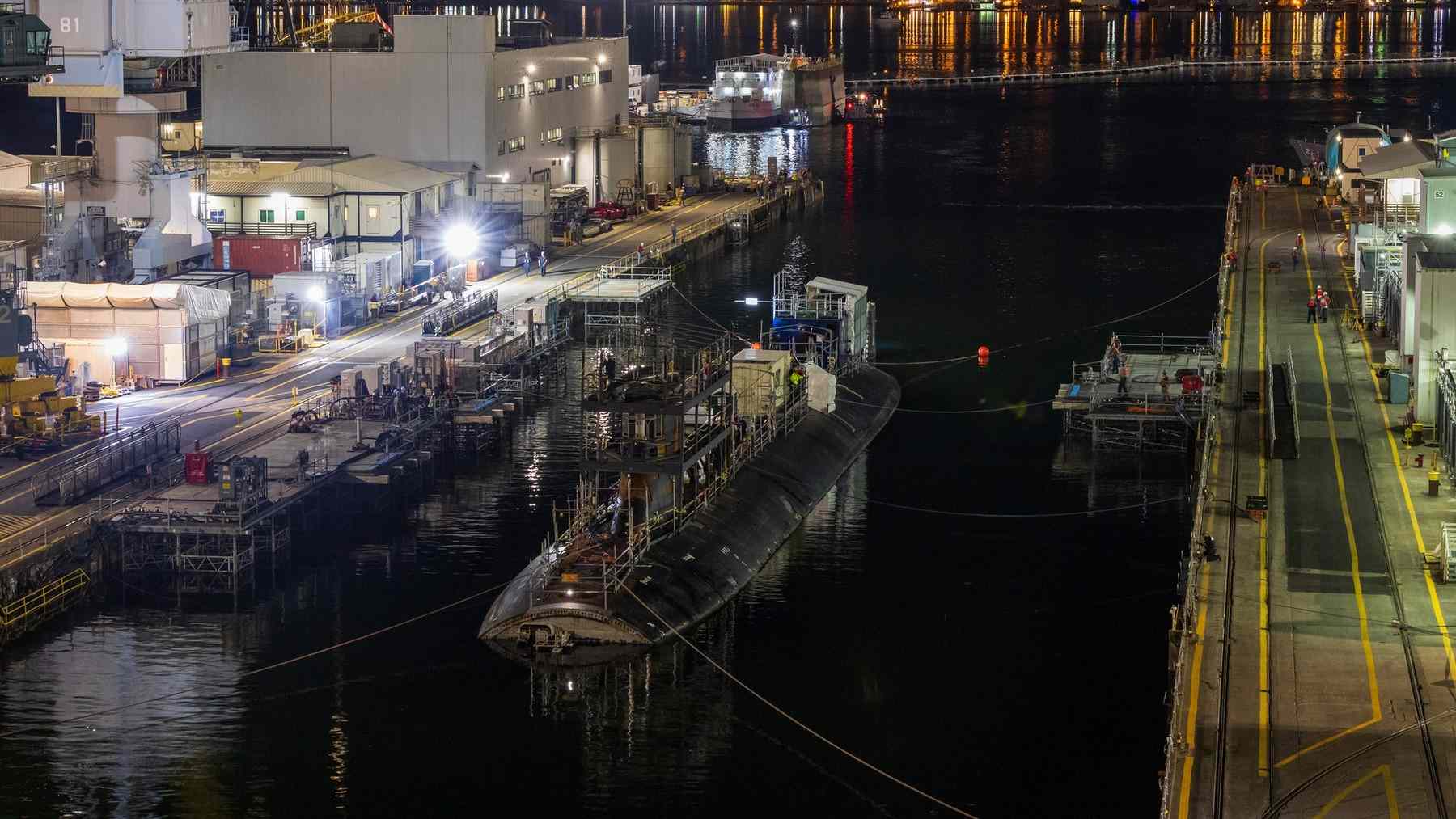

We’ve known for a while that USS Connecticut isn’t going anywhere in a hurry. The Seawolf-class attack submarine has been back in Bremerton, Washington, for nearly five years, and when we went through her repair delays in October, the missing nose looked like a pretty obvious reason why. The Navy’s own budget paperwork says a new bow dome for a Seawolf takes more than three years to get.
Apparently that’s not how it went for Connecticut. Janicki Industries, a company based in Sedro-Woolley, Washington, told TWZ it needed about 10 months to build the sub’s replacement sonar dome, and that the Navy took delivery in 2024. The Navy had been planning on roughly three years.
So if the nose has been done for a while, why is the boat still sitting in dry dock?
So what is a bow sonar dome?
It’s basically the submarine’s nose cone. Right at the front of the hull sits a huge ball of sonar sensors, and on a Seawolf that array is 24 feet across. The dome is the shell that wraps around it. It has to be tough and smooth enough to shove its way through the ocean, and it still has to let sound pass to the sensors behind it.
Without one, you’ve got a nuclear attack submarine with its ears hanging out. That’s pretty much the state Connecticut was in after she hit an uncharted seamount (an underwater mountain) in the South China Sea a little over five years ago. Eleven people aboard were injured, and the Navy’s command investigation later concluded the crash was preventable.
Some of the bow apparently stayed on after the impact. It didn’t last. According to TWZ, the whole bow structure came off on the trip to Guam, and the boat eventually made it home to Washington on the surface.
And Connecticut isn’t a small boat to be missing a nose. The Navy’s fact sheet lists her at 353 feet long and 40 feet across the beam. She displaces 9,138 tons submerged.
The Navy figured on three years
You can’t exactly order a Seawolf nose off a shelf. The Navy originally planned on 29 of these submarines and ended up buying three, which means just about every big replacement part is a one-off. Janicki more or less says so on its website: the shipyard needed a precise replacement, and there was no production line to get one from.
The company’s argument is that it had all the gear it needed in one building. That includes five-axis mills big enough to take a hemisphere and a 1,000-ton press for shaping plate with a double curve. If you’re not a machinist, a five-axis mill is a cutting machine that can come at a part from almost any angle, which is handy when the piece is round. And a double curve is the shape of a ball’s skin rather than a tube’s, so it bends two ways at once and you can’t just roll it.
Janicki claims it delivered “24 months faster than the next-best option.” That’s a company talking about its own work, so I’d take the exact number with a pinch of salt. Still, it lines up pretty well with a 10-month build against a three-year estimate.
So what’s still holding Connecticut up?
The Navy hasn’t gone into a lot of detail. A Navy official told TWZ in September that the job right now is rebuilding the boat’s structure and systems, along with the routine lifecycle maintenance she was due for anyway. Which means the crash repairs got rolled into a big overhaul, and from the looks of things the overhaul is the long pole in the tent now.
I also can’t find anything from the Navy or Janicki saying whether the new dome has actually been fitted to the boat yet. TWZ did run a picture of it, with one of Janicki’s five-axis machines working on it, but Janicki asked for the image to come down until another review is done. That’s fair enough when the thing in the photo belongs to a nuclear attack submarine. It does mean the first public look at Connecticut’s new nose was a short one.
The money’s a little murky too. Congress set aside $10 million for the dome shortly after the crash, along with $40 million for what TWZ calls “emergent” repairs, but nobody’s published a full bill. TWZ expects it to land well above $50 million. For a sense of scale, each Seawolf cost just over $10 billion in 2025 dollars. So even a repair bill several times that size looks reasonable enough next to the boat itself.
The Navy asked for a spare
The Navy apparently doesn’t want to go through this again. Its budget request for fiscal 2025 included money for one more Seawolf bow dome, to keep around in case another boat needs a replacement. Those documents came out the same year Janicki delivered Connecticut’s dome, and they still gave a lead time of more than three years.
Frankly, a spare nose for a class of three submarines seems pretty sensible. As far as I can tell, nobody’s said whether that second dome has been ordered yet, or who’d build it.
She’ll get about four years back
That summer 2027 target has already slipped from an original goal of September 2025. And the Navy’s latest shipbuilding plan, published in May, has Connecticut retiring in 2031.
Do the math and you get a submarine that’ll have spent close to six years out of action to buy roughly four more years of service. That’s a rough trade on paper. But the Seawolf class is tiny, and the third boat, USS Jimmy Carter, is a stretched 453-foot special-missions sub, which isn’t quite the same thing as a regular attack boat. So you can see why the Navy wants Connecticut back, even for a few years.
If the Navy hits its summer 2027 target, Connecticut goes back to sea with a brand-new nose and about four years left before her planned retirement in 2031.