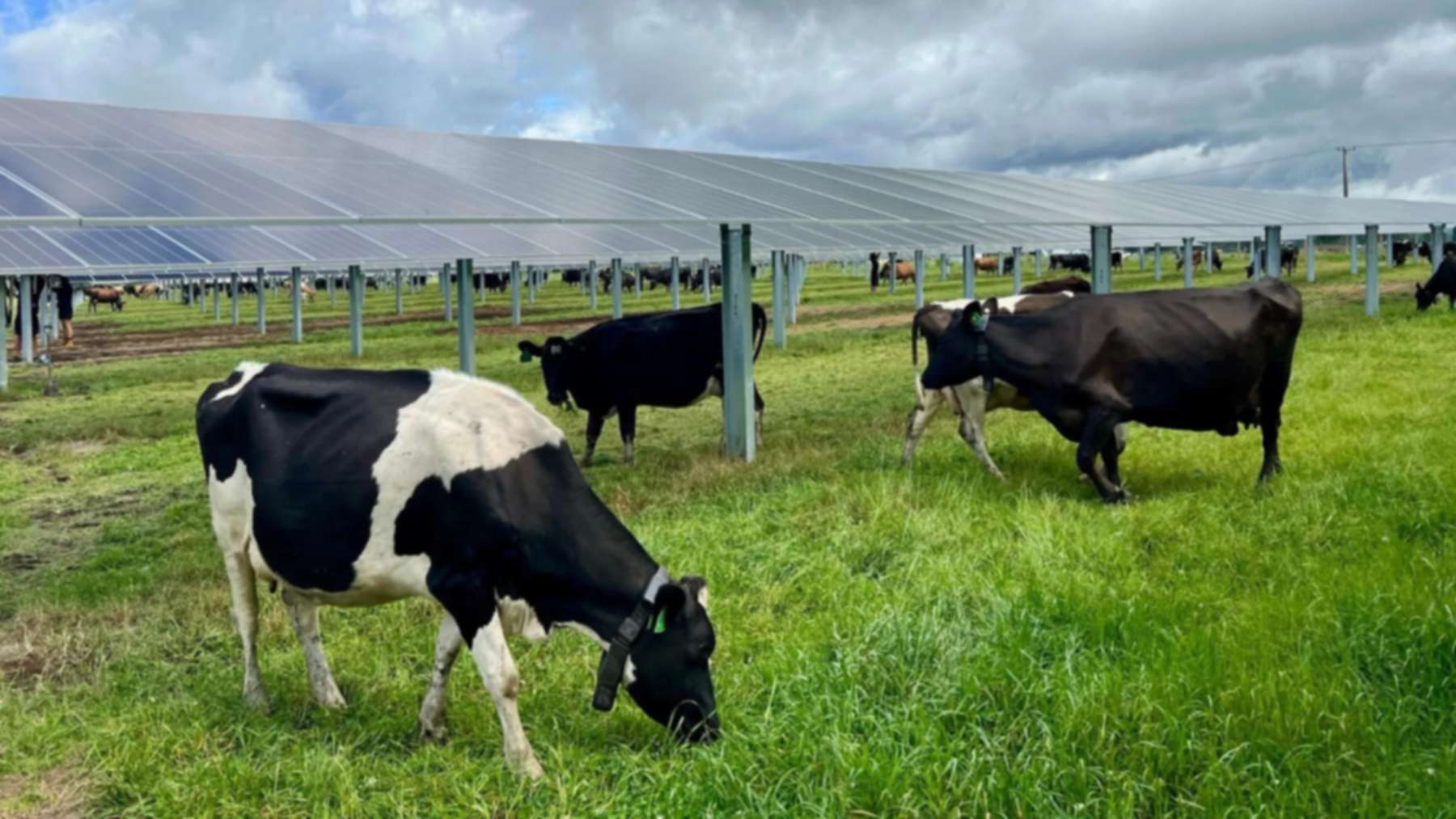

Most solar farms that share their land with animals share it with sheep. Sheep are short, they don’t need much headroom, and they fit under a regular row of solar panels without anyone redrawing the plans. Cows are a whole different problem.
So when a dairy farm in Galatea, on New Zealand’s North Island, decided to put 4.7 megawatts of solar panels on its paddocks, the engineer designing the trackers figured that lifting them high enough for cattle would cost a fortune. Yuneska Harris, head of utility projects at Clenergy, the solar mounting company that supplied the trackers, told Renew Economy she expected the structure to cost at least 160% more than a standard tracker. It came in at 57% more in total manufacturing costs.
That’s still a big jump, admittedly. But it’s a lot smaller than the number Harris had in her head, and she says she wasn’t alone in thinking that way. “Everyone thinks that increasing the clearance to allow grazing is going to be way too expensive,” she told the outlet.
The Gordon Solar Farm sits about 31 miles southeast of Rotorua, and it’s been seven years from the first idea to the opening. Rory and Susan Gordon own the dairy farm and drove the project along with Gerrard McCarthy of Micropico Systems, a company that specializes in renewable setups for farms. Harris didn’t come in until after five years of planning, consultation and permits, which sounds like a pretty exhausting stretch for everyone involved.
So what’s a tracker, and why does 7 feet matter?
A solar tracker is basically a steel frame with a motor that slowly turns a row of solar panels through the day so they keep facing the sun. You get more power out of it than out of a fixed panel, but it also means the panels are always moving, and that matters a lot when there’s a cow standing underneath.
A standard tracker stands about 5.2 feet tall. The ones in Galatea are about 7.2 feet. Harris says it took six designs to land on that height as the sweet spot, and the cabling and the solar panels themselves didn’t change. Only the height did.
Here’s where it gets a bit confusing. Renew Economy says that at maximum tilt, the panels leave about 3.6 feet of clearance above the ground, and it doesn’t explain how a 7.2-foot tracker ends up with 3.6 feet underneath. My guess is that 7.2 feet is measured to the pivot, and the low edge of each panel swings down toward the grass as it tips over to catch a low sun. Either way, 3.6 feet isn’t much room for a dairy cow.
So how do you keep 700 cows from wandering into a moving solar panel?
The cows only graze there at night
About 700 cattle use the Gordons’ paddocks, and the trick is pretty simple. The herd goes into the paddocks at night, when the trackers park the solar panels flat. Before sunrise, the cows get moved out for milking, and they spend the day somewhere else while the panels tilt and follow the sun.
You end up with cows eating grass under the panels at night and the panels making electricity over empty paddocks during the day. It’s a fairly elegant workaround, and frankly it’s the kind of thing a dairy farmer would come up with, since milking already sets the herd’s schedule.
What it doesn’t give the cows yet is shade. According to Renew Economy, there’s a plan to switch the trackers to horizontal mode in summer and let the animals back in during the day. That’s still a plan, though, and the farm isn’t doing it yet.
I’d argue that summer plan is the most interesting thing here, because we’ve already covered two dairy setups where shade made a measurable difference. On a University of Minnesota research farm, cows grazing under solar panels with a bottom edge 8 feet up breathed 66 times a minute, against 78 for cows in full sun. In Normandy, a herd under panels raised 16.4 feet stayed out until noon on hot days, while the herd in the open field headed back to the barn as early as 9:30 a.m. Galatea’s trackers are a lot lower than either of those, so the panels would presumably have to stay flat the whole time the cows are underneath.
So where did the extra 57% go?
Not where you’d think. Harris says the above-ground structure cost less than 10% more to manufacture at the taller height. The foundations were 47% more expensive than standard ones, and that’s where most of the extra money went.
The ground in Galatea is to blame. The farm sits near the Waiohau Fault, the soil is loose and volcanic, and the site carries a medium-high risk of liquefaction. If you haven’t run into that word before, liquefaction is what happens when an earthquake shakes loose, wet soil hard enough that it briefly behaves like a liquid. Anything standing on it can sink or tip, and that’s not what you want under a field of steel posts and glass.
So the foundations got bigger. Renew Economy describes them as 10.8-foot foundations, but it doesn’t say whether that’s how deep they go into the ground or the total length of each post. Harris estimates that in more typical ground, the foundations for this design would run somewhere around 15% to 20% above standard, which tells you how much of this bill comes down to the local geology.
There’s one more catch. All of these percentages cover manufacturing, and they don’t include installation. I’d love to tell you how many solar panels are out there and what the whole farm cost, but neither number has been published.
Even the size is a little fuzzy. Renew Economy puts the project at about 25 acres, while a press release from one of the suppliers ahead of the opening said about 20. So call it 20-something acres.
Installation hit its own snag, too. Working on equipment 7 feet off the ground slowed things down at first, until the team borrowed the shoe risers orchard workers wear. Apparently that did the trick, because the installers finished two weeks early. Farm gear rescuing the high-tech part of the job feels about right for a dairy farm.
How does this compare with cattle solar in the US?
One of the closest examples we’ve got is Silicon Ranch’s Christiana Solar Farm in Rutherford County, Tennessee, a 3.25-megawatt site on 40 acres. According to Canary Media, the company only raised its steel piles a little, and in whichever paddock the herd is grazing, the trackers are limited to a tilt of 20 or 30 degrees instead of their usual 60, so the lower edge of the panels stays above the animals’ heads. The 15-member herd moves between 15 paddocks every few days.
So both farms landed on the same basic idea: change what the panels do when the cows show up. Tennessee limits the tilt in daylight, with a small herd and piles only a little taller than usual. Galatea parks the panels flat at night, with about 700 cows and taller trackers, then gets the herd out of the way before the sun comes up. I’d say the New Zealand approach is easier to scale to a big dairy operation, but it gives up the daytime shade, at least until that summer plan happens.
Harris didn’t design Galatea from scratch, either. Her research included another cattle-under-solar setup in New Zealand, a 2.4-megawatt installation at Waiuku. It also covered a 60-kilowatt prototype at Farrer Memorial Agricultural High School in New South Wales, Australia. And she thinks the same design could come in cheaper in Australia, where she suggests the soil may allow shallower foundations than Galatea’s volcanic ground. That’s a pretty big turnaround for someone who says that early on, she was among those arguing to lower the clearance instead.
The Gordon Solar Farm officially opened on November 12, and the plan is for about 700 cows to have the paddocks under its solar panels every night.