
A solar panel has looked like the same object for most of your life. Glass in an aluminum frame, sitting on a steel rack, tilted at whatever angle somebody worked out for your latitude. The frame is there because glass needs holding, the rack is there because the frame needs bolting, and the holes those bolts go into are the reason plenty of buildings never get panels at all.
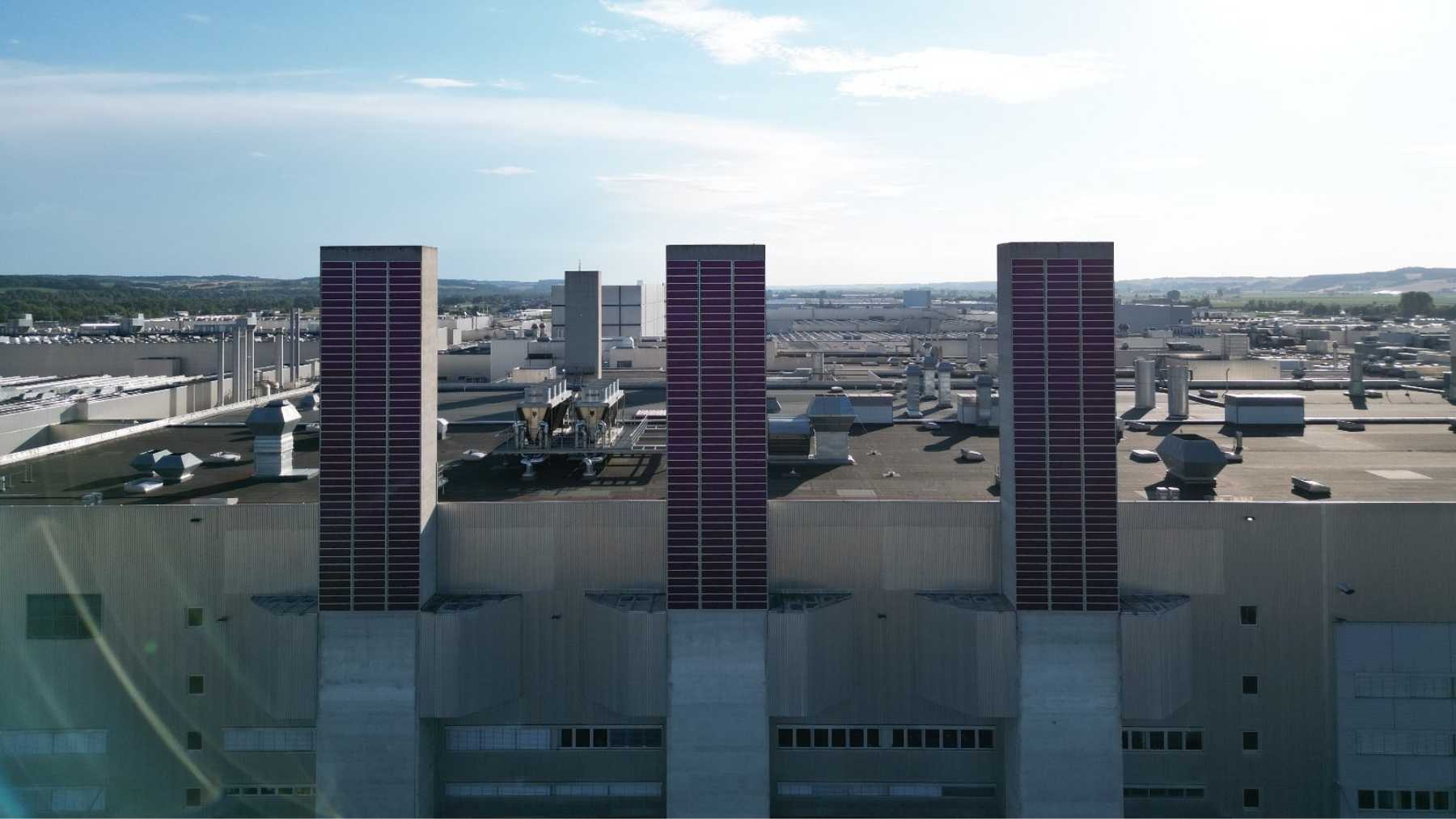
BMW has just finished a job that skips every part of that. At its plant in Dingolfing, in Lower Bavaria, crews stuck 414 sheets of German-made organic solar film onto the sun-facing sides of three towers standing more than 147 feet tall. No racking. Nothing drilled into the structure.
The film comes off a roll with the adhesive already on the back, and it goes onto bare concrete with a hand roller. The finished array makes about 22 kilowatts, which is roughly a generous house roof. That number is the part most people get wrong here, and it is worth getting right, because the kilowatts were never the point.
Three towers, 414 films, and a paint shop
The manufacturer is Heliatek, out of Dresden, and its own project list files the Dingolfing job under painting towers. The figures on that list are specific: 414 films, about 3,550 square feet of covered surface, 22 kilowatts peak, February 2026.
Heliatek’s announcement puts the towers at more than 45 meters, which is just over 147 feet, and says the films went onto the concrete facades within days. German trade coverage has since put them nearer 48 meters. The maker’s own figure is the conservative one, so that is the one to hold.
Dingolfing is not a quiet corner to run an experiment in. It is BMW’s largest production site in Europe, more than 740 acres, around 18,000 employees, roughly 1,350 cars a day and about 280,000 vehicles built in 2025. The 4 Series, 5 Series, 7 Series and the electric iX all come off lines there, and the bodies for every Rolls-Royce are built on the same site.
Christoph Schröder, the plant manager, described it as BMW “supporting an innovative technology in its development and industrialization phase” and checking it in practice at the plant. Automakers do not often say that out loud about equipment they have just switched on.
The same plant put 500 times more solar on a warehouse roof
Here is the context that makes 22 kilowatts make sense. BMW’s own April 2026 fact sheet for the site records that since the end of 2025, an 11-megawatt rooftop photovoltaic system has been running on the Dynamics Centre, the vast parts warehouse that supplies BMW dealers worldwide.
Eleven megawatts against 22 kilowatts is a factor of 500. Ordinary glass on a flat roof beat the film by that margin at the same address, within a couple of months of it going up.
So the towers are not a power project. They are a surface project. Three vertical concrete faces that no rack could have been bolted to without going into structure became generating area in a few days, and the fact that they generate very little is close to beside the point.
Finding new surfaces has been the whole game in European solar lately. A Bavarian grower put panels on top of the poles already holding up his hops. Frankfurt Airport stood 37,000 of them upright along a runway. A Swiss utility bolted 4,872 to the face of an Alpine dam, five feet off the wall so inspectors could still walk it. Every one of those still involves steel. This does not.
Three and a half pounds, a roller, and no holes
The product is called HeliaSol, and the datasheet is refreshingly blunt. One film is 17 inches wide and about 6 feet 7 inches long. It is 2 millimeters thick, under a tenth of an inch, or about three quarters of an inch where the junction box sits. It weighs 3.5 pounds.
Installation is four steps: prepare the surface, position the film, peel the liner off the adhesive, run a roller over it. Heliatek asks for an authorized installer and dry conditions above 46 degrees.
The film sticks to concrete, steel, glass, bitumen and roofing membrane, and the datasheet allows any slope from 1 degree to 90, which is the polite engineering way of saying that a wall counts.
It bends too, in one axis only, down to a radius of about 20 inches. That is how the same product ended up wrapped around an 89-foot chimney at Cologne Bonn Airport last September, 80 films for 4.4 kilowatts, and around the tower of a working wind turbine in Spain back in 2019.
What you give up is efficiency, and it is about two thirds of it
The datasheet lists aperture efficiency at 7.2 percent for the 50-watt film and 8 percent for the 55-watt one. The median module on an American home was 20.8 percent efficient in 2023, according to a federal solar industry update. Per square foot of surface, you are handing back roughly two thirds of the output.
At Dingolfing that works out to about 6 watts for every square foot of wall covered. Decent silicon on a decent roof does three times better.
What comes back the other way is a temperature curve no silicon panel can touch. Heliatek rates the film at 0.00 percent power loss per degree Celsius all the way up to 149 degrees Fahrenheit, and only past that does it start giving up 0.11 percent per degree.
Silicon begins bleeding output the moment it warms past lab conditions, and a dark wall in full July sun is not lab conditions. The stated operating range runs from 40 below to 158 above.
The warranty is five years on the product and 20 years on performance. TÜV Rheinland certified the film to IEC 61215 and IEC 61730 in April 2024.
It has been cleared for American buildings since March 2025
UL 61730 followed in March 2025. That is the certificate that decides whether an electrical product goes on a building in the United States, and Heliatek announced it as the opening of North America.
Seventeen months on, the company’s public reference list runs through Germany, Austria, Spain, France, the Netherlands, South Korea and Japan. The only entry anywhere in the Americas is a water reservoir in São Paulo from August 2025: 60 films, 3 kilowatts, about 590 square feet of surface.
There is still no American project on that list.
Twenty years in, it is still a reference project
Heliatek was founded in Dresden in 2006 on organic semiconductor work out of TU Dresden. It opened a roll-to-roll production line in August 2019 built for a million square meters of film a year, and expected to be running flat out by 2022.
The German cleantech outlet Cleanthinking, which updated its running file on the company on August 17, counts more than 100 installations worldwide and no series business behind them. The ramp is still not finished, and the company does not publish how much of that line it actually uses.
There has been no insolvency, no protective-shield filing and no shutdown, which after two decades and hundreds of millions of euros in investor money is worth saying plainly. HeliaFilm, the older product, has quietly disappeared from the website. HeliaSol is what is left.
The thing most likely to move the needle is regulatory rather than technical. Germany’s building modernization law took effect on July 29 and phases in a nationwide requirement for solar on new construction across the rest of the decade.
Conventional panels will cover that on ordinary roofs. The interesting buildings are the ones where they cannot: roofs that will not carry the weight, curved surfaces, facades, and substrates nobody is allowed to drill into. That list is more or less Heliatek’s entire addressable market.
The three towers at Dingolfing produce about what a good-sized American house roof produces. What they demonstrate is that three blank concrete faces at a car factory stopped being blank inside a week, with nothing driven into the structure and nothing hanging off it.
BMW’s own framing was verification, which is the most accurate word in the whole announcement. The number worth watching next is not a kilowatt figure. It is whether somebody orders 100,000 of these films instead of 414.