
Irrigation canals are about as unglamorous as infrastructure gets. You can drive past one in western Nebraska every day and never wonder where the water in it starts. But for the farmers on the Goshen/Gering-Fort Laramie canal, it starts at a diversion dam on the North Platte River in Wyoming, and it has to pass through a couple of concrete tunnels near the town of Fort Laramie that were finished in 1917.
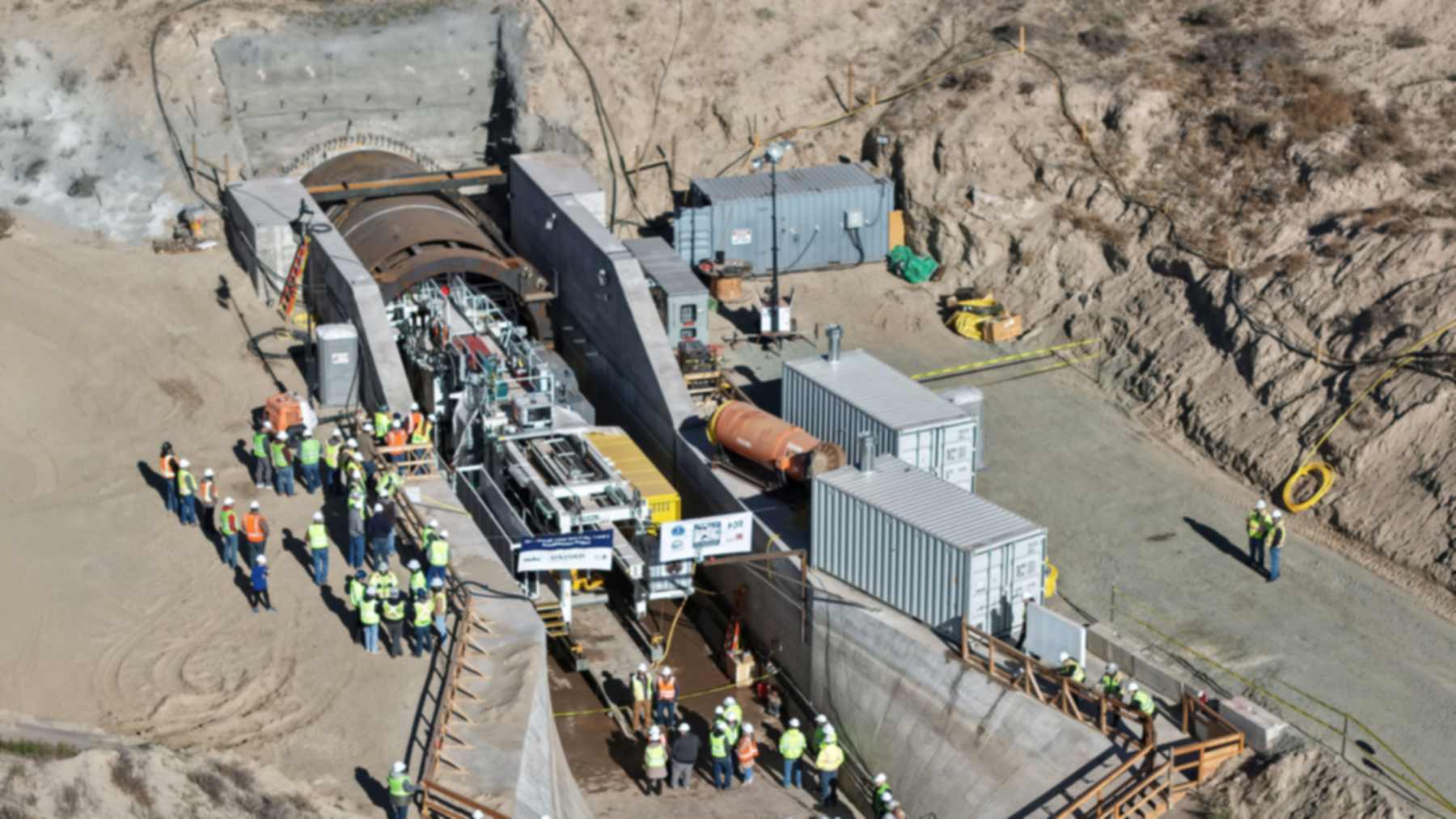
On Wednesday, November 18, construction officially started on replacing one of them. Tunnel No. 2 is being torn out from the inside by a custom-built tunneling machine called a digger shield, which removes about 5 feet of the old tunnel at a time and lines the hole with new precast concrete, according to Nebraska Extension. It’s running 24 hours a day, seven days a week.
The two irrigation districts that run the canal hosted a public launch at the site the day before with the contractor, Guy F. Atkinson Construction, and Extension counted more than 100 people there. If it all goes to plan, you’re looking at a new tunnel by mid-May 2027.
So why tear out a whole tunnel instead of patching it?
What happened to the old tunnel?
First, it helps to know what an irrigation tunnel actually does. It’s basically a canal that goes through a hill instead of around it, and the water moves by gravity, not pumps. Which means if something plugs the tunnel, the water behind it doesn’t stop coming, and there’s nowhere for it to go but over the canal banks.
That’s pretty much what happened on July 17, 2019. The Bureau of Reclamation’s environmental assessment says the roof of Tunnel No. 2 caved in and opened a sinkhole above the middle of the tunnel, and soil and debris filled the tube. HDR Engineering project manager Marcus Krall later put that sinkhole at about 100 feet across and 50 feet deep, according to the Scottsbluff Star-Herald. Reclamation’s own write-up of the repair puts the larger of two cave-ins at up to 75 feet wide and 40 feet deep, so treat the size as approximate.
With the tube plugged, the canal backed up and broke through its bank upstream. Cole Coxbill, a Goshen County farmer and vice president of the Wyoming Farm Bureau Federation, said at the time that the water climbed 4 feet in half an hour over a 13-mile stretch of canal, and the breach took out roughly a quarter mile of it. Nebraska Extension says water deliveries to more than 107,000 acres in Wyoming and Nebraska were cut back for 44 days. In the middle of July, which is about the worst time of year to turn off a farm’s water.
Coxbill also gave a few numbers for the tunnel itself back then. He said it was built between 1916 and 1917, measured 14 by 14 feet in concrete and ran somewhere between 140 and 180 feet underground. I couldn’t find Reclamation publishing that depth anywhere, so treat it as the Farm Bureau’s figure. Nebraska Extension describes the old tube as a 14-foot horseshoe shape.
He also put the length at 2,160 feet, and you’ll still see that number floating around. Reclamation lists 2,028 feet for the tunnel itself, plus a 316-foot concrete inlet and a 596-foot outlet. I’m going with the government’s number.
The districts did get water moving again. Emergency repairs started in late summer 2019, when crews backfilled the sinkhole and installed steel ribs to brace the old concrete walls, later adding metal sheeting over them. Steel ribs in a tunnel are basically a splint. Reclamation estimates they cut the tunnel’s capacity by 10% to 15%. The canal’s designed to carry about 1,500 cubic feet of water per second, and Reclamation says it’s been running short because of that temporary fix.
The digger shield takes 5 feet at a time
If you’ve seen any of the giant boring machines we’ve covered lately, like the ones chewing under New Jersey for the Palisades Tunnel, this one’s a different animal. A tunneling machine, a digger shield, is basically a steel cylinder with an excavator arm working out the front. The shell holds the ground up while the arm digs. Reclamation calls it a “partial-face shielded tunnel excavation machine,” which is a bit of a mouthful.
Atkinson says it recommended this setup, an open-face shield plus precast concrete liners, over the original plan to dig and support short sections in stages, because it would cut costs and risk. The shield was purpose-built for the job in Omaha, per Extension.
Here’s the order of operations. The work started at the outlet end, and it’s moving up toward the entrance. The shield bores the tunnel out wider than the old one, taking the original lining with it, along with any timbers left over from the 1917 construction. A Sandvik loader called a mucker (mining slang for the machine that scoops up the muck) hauls the broken concrete and dirt out of the tunnel, and a truck takes it to a dump site set aside for the project. Reclamation’s plan has the districts reusing screened material on canal banks and roads.
Then the new tunnel goes in. Each ring is made of six precast concrete segments, and each segment weighs anywhere from 6,000 to 9,500 pounds. They’re delivered to the back of the shield, moved forward, positioned, bolted together and sealed. After that, a specially mixed grout gets pumped in behind the ring.
If you’ve never dealt with grout, it’s basically a runny cement mix. Here it fills the gap between the new lining and the ground around it, so the tunnel is supported all the way around instead of sitting in a slightly oversized hole. By my math, even at the light end, one ring adds up to 36,000 pounds of concrete.
The new tunnel’s going to be bigger, too. Nebraska Extension says the shield turns the 14-foot horseshoe into an 18-foot round tunnel, a shape that meets safety standards nobody had in 1917. Scott Hort, general manager of the Gering-Fort Laramie Irrigation District, noted earlier this year that enlarging a tunnel is the easier direction to go.
An early 2025 project description put the finished inside diameter at roughly 16 feet once the 13-inch-thick lining is in, which checks out if you subtract a couple of feet of concrete from 18. That description also had 4-foot sections, and the rings going in now are 5 feet. I haven’t seen an updated inside diameter since, so take the 16 as a design figure rather than a final one.
How fast is it going?
Three crews are splitting the work on rotating shifts, 20 days on and 10 days off, according to Extension. Local radio station KRVN reported the plan calls for about three sections a day, as long as nothing goes wrong. Neither of them has said how far the shield has actually gotten since November 18, and I’d rather not guess.
There’s already been one hiccup. Late in October, part of the shield got damaged while it was being transported, KRVN reported. It’s been repaired and was ready to go pending some testing. A machine built for one tunnel in Omaha isn’t exactly something you can swap out for a rental.
The deadline is a real one, too. Hort was pretty upfront about it in February: water runs are supposed to start May 1, and if the tunnel isn’t done by then, water would have to go through it before it’s finished. With a mid-May target, that’s cutting it pretty close.
And who’s paying for it?
Nebraska Extension estimated last October that the whole project would cost around $150 million. At that point the districts had $64.5 million in grants from Nebraska and Wyoming, and up to $58.5 million was available as a low-interest loan from Reclamation.
Then in March, the Department of the Interior announced $100 million toward a long-term fix for the Fort Laramie tunnels, paid for through the One Big Beautiful Bill Act. I can’t find a public breakdown of how that federal money and the loan fit together now, so I won’t pretend to know the final split.
Tunnel No. 1 is next, and it’s longer
Tunnel No. 1 sits upstream, about 4 miles from Tunnel No. 2, and Reclamation lists it at 2,699 feet, plus a 209-foot inlet and a 794-foot outlet. Work on its inlet and outlet areas is already underway, so don’t expect the canal to be done with construction after this winter. Extension’s February update talked about digger shields, plural, so I’m not sure whether this one machine will do both tunnels.
If the shield stays on schedule, Tunnel No. 2 should be done by mid-May 2027. Nebraska Extension expects excavation on Tunnel No. 1 to start in fall 2027, after that year’s irrigation season, with the whole project finished in spring 2028.