
Nuclear fuel doesn’t really get recycled in the U.S. A power reactor burns through it, the spent assemblies go into a pool and later a steel cask, and that’s pretty much where the story ends.
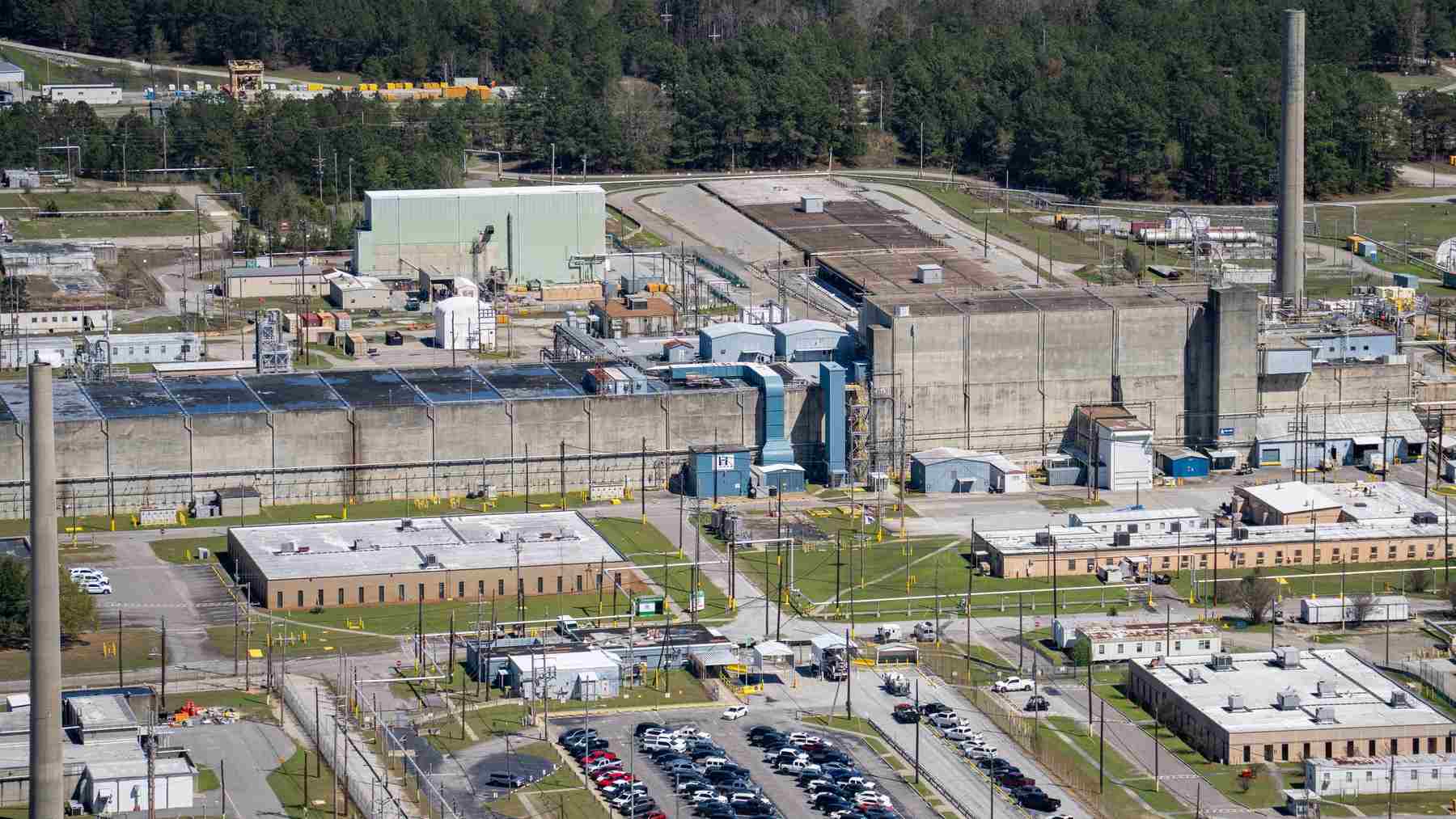
But there’s one building in South Carolina that spent decades doing the opposite. It’s called H Canyon, it sits on the Savannah River Site near Aiken, and on November 24 the Department of Energy said it’s ready to begin the chemical and mechanical preparations to run it again.
The goal this time is HALEU, a kind of enriched uranium that most advanced reactor designs are going to need. DOE’s plan is to dissolve about 80% of the used nuclear fuel stored underwater in a pool called L Basin, pull out the highly enriched uranium, and blend it down into up to 25.1 short tons of HALEU. (DOE gives that figure as 22.8 metric tons, in case you go looking.)
H Canyon isn’t making HALEU yet, though, and it probably won’t be for a while.
So what did DOE actually announce?
The head end is ready to go
The head end is the first stage of the process. It’s where used fuel (or target material) arrives, gets dissolved in acid and gets prepped for separation, all behind heavy shielding. Kevin Moeller, who manages H Canyon and HB Line, called it “the first system in what will be a multiyear effort” to produce HALEU, which is a pretty honest way to describe a milestone.
The separation work comes after that, and I can’t find a firm start date for it. DOE says the H Canyon team is preparing to begin first-cycle operations, and there’s still a lot to do before then, from reviving hundreds of old procedures to wrapping up maintenance and design changes. Back in February, the American Nuclear Society’s Nuclear News reported that plans called for the first load of HALEU to reach a fuel fabricator in the fall of 2027. That’s the closest thing to a delivery timeline I’ve seen.
The restart itself goes back to a February decision by DOE’s Office of Environmental Management to bring uranium recovery back at H Canyon. DOE calls the whole thing the FUEL mission (Fuel Utilization, Extraction, Leverage, which is a bit of a stretch as acronyms go). Tim Walsh, EM’s assistant secretary, says recovering the uranium also cuts long-term cleanup risk and waste, and DOE says it’ll reduce the number of high-level waste canisters the site has to fill for disposal.
So what is HALEU, and why does anyone want 25 tons of it?
Uranium fuel works because of uranium-235, the version of the atom that splits and gives off heat. Natural uranium is only about 0.7% U-235, so it gets enriched. The reactors running in the U.S. today use fuel enriched up to 5%, according to DOE. HALEU, short for high-assay low-enriched uranium, sits between 5% and just under 20%.
DOE says HALEU is essential to most advanced reactor designs, small modular reactors and microreactors included. The department has said a richer fuel allows smaller reactor designs and cores that last longer, which is pretty much the whole sales pitch for a lot of these new machines.
Getting HALEU isn’t exactly easy, either. Commercial enrichment in the U.S. is only now creeping past 5%. Last week we wrote about a New Mexico plant filling its first commercial cylinder enriched past 5%, and that product only reaches the low end of the HALEU range, depending on whose definition you use.
H Canyon comes at the problem from the other end. It starts with highly enriched uranium, the stuff at 20% and above, and waters it down with natural uranium. Think of it like cutting a cask-strength bourbon until it’s something you’d actually serve. According to the Savannah River Site, blending also makes the uranium unusable for weapons while keeping it fine for reactor fuel.
The tank had been sitting idle since about 2011
The second bit of news from November 24 is a lot less abstract. It involves a tank.
H Canyon needs somewhere to put the enriched uranium it recovers, and that somewhere is a large, double-walled storage tank outside the building. DOE says the tank had been idle since about 2011 because there was no mission that needed it. Now it has a job again. With the tank back online, H Canyon has a place to send material out of its own vessels, plus somewhere to keep extra uranium waiting to be blended into commercial-grade fuel.
Of course, a tank that’s been sitting for roughly 15 years doesn’t just switch back on. When the H Area team went to restart it, the internal transfer pump didn’t work. That pump lives inside the tank, so swapping it took a lot of planning, and the replacement went in with a 55-ton crane. Then the team found deterioration at the pump’s discharge connection and the piping around it. So they worked out a modified setup with a new discharge line, and that’s what got the tank back to normal operation.
“This was not simply a pump replacement,” said Lee “Roy” Kennedy, the operations support manager for H Area. I’d believe him. Working on anything inside a tank built to hold enriched uranium is a bit more involved than swapping out the sump pump in your basement.
H Canyon has done this sort of thing before, too. Before 2022, when it switched to what DOE calls a dissolve-and-dispose mission, it had recovered enough uranium to make 332 short tons of low-enriched uranium for commercial power reactors. Nuclear News dates H Canyon’s run of blending down uranium for power plant fuel to 2003 through 2011, so as far as I can tell, the tank going quiet around 2011 lines up with that work wrapping up.
Nobody goes into the hot side
Then there’s the building itself, and frankly it’s a strange place to work.
H Canyon is 1,028 feet long, 122 feet wide and 71 feet tall, according to the Savannah River Site. That’s nearly three football fields end to end, end zones included. It was built in the early 1950s, it started up in 1955, and the inside looks like a canyon, which is where the name comes from.
One side of that canyon is “hot,” meaning radiation levels are higher, and the other is “warm,” meaning they’re lower. The people working there are protected by thick concrete walls reinforced with steel. And according to the site, no one has been inside the hot side since the facility started operating. That’s more than 70 years, going back to Eisenhower’s first term.
So how do you run a chemical plant you can’t walk into? With cranes. Operators run most of the canyon from a control room, moving things around with remote-controlled cranes. Even the maintenance happens that way, using overhead bridge cranes, so workers don’t soak up more radiation than they have to. Used fuel shows up from the site’s L Area in shielded cask cars and gets dissolved in nitric acid. After that, a multistep chemical process using solvent extraction pulls the uranium away from the impurities, which go off to the site’s waste management facilities.
That setup made sense for H Canyon’s original job. The plant used to recover uranium and neptunium from reactor fuel tubes to make material for nuclear weapons. After the Cold War, its work shifted to nonproliferation and cleanup, and now it’s being pointed at fuel for reactors that, for the most part, haven’t been built yet.
DOE says H Canyon is the only operating, production-scale, radiologically shielded chemical separations facility in the U.S., and the only one able to produce HALEU at this scale right now. Which means if the head end hits a snag, there isn’t exactly a spare canyon down the road. It’s also only one of several big jobs DOE has going at Savannah River. Elsewhere on the site, the department is stripping out a 400,000-square-foot building that never made fuel and rebuilding it for a different mission.
DOE says the H Canyon team is preparing to begin first-cycle operations during the fiscal year that started October 1. Once that uranium comes out the other end and gets blended down with natural uranium, it’s headed to commercial partners to fuel advanced reactors.