
Walk into a Class 8 dealer in Houston or Columbus this spring and ask about hydrogen, and you will get one of three answers. The first will point you at the new PACCAR-Toyota Kenworth T680 fuel cell variant on the lot, a hydrogen truck that runs on electricity generated inside a fuel cell stack. The second will tell you to wait for Cummins’ X15H engine in 2027, a hydrogen truck that runs on a piston engine that looks, sounds and is serviced almost exactly like the diesel it replaces. The third will mention an experimental engine out of a German research university that has been making the rounds in the trade press, hit more than 60% thermal efficiency on the test bench, and is, technically, neither of the first two.
He won’t be wrong on any of them. He also probably won’t tell you that all three architectures are competing for the same fleet customer, that none of them has cleanly won the argument yet, and that the third one, the German experimental engine, has a much closer American cousin than most of the trade press has bothered to mention. The fight over which engine architecture replaces the diesel under a long-haul tractor in 2030 is still wide open, and it is being waged on three different fronts at the same time.
Three architectures, three different bets
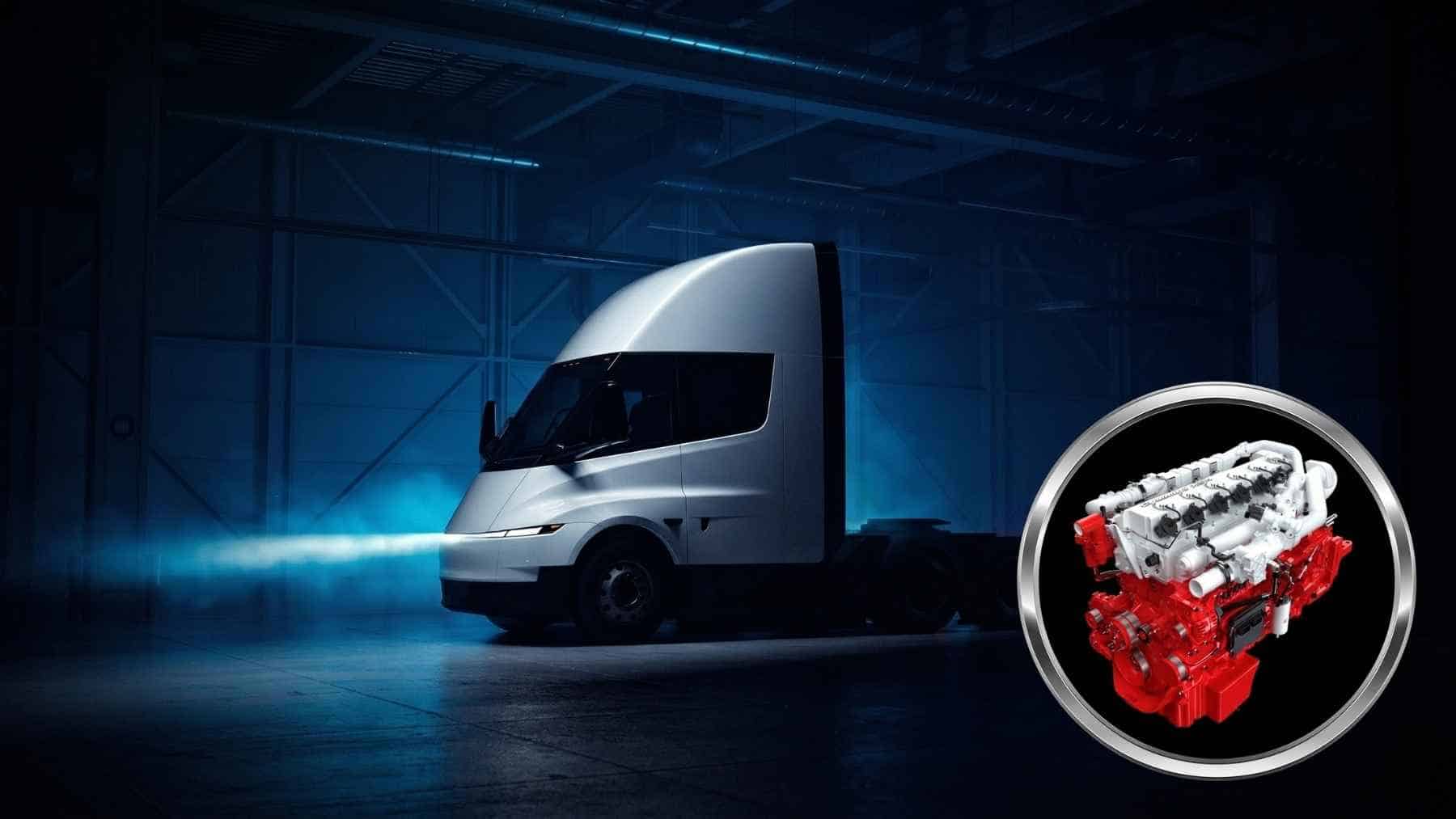
Bet one is battery electric. Tesla Semi confirmed an 822 kWh battery pack in its Long Range variant with CARB in May, with a quoted 500-mile range and roughly 1.7 kWh per mile efficiency. Tesla’s 8-K filed with the SEC describes “volume production this year,” with analyst estimates landing somewhere between 5,000 and 15,000 deliveries in 2026. Daimler’s Freightliner eCascadia, built in Portland, Oregon, carries up to 550 kWh and is rated for 230 miles. Volvo’s VNR Electric tops out at 564 kWh and 275 miles and has been the segment market share leader for several years running. Sysco has committed to 800 eCascadias for its food distribution fleet by 2026. All three of these architectures lose hardest on long-haul routes over 400 miles where charging dwell time becomes a wage problem for the driver.
Bet two is fuel cell. PACCAR began producing fuel cell variants of the Kenworth T680 and Peterbilt 579 in 2025, both powered by Toyota’s second-generation fuel cell module, with a quoted range of around 450 miles per fill. Hyundai’s XCIENT FCEV is already operating with NorCal Cargo on West Coast drayage routes. Nikola’s Tre FCEV is in limbo after the company’s bankruptcy. Fuel cells solve the dwell time problem the batteries do not, but they impose a hydrogen storage burden on the tractor and require a separate refueling network that the United States has barely begun to build out.
Bet three is hydrogen internal combustion. This is the option most of the trade press misses, because it does not look like a moon shot. It looks like a diesel. Cummins announced its X15H 15-liter hydrogen engine in 2022, built on its HELM fuel-agnostic platform that uses common architecture across diesel, natural gas and hydrogen with different head units for each fuel. Production target is 2027. Letters of intent are already on the books from Werner Enterprises, Transport Enterprise Leasing, Versatile and Terex Advance.
Cummins has been quietly pre-selling this engine since 2022
Werner Enterprises, headquartered in Omaha, Nebraska, runs more than 10,000 commercial vehicles and ranks among the largest fleets in North America. In September 2022, Werner signed a letter of intent to purchase 500 Cummins X15H hydrogen internal combustion engines upon availability. The company is targeting a 55% reduction in greenhouse gas emissions by 2035 and has decided that hydrogen combustion belongs in that math, alongside its battery and fuel cell pilots.
Jim Nebergall, General Manager of Cummins’ Hydrogen Engine Business, framed the bet in plain commercial terms when the Werner deal was announced: “Our fleet customers have shown tremendous enthusiasm for hydrogen internal combustion engines, which we believe can be a breakthrough technology essential to reaching Destination Zero. With enough interest, we believe we can manufacture this technology at scale yet this decade providing customers with an option that is a low initial cost, extended vehicle range, powertrain installation commonality, and end user familiarity.”
Read that last clause again. Low initial cost. Extended vehicle range. Powertrain installation commonality. End user familiarity. That is not the language of a green tech pitch deck. That is the language of a fleet operator’s procurement spreadsheet. Cummins is not selling hydrogen ICE on the premise that it is the cleanest possible solution. It is selling it on the premise that it is the cleanest solution a fleet operator can put on the road in 2027 without retraining mechanics, rebuilding service bays or replacing diagnostic equipment. The X15H is dimensionally interchangeable with the X15 diesel it replaces. A Werner shop that services X15 diesel today can service X15H hydrogen in 2027 with the same tools.
The list of customers is now long enough to be worth taking seriously. Beyond Werner, Cummins’ Q3 2022 8-K filing confirmed collaborations with Transport Enterprise Leasing and Versatile. Terex Advance signed a separate letter of intent to integrate the X15H into its Commander Series concrete mixer trucks, citing the engine’s compatibility with arduous duty cycles. At ConExpo 2026, Cummins also unveiled a next-generation X15 off-highway platform rated between 400 and 700 horsepower, multi-fuel from day one. None of this is in Silicon Valley. The American bet on hydrogen ICE for heavy duty is being built in Columbus, Indiana.
The German engine is not the only one in the room
The Magdeburg announcement that lit up the trade press in late April came out of the Institute for Engineering of Products and Systems at Otto-von-Guericke University, led by Prof. Hermann Rottengruber and researcher Aristidis Dafis, in partnership with WTZ Roßlau gGmbH and funded by Germany’s Federal Ministry for Economic Affairs and Energy. The single-cylinder test engine recorded more than 60% indicated thermal efficiency on the bench. The architecture is called the Argon Power Cycle, or APC.
The Cummins X15H and the Magdeburg engine are both hydrogen internal combustion. They are not the same architecture. The X15H breathes air. Nitrogen, oxygen, traces of everything else. It burns hydrogen instead of diesel and emits water vapor and a small amount of NOx. Its efficiency lands in the same neighborhood as a modern diesel, somewhere around 45%, give or take loading conditions. It is the conservative, commercially scalable, no-special-supply-chain bet.
The Argon Power Cycle does not breathe air. The closed loop uses a mix of pure oxygen and argon as the working fluid, with hydrogen as the fuel. The working gas is captured, cooled, separated and recirculated after each power stroke. Argon is a monatomic noble gas with a higher adiabatic index than nitrogen, which lets the same volume of working fluid reach higher temperatures and pressures from the same amount of fuel. That is where the efficiency gain comes from. WTZ Roßlau proved the underlying cycle on the bench in 2022. Magdeburg has now pushed it past 60% indicated efficiency. It is the high-risk, high-reward bet, and it still lives in the laboratory.
The story the trade press did not bother to tell is that Magdeburg is not alone. Noble Thermodynamics Systems, Inc., a clean-tech spin-out from the Combustion Analysis Laboratories at UC Berkeley, has been developing the Argon Power Cycle since at least 2017. NTS holds USPTO patent US20170211515A1 covering the recirculating noble gas internal combustion power cycle, works with Sandia National Laboratories at the Livermore campus through its Heavy-Duty Fuel-Flexible Optical Engine Laboratory, and is funded in part by the California Energy Commission and the Department of Energy’s Industrial Efficiency and Decarbonization Office. NTS published SAE Paper 2024-01-2690 last year on pre-chamber assisted combustion in an APC engine. The bet from NTS is currently aimed at industrial combined heat and power applications, not Class 8 trucks. Same thermodynamic cycle. Different end market.
The fine print Magdeburg did publish, and the trade press skipped
Rottengruber himself flagged the limits of the result to the few outlets that asked. The Magdeburg engine is not a finished product. It cannot yet deliver the power density a production diesel does. He also flagged a CO2 accumulation issue inside the closed circuit that the team has not fully resolved. None of those caveats made it into the celebratory English-language coverage.
The bigger trap in that 60% number is the distinction between indicated and brake thermal efficiency. Indicated efficiency measures the work done by the gas on the piston inside the cylinder. Brake efficiency measures the actual rotating power that reaches the output shaft, after mechanical losses to friction, pumping, accessories and parasitic load. APC engines run at higher peak cylinder pressures than air-breathing engines, which produces a larger gap between indicated and brake. A peer-reviewed paper in the International Journal of Automotive Manufacturing and Materials noted that while APC engines can gain 22% in indicated thermal efficiency, the actual brake thermal efficiency gain is closer to 4% once mechanical losses are accounted for. A separate 2021 study in Energy Conversion and Management on APC running on hydrogen reported brake efficiency around 19% under typical operating conditions, a figure dragged down by the practical realities of seal performance, scavenging losses and combustion stability that the published bench result does not capture.
The 60% figure on the Magdeburg press release is real, for the variable it measures, in the conditions it was measured. The number that ends up at the rear wheel of a Class 8 tractor pulling 80,000 pounds over the Donner Pass is a different number, and it has not been published yet. Best case, with engineering work that has not happened, brake efficiency for a production APC truck engine probably lands somewhere in the 50 to 55% range, which would still meaningfully beat diesel. Worst case, it lands below 45% and the whole architecture loses its selling point. Nobody knows yet.
What this means for a US fleet ordering in 2027
A fleet manager building a Class 8 procurement plan for the back half of this decade is now staring at three options, each with a different risk and reward profile. Battery electric makes financial sense for regional drayage and known-route operations under 300 miles, and Tesla Semi is shipping at increasing volume out of Nevada with public Megacharger infrastructure starting to come online in Southern California. Fuel cell makes sense for medium-haul work between 200 and 450 miles where refueling dwell matters, and the PACCAR-Toyota Kenworth T680 FCEV is already on order books today. Hydrogen internal combustion makes sense for long-haul and vocational duty cycles where the truck has to drive, sound and service like a diesel, and Cummins is taking pre-orders for X15H builds two years from now.
The Magdeburg result, if it scales into a brake-efficiency win and somebody licenses the APC architecture into a production heavy-duty platform, would dramatically extend the case for that third option. If it does not scale, Cummins still ships in 2027 with a conventional air-breathing hydrogen ICE that is already pre-ordered by one of the largest fleets in the country. The fleet hedging across all three architectures in the next procurement cycle is the fleet that will not have to write off a major capital decision in 2030.
The fight over what replaces diesel under a long-haul tractor is not Tesla versus Toyota. It is battery versus electrochemistry versus thermodynamics, with Indianapolis quietly winning the third bracket while everyone else watches Austin and Plano. Magdeburg just made that third bracket look a little less crazy.