
If you’ve ever been stuck behind an oversize load on the interstate, you know the ritual. Pilot cars, flashing lights, a modular home or a wind turbine blade doing half the speed limit while a mile of traffic stacks up behind it. Melbourne ran the heavyweight version of that a few weeks back, and it makes the average house move look like carry-on luggage.
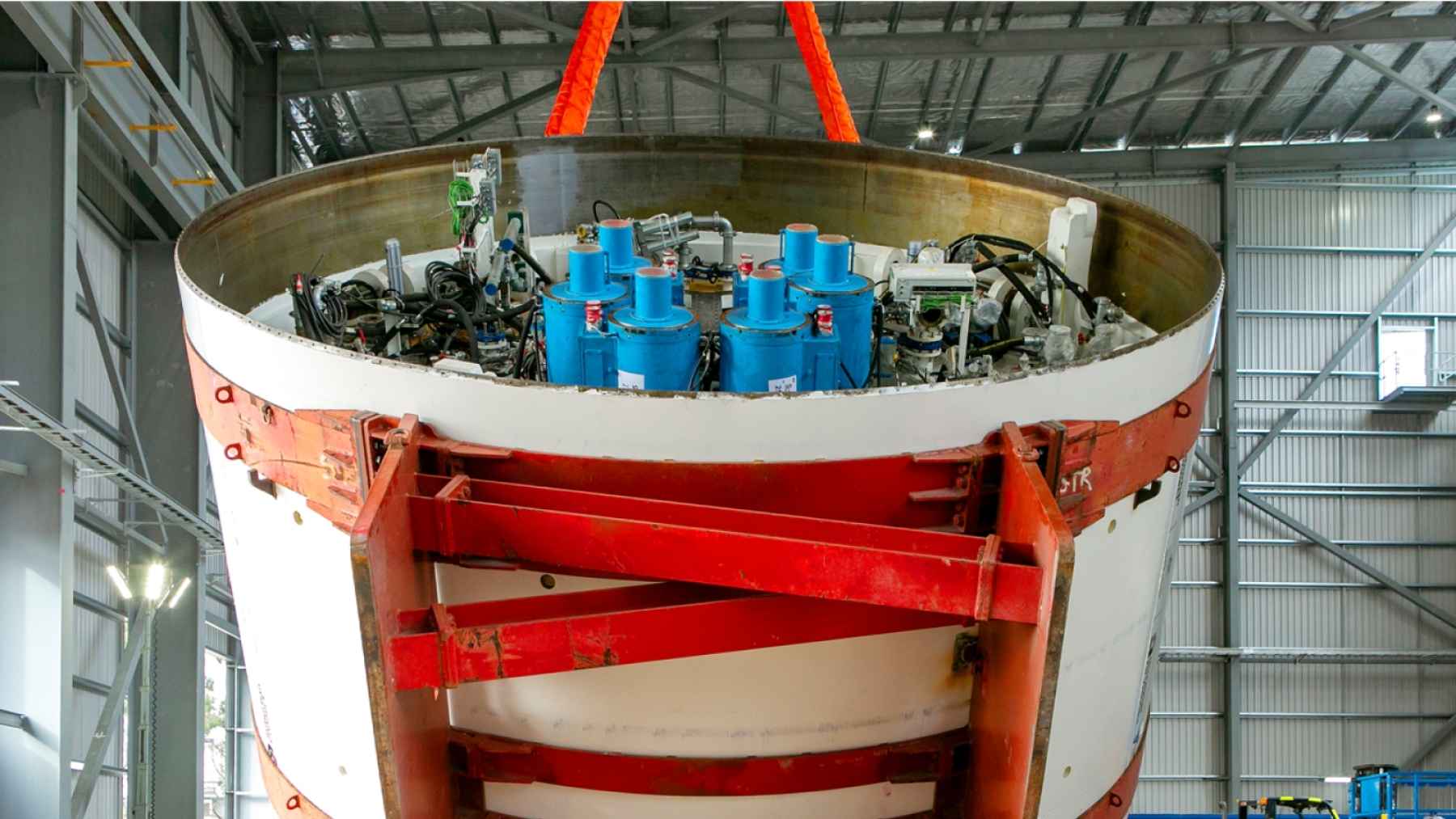
The cargo was the front shield of a tunnel-boring machine named Aayushi, a steel ring that weighs about 254 tons (230 metric tons). Ghella, one of the contractors building the tunnels, says it rolled out of the Port of Hastings on a truck 180 feet long and headed for a worksite in Clarinda, in Melbourne’s southeast. The machine’s middle shield, about 209 tons (190 metric tons), made the same trip on its own set of permits, and the tail shield’s on site too.
So what’s a shield, exactly?
It’s the steel cylinder at the front of the machine that holds the ground open while the cutterhead grinds through it, giving the crew a protected space to build the concrete tunnel lining before the earth settles back in. Basically, it’s the reason the people working inside an unfinished tunnel don’t spend their shift thinking about the dirt above them.
Aayushi is one of the machines digging the Suburban Rail Loop, a 56-mile orbital rail line meant to connect Melbourne’s suburbs to each other without routing every trip through downtown. This machine’s assignment is one of the twin tunnels running from Clarinda toward Glen Waverley, part of a roughly 10-mile package handled by Suburban Connect, a consortium of CPB Contractors, Ghella and Acciona. And frankly, the digging might end up being the least dramatic part of its year.
So how do you move a 254-ton steel ring?
Very slowly, and at night. The shields traveled separately under superload permits. It’s pretty much the same deal as the oversize permits American states issue: the state approves one specific route, checks that every bridge along it can take the weight, and tells you exactly when you’re allowed to roll.
The rig itself measures 180 feet long, 24.6 feet wide and 17.7 feet high, according to Ground Engineering. A standard truck is about 8.5 feet wide. A typical Melbourne traffic lane runs between 10.8 and 11.5 feet, so at 24.6 feet the load was wider than two lanes side by side. The convoys left around 10 p.m., held a top speed of 37 mph, and pulled into Clarinda in the early hours of the following morning. Each shield rode alone, and I’d guess the bridge engineers insisted on that.
If you’re wondering why anyone would ship a tunneling machine in pieces at all, it’s because the finished product is basically a rolling building. Victoria’s Big Build lists the Clarinda machines at 23.8 feet in diameter and somewhere between 394 and 492 feet long once the trailing gear is attached. There isn’t a road vehicle on Earth that moves that in one piece, and even if there were, it wouldn’t clear the first overpass.
The machine gets put together at the bottom of a 64-foot hole
The destination for all this steel is a launch pit that crews spent months digging to a final depth of 64 feet, roughly a six-story building sunk into a suburb. Big Build says the pit’s finished, and specialized cranes will now lower each section into the pit so the machine can be assembled underground ahead of its first cut. An acoustic shed is going up over the site so the neighbors aren’t living next to an open tunneling operation around the clock.
Ghella said in late August that the remaining components, including the back-up gantries, were scheduled to arrive over the following weeks. The gantries are the long string of trailing platforms that carry the machine’s power, controls and support systems, and they’re most of that 394-foot minimum length. Even at 492 feet, Aayushi comes in shorter than the 706-foot machine we covered in Washington state.
Aayushi’s sibling Alice is already cutting from the Burwood end of the project, digging with its front section while the rest gets bolted on behind it, an arrangement we went through in detail when Alice made its first cut. Clarinda gets its turn next.
So when does it actually start digging?
Neither Ghella nor the state has named a day. The official line has Aayushi tunneling toward Glen Waverley before the end of the year, and as far as I can tell nobody’s narrowed that down to a month. Which seems fair enough while the machine’s still going into the ground one section at a time.
Victoria’s Big Build confirmed in its September update that Aayushi is being assembled at Clarinda for its drive toward Glen Waverley this year, and Ground Engineering reported on September 10 that tunneling on the project’s first stretch, out of Burwood, had already begun.