
American reactor construction has a steel problem that has nothing to do with reactors. The big pressure-retaining components come off forging presses, and the US mostly stopped having those.
Oak Ridge National Laboratory puts it bluntly in its own materials: casting and forging capacity for very large metal parts has declined and moved overseas, and the shortages that follow are hitting energy, defense, aerospace and oil and gas at the same time.
So on August 19, at a manufacturing event in Tennessee, Oak Ridge and Idaho National Laboratory put a 3D-printed steel pressure vessel on a table and announced a joint program to make more of them.
It is a small vessel. It is not certified for anything. And a lot of the coverage this week has been quietly upgrading what actually happened.
What the labs said, and what they did not
The announcement came at Materials and Manufacturing Innovation Days, an ORNL event. The release says the vessel was printed in July, measures roughly three feet by five, and marks an early milestone by showing the technology can scale up.
Read that again, because the wording is deliberate. Early milestone. Ability to scale. The labs did not claim a first, and neither should anyone else.
They have reason to be careful. ORNL has printed pressure-retaining nuclear hardware before, including stainless steel irradiation capsules that function as containment barriers and pressure vessels and came back intact after a month inside the High Flux Isotope Reactor.
What is new here is the size, the closed geometry, and a steel alloy the labs describe as relevant to nuclear service. That is a real step. It is not a forge replacement.
Three arms, one part, and a collision problem
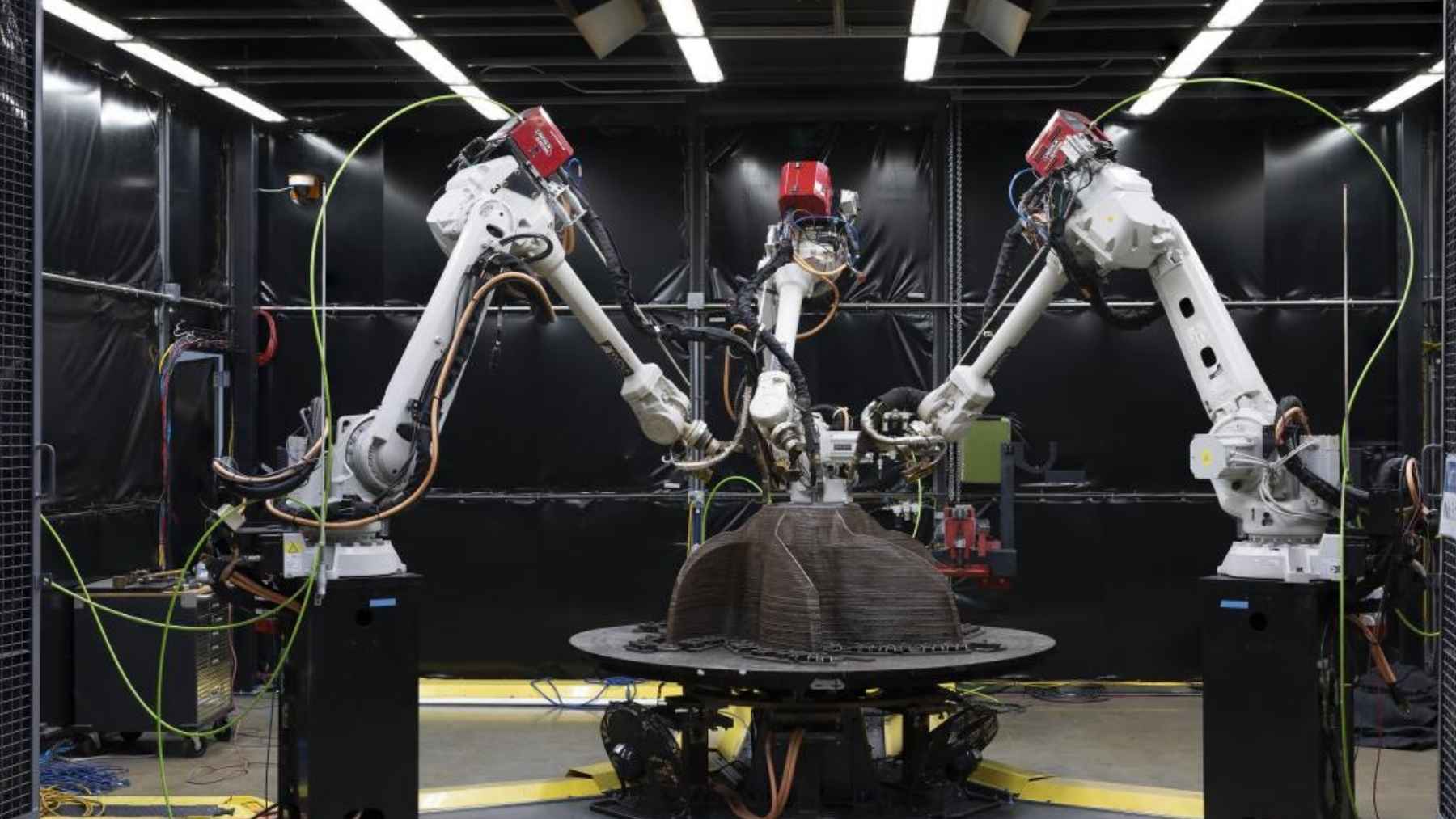
The machine is called MedUSA, short for Large-scale Multi-agent Wire Arc Additive Manufacturing. It lives at the Manufacturing Demonstration Facility and it took an R&D 100 Award in 2024.
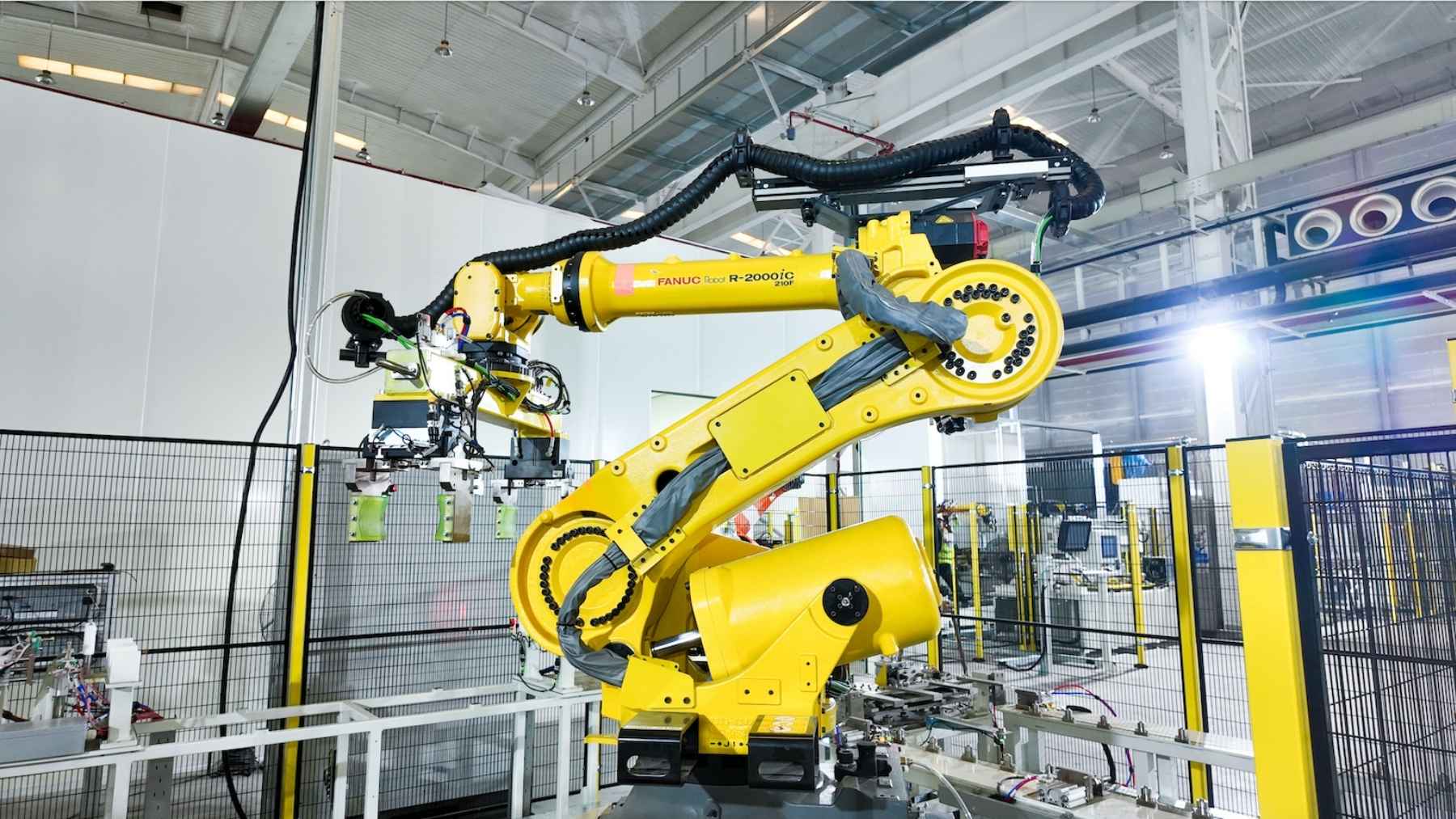
Three robotic arms, each carrying a welder, work around a shared turntable and lay down molten wire bead by bead. Welding is not the hard part. Getting three live arcs to move around one heating, warping object without colliding or corrupting each other’s weld pools is the hard part.
ORNL co-developed the system with Lincoln Electric Additive Solutions, and the industrial half of that matters for what comes next. Lincoln runs its own path-planning software, monitors the process as it deposits, and laser-scans finished parts against the original CAD.
The throughput number is the one worth remembering. By 2024 the system was laying down steel at 100 pounds an hour, which is the figure that makes anyone think about industrial parts rather than lab curiosities.
The 46-hour impeller was a mold, not a part
This distinction gets flattened in almost every writeup, so it is worth being precise.
MedUSA printed a 900-pound can for a hydropower impeller in 46 hours, against the months such things normally take. But the can is a mold. It gets packed with metal powder and pushed through a hot isostatic press, and the press makes the impeller.
That is powder metallurgy hot isostatic pressing, and ORNL is pursuing it as a second route around forging alongside wire arc printing. The lab has also printed an 837-pound stainless canister for spent fuel dry cask storage and put it through drop and puncture testing.
So MedUSA’s résumé is real, and it is mostly cans, canisters and tooling. The pressure vessel is the first time it has been pointed at something whose job is to hold pressure with a core inside it.
Some perspective on scale, because the coverage keeps skipping it. ORNL says the parts it wants to bring back onshore weigh at least 10,000 pounds each. The demo vessel is a three-by-five-foot object.
And an actual reactor pressure vessel is in a different universe again. The calandria vessel currently under fabrication for Canada’s first small modular reactor weighs 606 tons and runs 98 feet long, and exactly one shop on the continent has started one.
Nobody is printing that this decade. What wire arc printing plausibly gets you first is the tier below: smaller vessels, closure heads, nozzles, tooling and the mid-size pressure-retaining hardware that microreactors and SMRs need in quantity.
That is still a large market, and it is the part of the supply chain that currently routes through forges in Japan, South Korea and France.
Born-qualified is the actual bet
Printing a shape is the easy half. Convincing a regulator the shape will survive forty years at temperature is the expensive half, and it is where the joint program is aimed.
The idea is to run sensors and AI-driven analysis during the build so the vessel’s geometry and material properties get verified as it is deposited, layer by layer. ORNL lead researcher Patxi Fernandez-Zelaia calls the goal “born-qualified” components.
Jorgen Rufner, who leads INL’s advanced manufacturing group, framed the payoff to Interesting Engineering as evaluating how a component performs while it is being produced, which is what shortens qualification timelines.
That is the difference between the two labs, and it is why this is a joint program rather than an ORNL press release. Oak Ridge has the printer. Idaho has spent decades qualifying reactor materials and knows what evidence a regulator will actually accept.
Whether ASME and the NRC accept process data as a substitute for destructive testing on a pressure boundary is an open question, and not a small one. No printed nuclear pressure vessel has gone through that process yet.
The Antares brackets, described accurately
ORNL cites one piece of hardware from this same printer and material that has been near a live core: neutron sensor brackets for Antares Nuclear’s Mark-0 microreactor.
Mark-0 did reach criticality at Idaho National Laboratory on June 4, the first reactor to do so under the Energy Department’s pilot program. But it was zero-power criticality, and INL director John Wagner went out of his way to clarify that the chain reaction “was sustained at essentially no measurable energy output.”
Not electricity generation. Not sustained heat. A physics validation with printed brackets holding sensors, not printed steel holding pressure.
Edwin Lyman of the Union of Concerned Scientists called that milestone a rudimentary first step with no bearing on whether the reactor ends up safe or commercially viable. The same caution applies here.
What would make this matter
The honest read is that ORNL has shown a closed vessel of this class can be printed, and has now teamed up with the lab that knows how to prove things to regulators.
What comes next is unglamorous: material testing, ASME code work, and enough process data to convince someone that a welded-up vessel behaves like a forged one under neutron flux and thermal cycling. None of that has happened.
If it works, the US gets a parallel route for mid-size pressure hardware that does not depend on a forging press it no longer owns. If it does not, the reactor buildout keeps queueing behind the same handful of shops it queues behind today.
Either way, this week produced a three-by-five-foot steel object and a research agreement, which is a genuinely useful thing and a considerably smaller thing than the headlines suggest.