
Back in June, Sweden picked a British reactor for its first new nuclear plant in four decades, and I figured that settled what the country was going to build. It settled about half of it.
On September 3, in Stockholm, a second Swedish developer signed a different set of partners for a different machine. Studsvik AB agreed with GE Vernova Hitachi Nuclear Energy and Samsung C&T to develop four BWRX-300 reactors, roughly 1,200 megawatts between them, with the first unit running in the mid-2030s. GE Vernova Financial Services and DS Investment Partners, a Seoul investment firm, are in the group as well.
So the reactor design is American and Japanese, the construction contractor is Korean, the lead investor is Korean, and the ground is Swedish.
Studsvik chief executive Karl Thedéen put the ambition plainly in the announcement: “One reactor is a project. Four is the start of an industry.”
So what is a BWRX-300?
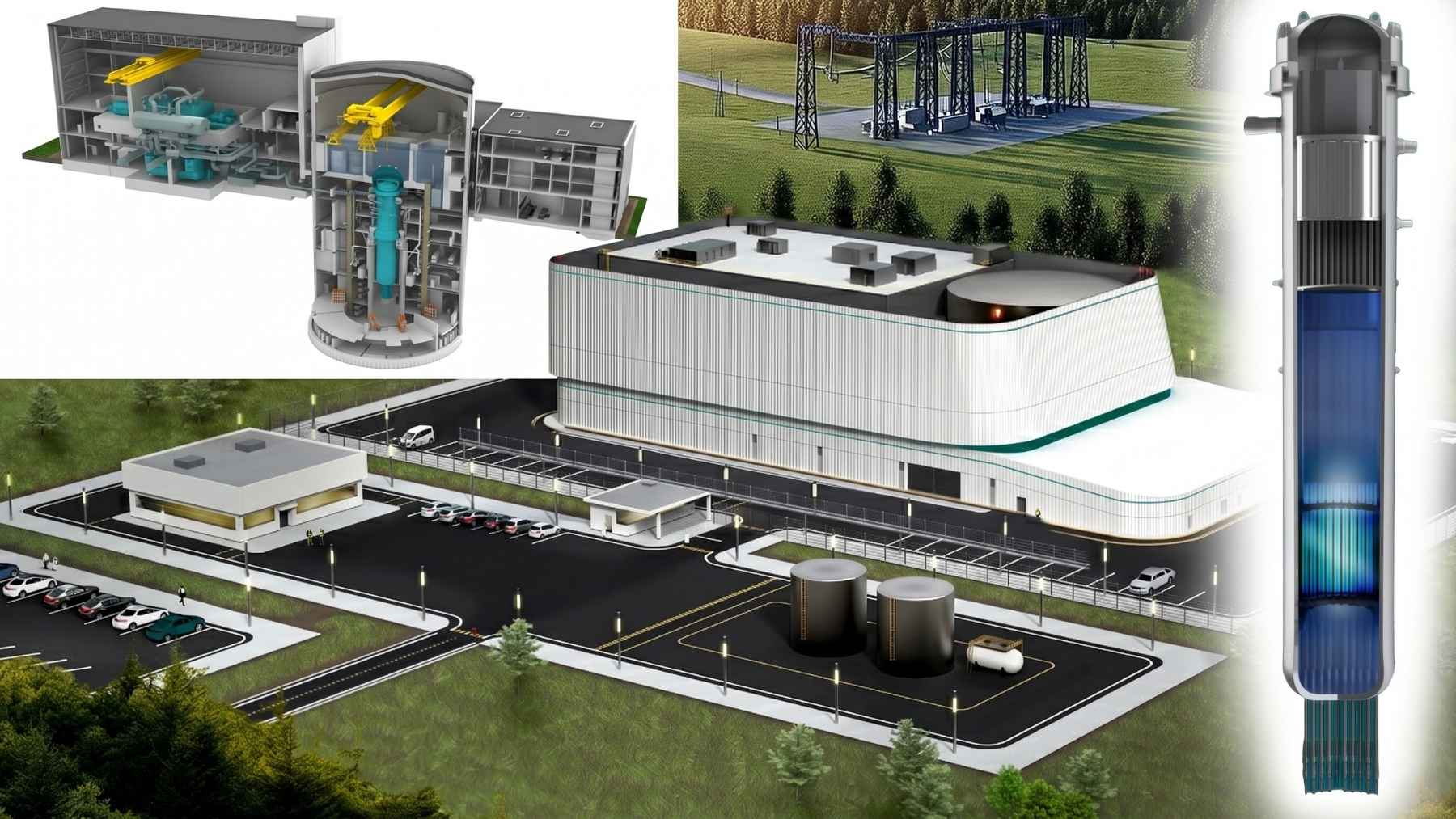
It’s a boiling water reactor, the same family that has been running on the American grid since the 1970s, shrunk to about 300 megawatts and simplified fairly aggressively. Water boils inside the vessel, steam goes straight up to the turbine, and that is the entire cycle. A pressurized water reactor needs a separate loop and a steam generator to get there; this one skips both.
GE Vernova also took some hardware out. A conventional boiling water reactor pushes coolant through the core with large electric recirculation pumps, and this one leaves them on the shelf. The vessel is tall enough that hot water rises and cooler water sinks on its own, so the loop runs on heat and gravity rather than on a pump you have to keep powered.
That vessel measures about 90 feet tall inside and 14 feet across (27.36 by 4.2 meters), according to GE Vernova’s published general description. The containment wrapped around it is a steel and concrete cylinder about 125 feet high and 62 feet wide (38 by 19 meters), and it goes deep into the ground instead of standing up in a dome you can see from the road.
The company deleted the safety relief valves too, which is the change I’d flag if you only remember one thing about this reactor. Those valves dump pressure out of a boiling water reactor in a hurry when something goes wrong. GE Vernova’s own document says they have historically been the most likely cause of a loss-of-coolant accident in this family of plants, so the design takes them out and hands the job to three isolation condensers. Each condenser is a heat exchanger sitting in its own pool of water above the reactor, and steam rises into it, condenses and drains back down. Two of the three can carry decay heat for a week with nobody touching a control, and when the pools run low, crews top them up from a fire truck.
Studsvik wants four of them on one site.
Sweden is now working on two different small reactors at once
Videberg Kraft, the project company Vattenfall set up for new nuclear, spent three years grinding through 75 reactor options and chose Rolls-Royce SMR on June 15, three units of 470 megawatts each next to the existing Ringhals plant on the west coast. The final round came down to Rolls-Royce and the BWRX-300. The British box won.
Ten days later the Swedish government agreed to buy 60 percent of Videberg Kraft from Vattenfall for up to SEK 1.8 billion (about $190 million), dropping Vattenfall to 20 percent and leaving the industrial consortium Industrikraft with the other 20 percent. Those shares formally move in the second half of 2027.
Studsvik is doing it the other way, privately, with no state shareholder in the project company. Two Swedish programs, two reactor designs, two ownership models, roughly the same finish line in the mid-2030s. For a country that hasn’t started a nuclear plant since 1985, that’s a pretty abrupt change of pace.
So why would a small country run two different reactor designs at once instead of standardizing on one? Nobody sat down and planned it. Two separate developers ran two separate procurements on their own timelines and landed in different places, and if you want a fleet of identical units, that is the slower road.
The BWRX-300 is not a paper reactor either. Ontario Power Generation is already building one at Darlington, east of Toronto, and Tennessee Valley Authority has a construction permit application in front of the Nuclear Regulatory Commission for a unit at Clinch River. Poland has approved six sites for up to 24 of them.
Nyköping has been in the nuclear business since 1947
Studsvik was founded that year as the center of Sweden’s national nuclear program, and its research reactors were shut down and dismantled a long time ago. What runs on the site today is mostly the back end of the industry.
Cyclife Sweden, an EDF subsidiary that bought the waste treatment business from Studsvik in 2016, operates a metal plant on the same industrial park. It takes components up to about 440 short tons (400 metric tons) and 98 feet long, cuts them apart, sandblasts the contaminated surfaces and melts what’s left into ingots, at a licensed rate of roughly 5,500 short tons (5,000 metric tons) a year. Four German steam generators showed up there in January, and a dozen more are booked.
So a site that takes dead reactors apart for a living now wants four live ones. Studsvik still runs hot cell laboratories there testing fuel and materials, and it holds a nuclear license for the property already, which matters because earning one from scratch takes years. The alternative is Målma, a greenfield plot at Valdemarsvik about 135 miles (220 kilometers) south of Stockholm, where an application went in this past March under Sweden’s new law requiring government sign-off for reactors outside the three existing stations. Studsvik will choose between the two during the development work.
The Swedish state hasn’t said yes yet
I’d be doing you a disservice if I let the megawatt figures sit there without the caveats, because there are several. The agreement is exclusive for a fixed period the parties can extend, and the companies state outright that it is not a final investment decision and does not authorize construction. A joint project company still has to be formed, and the definitive agreements are unwritten.
Money is the other open item. Studsvik handed an application for state support to Financial Markets Minister Niklas Wykman on June 12, covering up to 1,400 megawatts across its ReFirm program, and the government has not granted it. Negotiations over terms have not begun. Any final package needs Swedish approvals and, where it applies, European Commission clearance under EU state aid rules.
Sweden’s financing framework covers up to 5,000 MW in total and runs on state-backed loans plus two-way contracts for difference. Applications opened on August 1, 2025. Studsvik’s was the third one in, behind Videberg Kraft and the lead-cooled developer Blykalla.
Ontario Power Generation applied to the Canadian Nuclear Safety Commission on March 25, 2026 for a 20-year license to operate the first BWRX-300 at Darlington, and the regulator cleared the first construction hold point five days later. The next hold point is the installation of the reactor pressure vessel.