
Every American data center story lately runs on the same plot. Somebody has the chips, somebody has the money, and then the whole project sits around waiting for the grid. It’s why Oracle is bankrolling its own gas-fired power plant in the New Mexico desert to serve OpenAI, and why China skipped the wait entirely by sinking a data center off Shanghai and letting offshore wind and seawater handle the rest. The workarounds keep changing. The bottleneck never does.
A startup working both sides of the Oregon-Washington line has now pushed that logic to its endpoint: if the grid is the problem, don’t touch the grid. Don’t touch land either. Panthalassa builds wave-powered steel buoys that generate their own electricity in the open ocean, run AI inference chips on board, and talk to shore through nothing but a Starlink connection. No anchor. No mooring. No subsea cable. And on May 4, Peter Thiel led a $140 million Series B into the company, a round that reportedly values it at close to $1 billion.
The machine is a lollipop that works like a floating dam
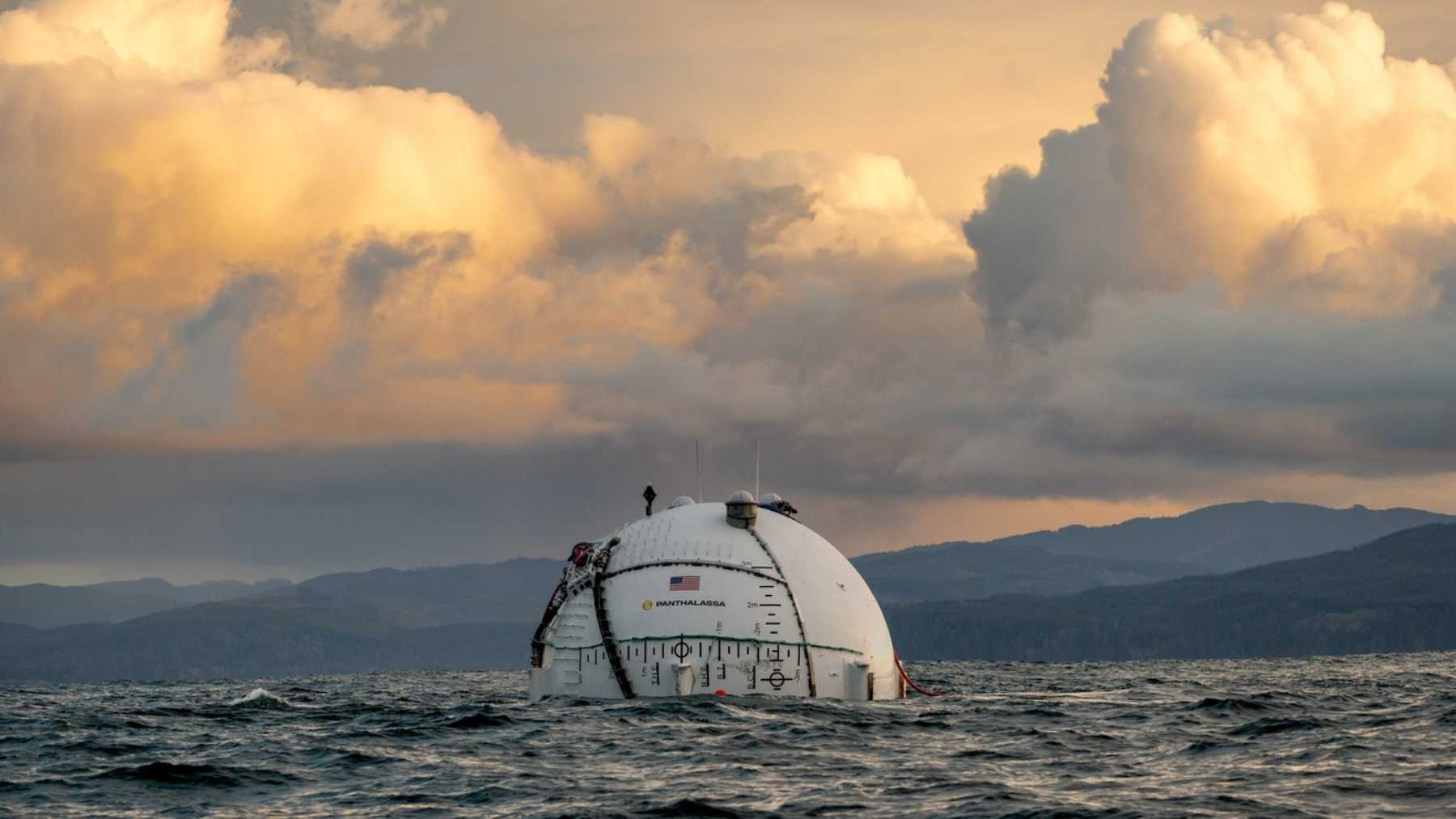
Picture a steel sphere bobbing at the surface with a long tube hanging straight down into deep water. That’s the whole machine: a giant lollipop standing upright in the middle of the ocean. Panthalassa calls the current design Ocean-3, and CEO and co-founder Garth Sheldon-Coulson walked CBS Sunday Morning through the basics back in April. Each passing wave lifts the whole structure and lets it fall again. That motion drives the water sitting inside the tube up into the sphere, where it gets pushed through a turbine. The turbine spins a generator, and the same water keeps cycling through the machine to do it all over again. Sheldon-Coulson’s go-to comparison is a hydroelectric dam, except this one floats.
So there’s no fuel, no engine, and, according to the company, no direct emissions. There’s also nothing holding it in place. The node isn’t tethered to the seabed, carries no mooring lines, and never plugs into a power cable. It gets towed out of port lying flat, flips itself upright once it reaches open water, and then holds position using the hydrodynamic shape of its own hull, as Energy Digital describes it. “It’s like a little Roomba, except it’s enormous,” Sheldon-Coulson told CBS.
Wave power has always died at the cable
Wave energy is one of those technologies that has been five years away since the 1970s. The physics were never the issue; the open ocean carries absurd amounts of energy, and it delivers day and night in a way solar can only envy. What killed project after project was everything around the generator. Mooring systems fight the sea full time. And the transmission cable back to shore costs a fortune to lay, a fortune to maintain, and a fortune to repair when the sea inevitably wins a round. You’d capture some of the cheapest raw energy on the planet, then watch the budget drown in the hardware needed to move the electrons home.
Panthalassa’s answer is to delete the cable instead of paying for it. The electricity never leaves the buoy. Inference chips ride inside the node, the cold seawater around them handles the cooling, and the wave power gets spent on the spot answering AI queries. A question goes up to a Starlink satellite, the chips chew on it, and the answer rides the same link back down. According to the company, that satellite connection is the only link to shore the entire system will ever need.
Which quietly changes what the product is. Panthalassa isn’t really selling electricity. It’s selling compute, with the electricity as a captive ingredient. That one move sidesteps the problem that has bankrupted wave-energy ventures for decades. Whether it creates new problems of its own is a fair question, and we’ll get to it.
Peter Thiel does not usually back buoys
The round, announced May 4, lands at $140 million and was led by Thiel, GeekWire reported, with the money earmarked to finish a pilot manufacturing facility near Portland. Before this, Panthalassa had raised around $78 million in total, according to Data Center Dynamics. The investor list from the announcement reads like a Silicon Valley reunion: John Doerr, Marc Benioff’s TIME Ventures, Max Levchin’s SciFi Ventures and Super Micro all participated. Thiel’s own statement ended with six words you don’t often hear in marine engineering: “Panthalassa has opened the ocean frontier.”
The company is older than the hype suggests. It was founded in 2016 as a public benefit corporation and spent nearly a decade quietly testing hardware, putting its Ocean-1 prototype in the water in 2021 and the larger Ocean-2 in 2024, per the funding announcement. The roughly 120-person team pulls from SpaceX, Tesla, Blue Origin, Boeing and NASA, among other places, and Sheldon-Coulson himself came out of hedge fund Bridgewater Associates before deciding the open ocean was the better trade.
There’s a pattern forming around money like this, too. Two months before Panthalassa’s round, Starcloud, a Washington state startup that wants to put data centers in orbit, raised $170 million of its own and crossed a $1.1 billion valuation, per the same GeekWire report. Orbit, seabed, open water: if the grid can’t feed the machines, investors will fund just about any address that can.
A 2-cent kilowatt-hour is a claim, not a price sheet
Now for the asterisks, because there are a few. The number doing the heavy lifting in this story is cost. Panthalassa asserts that, at scale, its platform could generate power for as little as $0.02 per kWh, as Data Center Dynamics notes. That figure would undercut basically everything on the market, gas included. It is also, as of today, a projection from a company with zero commercial nodes in the water. Wave energy has a long history of cost models that looked beautiful right up until the ocean started editing them.
The skeptic’s case writes itself, and outlets like CleanTechnica have already written it. Satellite links work for inference, where a small question produces a small answer, but they’re a poor fit for training frontier models, which need racks of GPUs wired together with fat, low-latency connections. That caps the addressable market at a slice of AI compute rather than the whole pie. Stationkeeping is the other open question: a free-floating machine with no mooring has to hold its patch of ocean through winter storms using hull shape and software alone, something nobody has demonstrated at fleet scale. Add saltwater corrosion, biofouling and the cost of fixing a generator that sits a very long boat ride from port, and you have a respectable list of ways this gets hard.
Panthalassa’s response to all of it is the same: build the thing and put it in the water. Construction of the Ocean-3 units is already underway, and Sheldon-Coulson told CBS he expects them operating offshore by around August of this year. The pilot series is headed for the North Pacific, with commercial deployments targeted for 2027, according to the company.
The ocean is having a real moment as an energy answer right now. Japan is pulling round-the-clock electricity out of the gap between fresh and salt water in Fukuoka. China parked its servers on the seabed. And this summer, if the schedule holds, a giant steel lollipop will start answering chatbot queries somewhere in the North Pacific with nothing beneath it but very deep water. If the 2-cent claim survives contact with the real ocean, every grid fight we cover starts to look optional. If it doesn’t, the Pacific gets a very expensive bath toy. Either way, the answer arrives fast, and it arrives by satellite.
 @marcbrown ROOKIE3 months ago