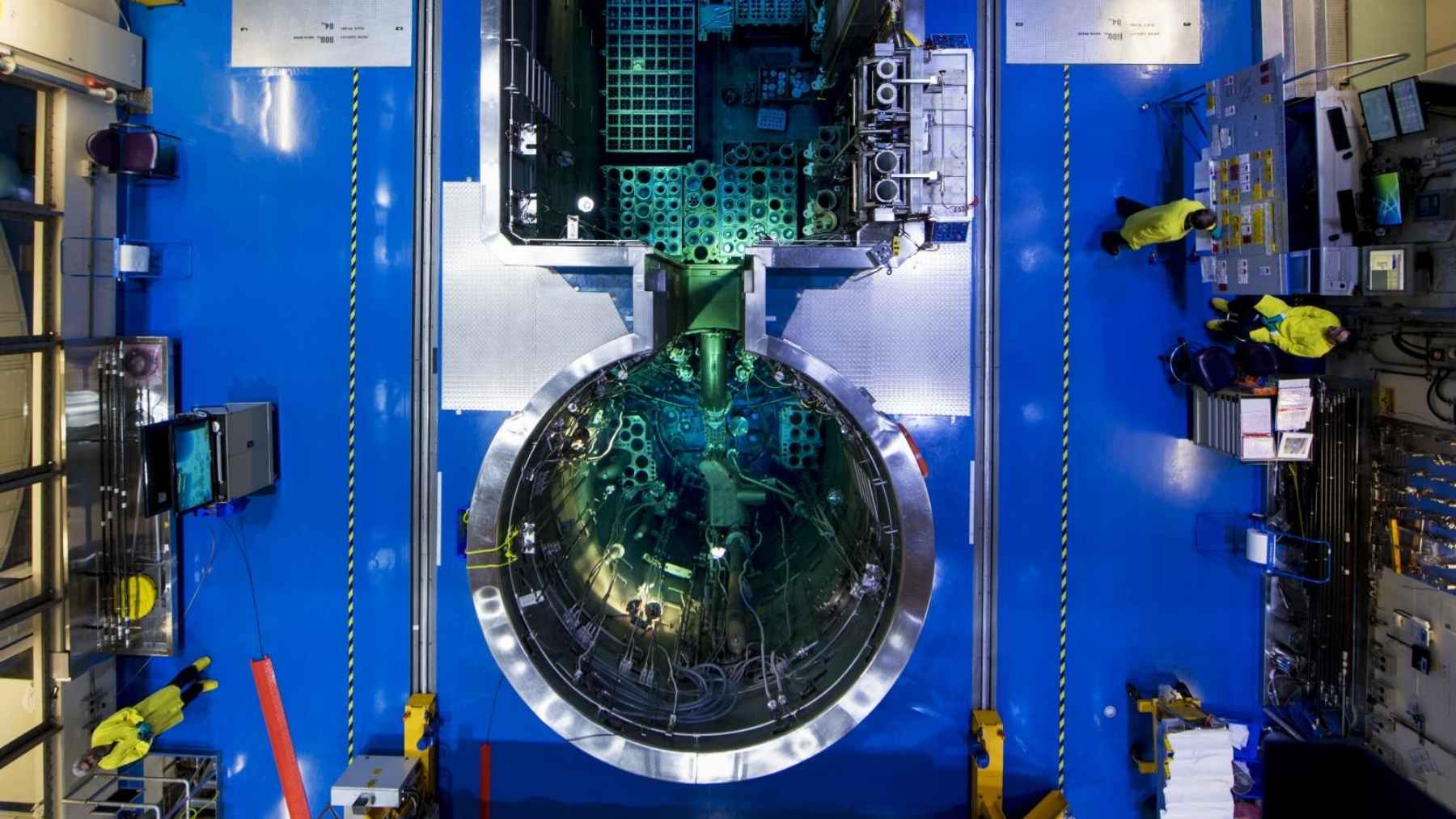

You’ve probably heard the joke that a nuclear power plant is just a very expensive way to boil water. And whoever came up with it wasn’t far off. A power reactor splits atoms to make heat, and the plant turns that heat into steam to spin a turbine for the grid.
Australia’s only nuclear reactor doesn’t boil water for anyone. It’s called OPAL, it sits at Lucas Heights on the southern edge of Sydney, and ANSTO, the federal nuclear science agency that runs it, says outright that it can’t be converted to make electricity. Nuclear power plants are banned under Australian federal law anyway, so no one’s asking it to.
OPAL makes neutrons instead, about 1.5 quintillion of them every second by ANSTO’s count. Particle accelerators can make neutrons too (that’s what the spinning tungsten wheel inside Sweden’s spallation source is for), but a reactor turns them out just by running. ANSTO uses OPAL’s neutrons to make medical isotopes, pipes them next door to a building full of research instruments and soaks silicon ingots in them.
OPAL first went critical 20 years ago last month, which is reactor-speak for its chain reaction starting to keep itself going. ANSTO marked the anniversary on August 12 with a tally of what the reactor’s done since, counting more than 10 million nuclear medicine doses it helped produce and more than 8,000 experiments. It also counts more than 990 tons (900 metric tons) of silicon ingots irradiated in OPAL’s pool.
ANSTO’s CEO, Shaun Jenkinson, put OPAL’s work in fairly personal terms in the agency’s anniversary announcement. If you drive an EV or a hybrid, he said, there’s “a very good chance” some small part of it works because of OPAL, and he extended that to anyone who’s been on a high-speed train in another country. That’s a pretty bold thing to say about a machine that can’t power a light bulb.
So what does a reactor actually do to a lump of silicon?
Silicon needs a little help to carry current
Pure silicon is actually lousy at conducting electricity. Silicon makers fix that by adding a tiny amount of another element, and phosphorus is one of the usual picks. That’s called doping.
Manufacturers normally do it chemically while the crystal’s being grown, and it works fine for most chips. But chemical doping never spreads the phosphorus perfectly evenly, and ANSTO says that evenness matters most in high-power gear. That’s the kind of hardware that switches current in EVs, electric trains and the power grid.
A reactor does it from the inside. About 3% of the atoms in natural silicon are a slightly heavier version called silicon-30. When one of those atoms absorbs a neutron, it turns into silicon-31, which is unstable, and according to the IAEA, half of any silicon-31 decays into phosphorus within about 2.6 hours.
Silicon-30 is spread evenly through the ingot to begin with, so the phosphorus ends up spread evenly too. The reactor makes the new element out of atoms that were already sitting in the crystal, and frankly, I think that’s a clever trick.
The ingots go in while the reactor’s running
OPAL has six vertical slots for silicon inside its reflector vessel, a tank of heavy water (water whose hydrogen carries an extra neutron) that surrounds the core and bounces some of its neutrons back in. The ingots ride in unsealed cans on a rotating rig, and operators can load and unload them with the reactor at full power.
A batch can be anywhere from 4 to 8 inches across and just under 2 feet long. Depending on what the silicon maker orders, it stays in for anything from an hour or less to five days, and the agency says the result lands within 5% of the resistivity the customer asked for. Resistivity is basically how hard the silicon makes current work to get through it.
You might be wondering whether it comes out radioactive. For a little while, yes. The cans go into a neighboring service pool, where the agency says the activity dies down over about 48 hours. Then the ingots get cleaned and checked to confirm they’re no longer radioactive before they ship back to the manufacturer.
The whole core is a 4-by-4 grid
OPAL’s core is 16 fuel assemblies arranged four by four, with five control rods to regulate its power and shut it down. It runs on low-enriched uranium. The reflector vessel holding all of that sits at the bottom of a pool about 43 feet (13 meters) deep. The water cools the fuel and doubles as a radiation shield. And because the pool is open at the top, operators can look straight down into it and handle things in the water.
OPAL’s rated at 20 megawatts of heat. Research reactors are usually rated that way, since the heat’s basically a by-product, and OPAL doesn’t turn any of it into electricity.
Oak Ridge’s High Flux Isotope Reactor in Tennessee runs at 85 megawatts compared with OPAL’s 20, and we’ve covered the californium it makes for starting up new American reactors. The Westinghouse AP1000, the design Georgia’s Plant Vogtle uses for its two newest reactors, is rated at 3,415 thermal megawatts, more than 170 times OPAL’s 20. By reactor standards, OPAL’s pretty small.
OPAL runs about 300 days a year
ANSTO schedules OPAL to run around the clock for 300 days a year, in stretches of 30 to 35 days. Each stretch ends with a refueling outage that usually lasts four to six days, when crews pull three spent fuel assemblies out of the core and put fresh ones in. Longer maintenance shutdowns of one to four weeks get worked in on top of that.
ANSTO says OPAL was designed to run for at least 40 years, and that it’s working on keeping the reactor going well beyond that. At 20, OPAL’s arguably only middle-aged.
So is any of it in your car?
Maybe, but you’d have a hard time proving it. ANSTO reports those 990-plus tons as one total in its anniversary material, with no split by customer or industry. Which means I can’t tell you how much went into cars rather than trains, grid equipment or renewable energy hardware. I also went looking for a way to check whether a specific car’s power electronics started out as reactor-treated silicon, and came up empty.
Jenkinson told ABC News that Lucas Heights has 60% of the market for this kind of silicon worldwide, and ANSTO’s own website calls the agency the world’s largest producer of it. I haven’t found an independent count of that market to check either one against, so I’d treat both as ANSTO’s own numbers.
In the fiscal year that ended on June 30, ANSTO says OPAL ran for 98.3% of its scheduled time, and the reactor schedule it last updated on July 17 has OPAL penciled in through 2028.