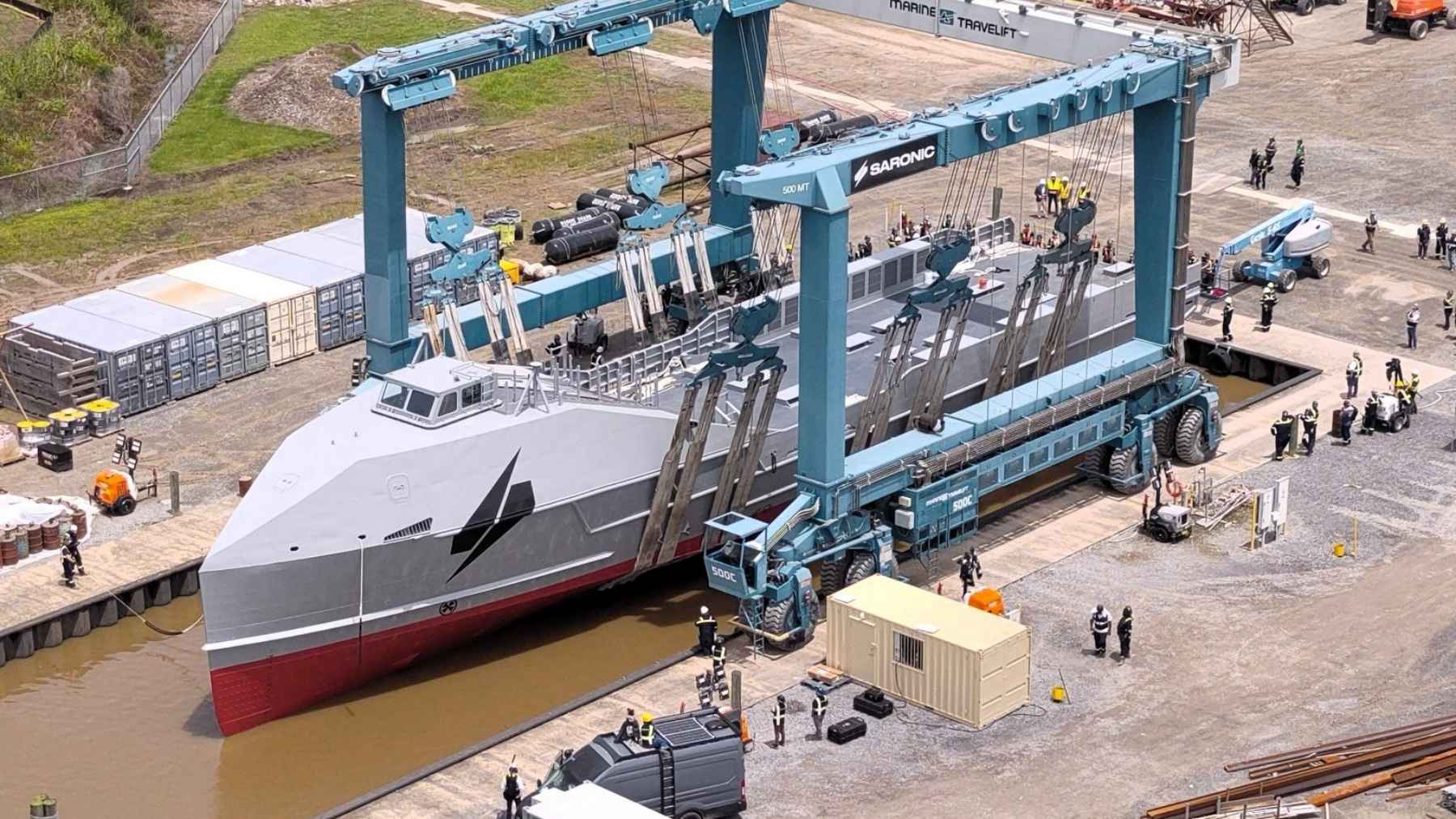

Building a warship in America is famously a slow, expensive business. The big combatants the Navy actually fights with, the destroyers and frigates and carriers, spend years in design review and years more on the ways before anyone gets them wet, and the bill runs into the billions. So when a four-year-old startup out of Austin says it took an entirely new class of ship from a blank sheet to on-water trials in under twelve months, the honest first reaction is to assume someone got generous with the calendar. Saronic Technologies launched the first hull of its Marauder in late May, and the numbers behind it are worth slowing down on.
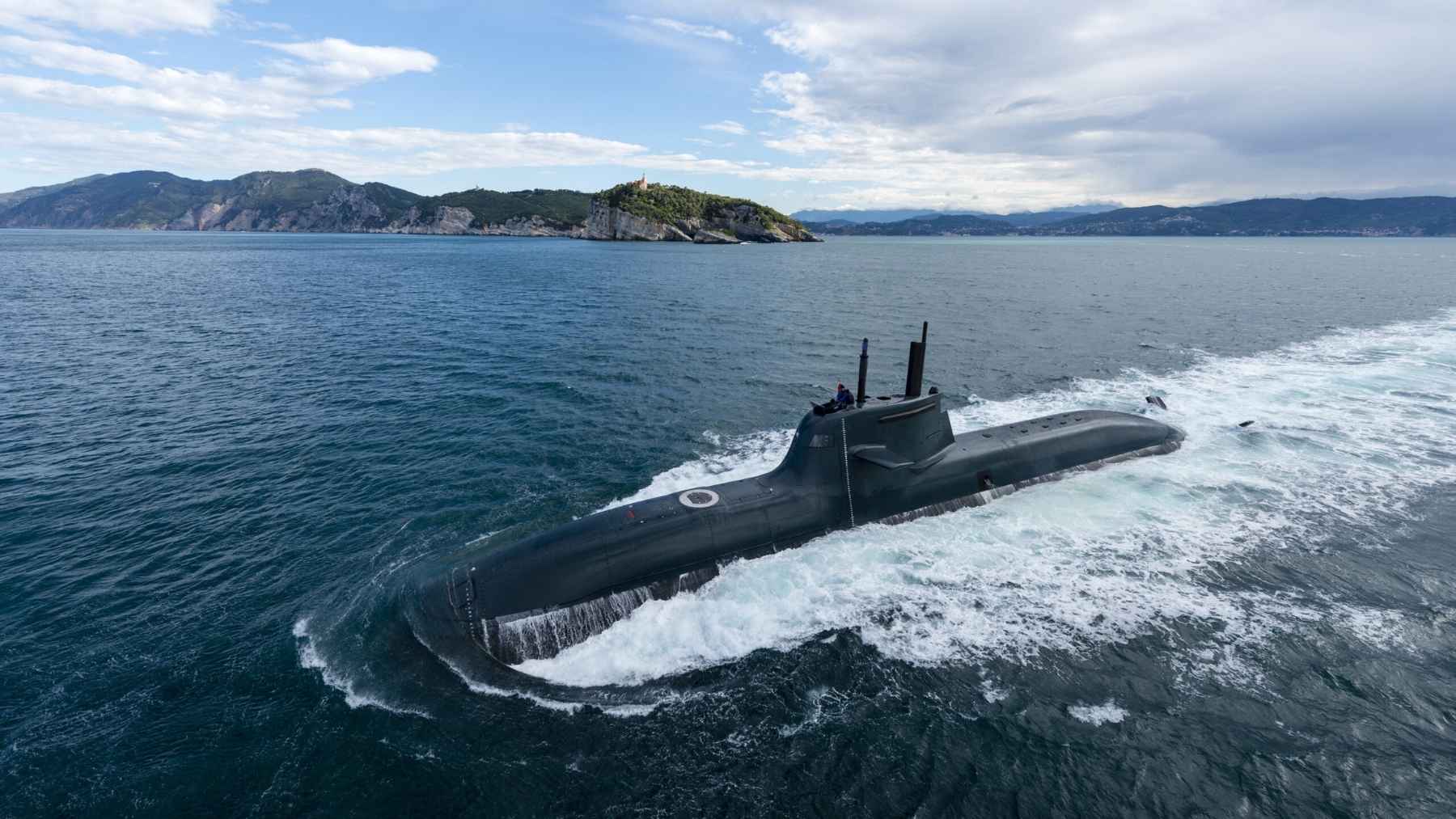
The Marauder is a 180-foot Medium Unmanned Surface Vessel, or MUSV, and it went into the water at the company’s shipyard in Franklin, Louisiana, to start on-water trials, according to Naval News. It is not in service, it is not deployed, and the Navy has not bought one. What it is, for now, is a very large robot boat floating in a Louisiana bayou, and that turns out to be a bigger deal than it sounds.
The Marauder is a 180-foot hull designed to stay out for weeks
By Saronic’s figures, the Marauder tops out at more than 25 knots, carries a 150-ton payload, and has a range of up to 5,400 nautical miles, dropping closer to 4,100 when it’s loaded to the gills. Those are not patrol-skiff numbers. A 150-ton payload and a multi-thousand-mile range put it in the category of a logistics and sensing platform that can cross an ocean and loiter, rather than a small drone that gets trucked to a coast and tossed in.
The autonomy is the other half of it. Saronic runs a software-based fleet intelligence platform that keeps a human on the loop, so operators get real-time visibility into what the ship is doing and can step in, rather than a sailor in a seat steering every turn. NVIDIA hardware runs onboard to process vision and reasoning models at the edge, which is how a hull with nobody aboard decides what to do when it sees something. It is the same edge-autonomy problem carmakers are trying to crack for genuinely hands-off Level 4 driving on the road, just with saltwater and a much larger hull.
Under a year from design to the water is the part that matters
The spec sheet is interesting. The build timeline is the actual headline. Saronic laid the keel for the first Marauder in August 2025 and had the hull in the water by late May, going from initial design to on-water trials in under a year, which the company calls a pace American shipbuilding hasn’t seen since World War II. That “since World War II” line is Saronic’s framing, not a Navy assessment, so read it as the company planting a flag rather than a neutral measurement. The point underneath it holds up either way: traditional shipbuilding measures this kind of milestone in years, not months.
How they pulled it off is less glamorous than the claim. Saronic bought the former Gulf Craft yard in Franklin, ran design, manufacturing and autonomy development under one roof instead of farming them out to three organizations on three timelines, and treated the hull as the first unit of a production line rather than a one-off prototype. The second Marauder hull was flipped in March and is being fitted out now; the third and fourth are already under construction. A $300 million expansion of the Franklin yard broke ground in November 2025, will add more than 300,000 square feet, and is meant to be capable of building up to 20 Marauders a year once it’s finished by the end of 2026. Saronic says that expansion should add around 1,500 jobs.
One boat under contract, and a $9.25 billion checkbook
This is the part that’s easy to blur, so let’s be exact. The Marauder does not yet have a production contract. The boat Saronic actually has under contract is the Corsair, a 24-foot autonomous surface vessel that carries roughly 1,000 pounds out to more than 1,000 nautical miles at 35-plus knots. The Navy awarded Saronic a $392 million Corsair production contract in December 2025, announced by Navy Secretary John Phelan at the Reagan National Defense Forum, with nearly $200 million put on contract right away. Phelan’s whole pitch was speed: prototype to production in under a year, done through an Other Transaction Authority agreement rather than the usual acquisition crawl.
The checkbook behind all this is large. In March, Saronic closed a $1.75 billion Series D led by Kleiner Perkins at a $9.25 billion valuation, more than double the $4 billion it was worth a year earlier. The company is run by co-founder and CEO Dino Mavrookas, a former Navy SEAL, and now employs more than 1,300 people. Part of that money is earmarked for Port Alpha, a next-generation yard in Texas the company calls the shipyard it really wants to build.
The Navy hasn’t actually bought a Marauder
Here’s where the launch and the program need to stay separate. A few days before the hull hit the water, the Navy named Saronic one of seven companies selected for its MUSV Marketplace, a prototype effort that will run at-sea demonstrations from June through October 2026. Each selected company is in line for roughly $15 million to support testing, and the platforms that pass could become eligible for larger follow-on production work in roles like intelligence and surveillance, logistics, maritime sensing and distributed operations. Saronic is competing there against bigger, established shipbuilders, which makes showing up with real hardware in the water instead of a slide deck exactly the demand signal a startup wants to send. It is not the Navy committing to buy the thing.
Congress wants a plan before it wants the boats
There’s one more wrinkle, and it landed the same week. The House Armed Services Committee’s draft of the fiscal 2027 defense policy bill includes a provision that would block the Navy from taking delivery of unmanned surface vessels until the service hands Congress a concept of operations, a concept of employment, and a strategy for folding these ships into the fleet’s overall design. It’s the kind of language that doesn’t kill a program, but it does remind everyone that putting a robot warship in the water is the easy part. Figuring out what a fleet of them is actually for, who commands them, and how they fit next to crewed ships is the part nobody has fully written down. It’s the same gap lawmakers are still trying to close for autonomous cars on American roads: the machine tends to work before the rulebook does. Saronic built the boat fast. The doctrine to use it is still moving at the old speed.