
Energy tech misses its deadlines so reliably that the misses barely register anymore. Fusion has been a couple of decades out for about as long as anyone reading this has been alive, hydrogen keeps rescheduling its big year, and the whole sector has quietly learned to file it under “eventually.”
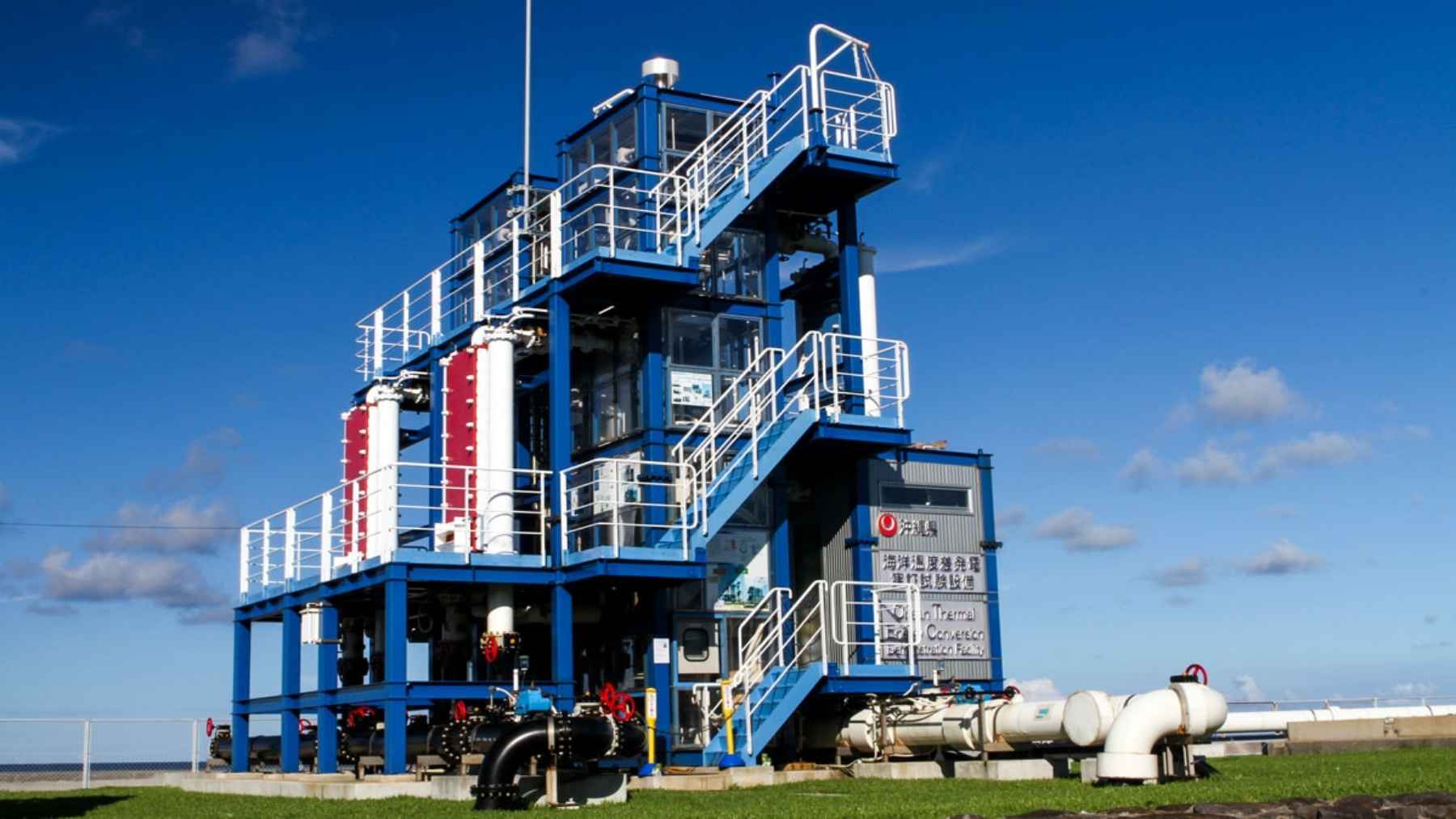
So an obscure ocean-power project blowing past its target date should be worth a shrug and nothing more. This one isn’t, because the usual excuse doesn’t apply. The machine works. It has been sitting on Kume Island in Okinawa making electricity since 2013.
In March 2023, Mitsui O.S.K. Lines announced it was going after the world’s first commercial ocean thermal energy conversion plant, at 1 megawatt, “by around 2026.” It’s July 2026. There is no 1 MW plant.
What there is instead is a partnership agreement MOL signed with Kumejima Town on October 28, 2025. It moves the start of operations out to fiscal 2031, and it lists as its first order of business the “development and design of intake systems” for that 1 MW plant.
Five years, gone. Not because the physics quit. Because of a pipe.
A 20-degree gap is enough to spin a turbine
Ocean thermal energy conversion is a heat engine, and heat engines need a hot side and a cold side. The ocean happens to sell both at the same address.
At Kumejima the surface water sits between 25 and 30 degrees Celsius all year. A pipe running about 2.3 kilometers offshore and 612 meters straight down hauls up water at 8 to 10 degrees. Those numbers come from Xenesys, the Tokyo engineering firm that built the plant and still maintains it for Okinawa Prefecture.
The warm water boils a working fluid. The vapor spins a turbine. The cold water condenses that vapor back to liquid, a pump sends it around again, and nothing gets burned or vented.
The fluid at Kumejima is R134a, the refrigerant that spent two decades in car air conditioning before regulators pushed it out. It boils well below freezing at atmospheric pressure, which is the whole trick: you don’t need much heat to turn it into a gas.
Roughly 20 degrees of difference is the floor for any of this to work. Which is why the map of viable sites is basically the tropics and a thin band either side of them.
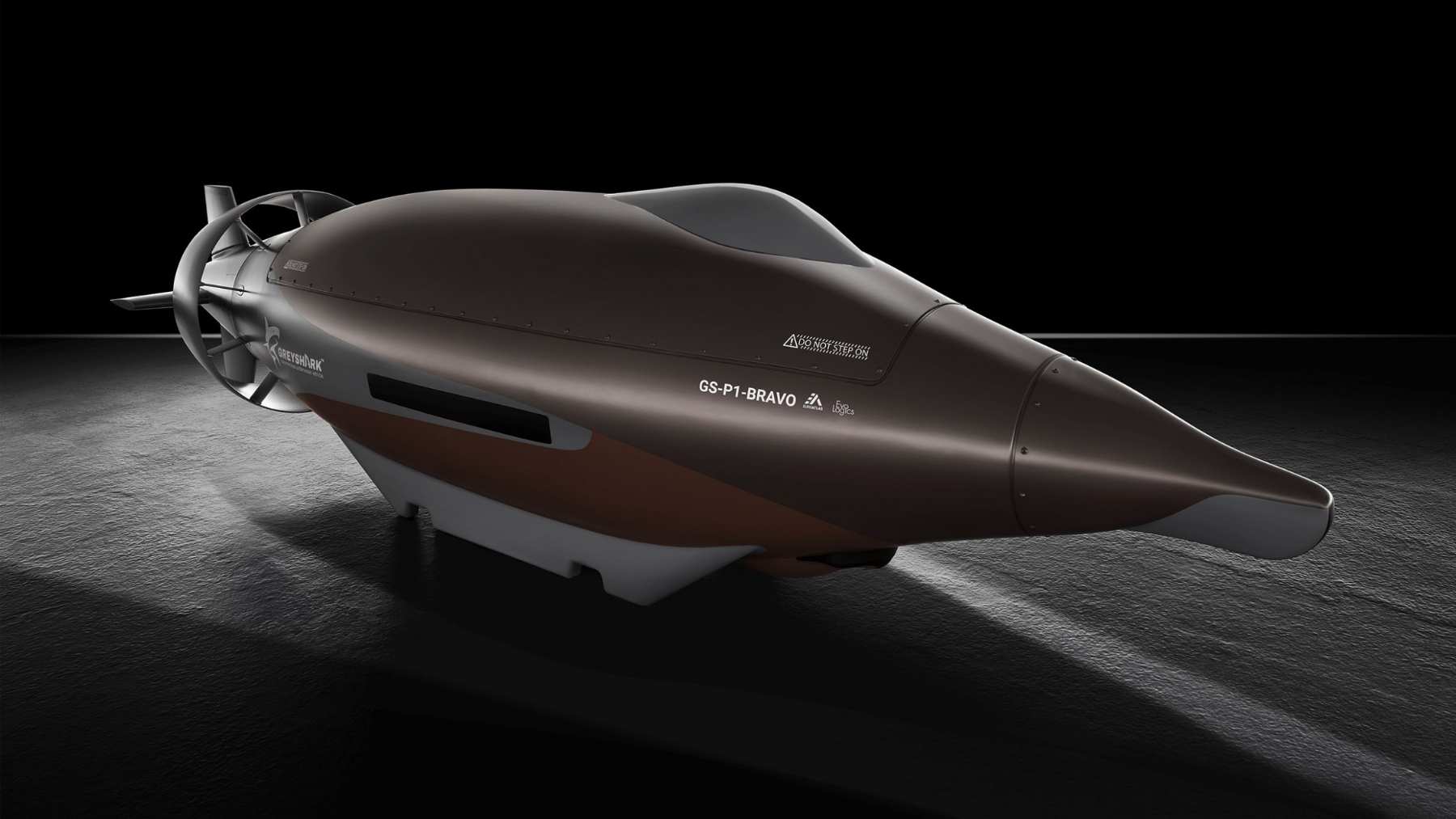
Japan has been picking at the ocean’s leftover physics for years now. It has tethered a 330-ton turbine shaped like an airplane in the Kuroshio Current, and it runs a plant in Fukuoka that pulls power from the salinity gap between brine and treated wastewater. Kumejima is the oldest of the bunch.
The plant is last in line for its own water
The facility is rated at 100 kilowatts. Not megawatts. A hundred kilowatts, which is roughly what one fast EV charger pulls when it’s working hard.
And it frequently makes less than that. Okinawa Prefecture’s own page for the plant explains why without any embarrassment: the demonstration unit doesn’t always get its full allocation of seawater, because other users on the island have first call on it.
The power plant is at the back of the queue behind the shrimp farms. That isn’t a complaint from the prefecture, it’s a statement of priorities. The plant exists to prove a point. The aquaculture businesses exist to make money.
The pipe is the part that keeps killing these projects
Every renewable has one component that eats the budget. Wind has the turbine, solar has the panel. OTEC has a tube full of cold water.
Taking Kumejima from 100 kilowatts to 1 megawatt means a new intake roughly 1.5 meters across, and the island expects to spend between $60 million and $80 million on it, according to reporting by Eos, the American Geophysical Union’s science magazine. Sixty million dollars of plumbing to feed one megawatt of plant.
Scale up and it gets uglier before it gets better. A 100 MW plant wants an intake seven to ten meters in diameter, which stops being a pipe and starts being a tunnel.
The last outfit to try this at scale is the cautionary tale. NEMO was a 16 MW floating plant planned off Bellefontaine, Martinique, run by Akuo Energy and DCNS, later renamed Naval Energies, with €72 million of EU funding awarded in 2014. In 2018 it was frozen. Akuo said the reason was technical difficulty with the main cold-water intake pipe.
The design had called for about a kilometer of tube, six meters wide, hanging off a floating platform in a cyclone belt. Nobody has cracked that one yet.
Which is why MOL’s October agreement leads with intake design instead of turbines, and why fiscal 2031 is a plumbing schedule rather than a power schedule.
The cold water gets used four more times after the turbine is finished with it
All of which raises the obvious question. Why would anyone spend $60 million on a pipe to run a 1 MW power plant?
Because it isn’t a power plant’s pipe.
Water leaving the condenser comes out chemically unchanged and still cold, around 10 to 12 degrees. MOL’s framing is that the same water gets a second life in fisheries, agriculture and air conditioning once the generator is done with it.
That’s not a brochure line, it’s the existing business. The prefecture’s OTEC site counts 18 companies on the island drawing on deep seawater, and the demonstration work names them: sea grapes grown by Kumejima Deep Seawater Development, land-based oyster farming by GO Farm, alongside the kuruma prawns the island has farmed since the 1970s.
Then there’s chilled-soil agriculture, where cold water pushed through underground pipes lets temperate crops grow in a subtropical climate. A deep-seawater spa. Cosmetics. Bottled water.
Before the first intake pipe went in back in 2000, the island’s biggest industry was sugarcane.
The economics only close if the pipe gets treated as shared infrastructure, the way a town treats a water main, with everyone who benefits paying into it. On Kumejima that’s already how it runs. The sea grape and prawn operations pay for the deep water they draw.
The town’s stated goal is 100% renewable self-sufficiency by 2040, with OTEC as the baseload sitting underneath the solar.
It’s the same move that rescued osmotic power, incidentally. That technology went nowhere for years on river water, and only started working in Denmark when someone fed it industrial brine instead. Sometimes the fix isn’t the machine, it’s what you point it at.
Hawaii has the same setup and a much bigger power bill
None of this is foreign to the United States. The Natural Energy Laboratory of Hawaii Authority at Keahole Point on the Big Island has been running the identical experiment, cascade and all, for decades.
Makai Ocean Engineering’s 105 kW plant there has been feeding the grid since 2015 and is still the largest grid-connected OTEC unit anywhere on earth. The Department of Energy’s marine energy database is blunt about what that actually means: it is not a commercial power plant and it does not run continuously.
What makes Hawaii worth watching is arithmetic. A Pacific Northwest National Laboratory team published a DOE-funded feasibility study in the Journal of Marine Science and Engineering on December 30, 2025, modeling the thermal resource off Kona.
The water there supports a 100 MW plant year-round. Mean output above 80 MW at 500 meters, above 100 MW with 95% probability once you pass 1,000 meters, and up to 1.2 terawatt-hours a year out of a single plant.
The same paper prices electricity on the Big Island between 39.73 and 52.79 cents per kilowatt-hour in 2024, against a mainland average of 13.27 to 17.01 cents. Hawaiians pay roughly triple what you do.
Published levelized costs for large offshore OTEC land between 18 and 44 cents per kWh. That’s not a fair fight, because a retail bill carries transmission and margin that a plant-gate number doesn’t. But the ranges overlap, and that overlap is why Hawaii keeps commissioning studies instead of dropping the idea.
The catch is the entry fee. First-of-a-kind commercial OTEC plants are estimated at $500 million to $800 million. And when the PNNL team surveyed NELHA’s tenants, it found the same dependency you see on Kumejima. Several said flatly that they could not run profitably without the cold water, because cooling anything with Hawaiian electricity is punishing.
Three percent is the number everyone leads with, and it’s the wrong one
Worth saying the quiet part before the comments do. OTEC is appallingly inefficient. The PNNL paper puts the theoretical ceiling at 4.7% for open-cycle systems and 6.7% for closed-cycle, and working plants land near 3%. A combined-cycle gas plant clears 60%.
Measured that way the technology is a punchline, and its own engineers will tell you so.
But efficiency tracks what fraction of your fuel you convert, and that only matters when the fuel costs money. Nobody invoices Kumejima for the Pacific Ocean. Waste 97% of a free, self-replenishing temperature gradient and you’ve lost nothing except the pumping energy, which the plant already pays out of its own output.
The number that decides this is capital cost per delivered kilowatt-hour, and that one moves with size. Okinawa Prefecture’s published figures, worked out with IHI Plant Construction, Xenesys, Yokogawa Electric and shipbuilder Japan Marine United, put a commercial 1 MW-class plant at 31.0 to 44.5 yen per kWh and a 10 MW-class at 18.6 to 23.5. Ten times the plant, roughly half the cost per unit of electricity.
Which is the trap. It has to be big to be cheap, and it has to be cheap to get built big.
So the figure worth tracking on Kume Island isn’t 3%. It’s 1.5 meters, the diameter of a pipe that costs more than the power plant hanging off the end of it.
Fiscal 2031 isn’t a bet on thermodynamics. Those were settled when French physicist Jacques-Arsène d’Arsonval proposed the idea in 1881, and settled again in practice on Kumejima in 2013. It’s a bet that an island of a few thousand people can justify that pipe on the grounds that a power plant, an oyster hatchery, a prawn farm and the air conditioning can all drink from it at once.
If the cascade pays, the electricity is close to a bonus. If it doesn’t, 2031 slips too, and somebody writes this same piece again in five years.