
Ask anyone building a data center in Texas how they plan to power the thing, and the answer has gotten boringly consistent. Park a row of gas engines out back, run them behind the meter, stop waiting on the utility.
There is a good reason it became the default. Interconnection in ERCOT and PJM is now a multi-year problem, and nobody spending billions on an AI buildout wants to explain a two-year power delay to a board.
So the interesting part of what Amogy and 2G Energy pulled off at a facility in Houston isn’t that they built another on-site generator. It’s what they poured into it.
The two companies said on August 3 that they had completed an integrated ammonia-to-power test, according to their joint announcement on GlobeNewswire. A chemical reactor splits liquid ammonia into hydrogen. That hydrogen travels a few feet into a German piston engine. The engine makes electricity.
No hydrogen storage tank. No fuel cell stack. And whenever the operator wants, the same engine goes back to burning methane out of the pipeline.
The reactor and the engine had to learn to talk to each other
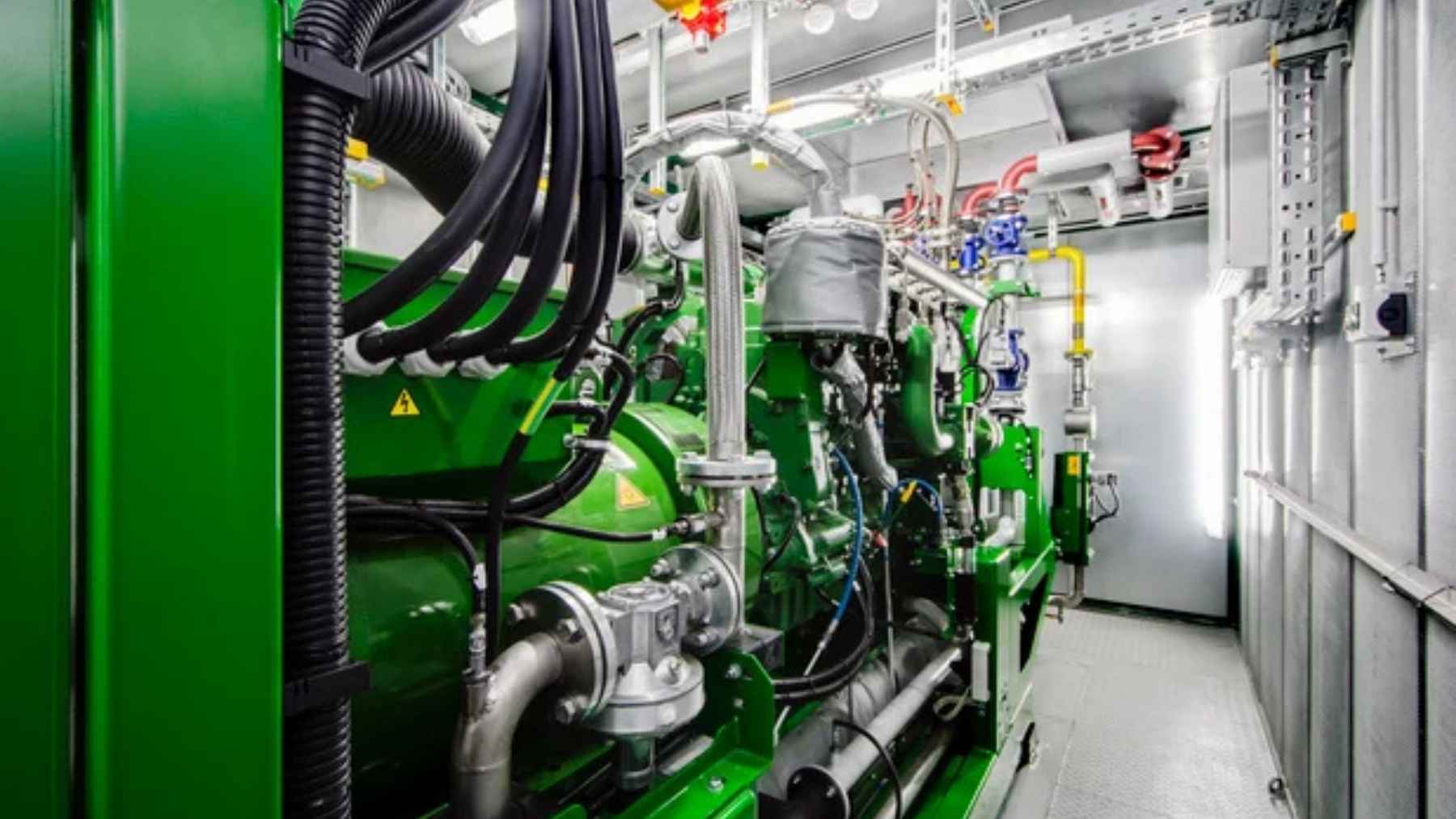
The product has a name, AMMDrive, and a very specific hardware pairing. Amogy supplies the ammonia reformer. 2G supplies an Agenitor 412 reciprocating engine-generator set, which is a machine it has been selling into European cogeneration for years with a gas meter on the front instead of a chemical reactor.
Data Center Dynamics reported that the reformer turned ammonia into a hydrogen-rich stream that ran the engine and hit the numbers both companies say a commercial product needs. Amogy CEO Seonghoon Woo called the result “an important proof point for Amogy’s ammonia-to-power platform.”
What actually got proven is the handshake. Fuel delivery, control systems, two very different pieces of hardware agreeing on what they’re doing. That sounds unglamorous until you remember it’s the step that kills most integration projects.
The companies also say the engine can be configured to throw off usable heat alongside the electricity, and that the architecture is modular enough to add capacity in stages rather than all at once. Neither firm disclosed the electrical output of the unit that ran in Houston. For scale, 2G’s own hydrogen product literature lists the Agenitor 412 running on pure hydrogen at 360 kW electrical and 40.5 percent electrical efficiency. Whether the ammonia-fed version lands in the same neighborhood is exactly the kind of thing a commercial deployment would settle.
Cracking ammonia is old chemistry aimed at a new customer
Ammonia is NH₃. Three hydrogen atoms hanging off one nitrogen. Push it through the right catalyst at the right temperature and it splits, or cracks, into hydrogen gas and nitrogen gas.
The hydrogen is the point. The nitrogen makes up about 78 percent of the air you’re breathing right now, so nobody spends much time worrying about where it ends up. Amogy has been selling that trick for years, and mostly it has pointed the resulting hydrogen at a fuel cell. The company powered a drone, a farm tractor and a semi-truck, then in September 2024 sailed a retrofitted 1957 tugboat it named the NH3 Kraken on a Hudson River tributary north of New York City.
Houston is different because the endpoint is a reciprocating internal combustion engine. Pistons, crankshaft, connecting rods, valves. The distinction matters more than it sounds: a fuel cell converts hydrogen electrochemically and a piston engine burns it, and those are two entirely separate engineering problems with separate emissions profiles. Burning a hydrogen-rich stream in air at combustion temperature makes nitrogen oxides. A fuel cell doesn’t, and that gap is what an air permit writer in Texas gets paid to care about.
The fuel cell version of this argument is already running commercially. One Santa Clara data center has spent more than two years off the utility grid making its own electricity from hydrogen fuel cells and cooling its racks with the water those cells produce. Amogy and 2G are betting a piston engine is the cheaper, more familiar path to the same place.
2G’s engines already eat four different fuels
2G isn’t a name most Americans know. It was founded in Heek, in North Rhine-Westphalia, in 1995, and it builds combined heat and power units across a range the company puts at 20 kW to 4,500 kW.
Fuel flexibility has always been the business model. DCD reported in May that 2G’s containerized products span 50 kW to 2.5 MW, and that most of them run on biogas, natural gas, hydrogen or propane without changing the block. Feeding one a hydrogen-rich stream from an ammonia cracker isn’t a philosophical leap for a company that already sells pure-hydrogen units. It’s the same combustion chemistry with a different delivery method.
The American numbers are what make 2G worth watching. On July 30 the company confirmed second-quarter order intake of €422.4 million, against €54.1 million a year earlier. US data centers alone accounted for €350.3 million of that, up from €8.3 million.
First-half order intake came to €479.4 million, and management held full-year revenue guidance at €490 million with an EBIT margin of 9.5 to 10.5 percent. Pairing with Amogy gives that sales team an ammonia story to tell on top of the gas story it was already telling very successfully.
Switching back to methane is the actual sales pitch
Here is where the pitch gets clever and a little hedged at the same time. Low-carbon ammonia at hyperscale volume does not exist yet. So neither company is asking a data center operator to bet a multi-billion-dollar campus on a fuel with no mature market behind it.
What they’re selling is one physical machine with two modes. Install it now, run methane today because that’s what the pipeline delivers, and pipe in the reformer later if the ammonia market matures or the sustainability reporting starts biting.
Strip the press-release language off that and you get a pretty honest proposition: buy the engine, keep the option. 2G CEO Pablo Hofelich framed the collaboration as evidence its engine platform can handle a broad set of fuel pathways, ammonia-derived hydrogen included.
Whether a hyperscaler pays a premium for optionality it may never exercise is a different question. Optionality is easier to sell to an engineering team than to a CFO.
Reciprocating engines are quietly winning the speed race
Amogy and 2G aren’t chasing a niche. They’re chasing the fastest-growing corner of American power procurement.
Enverus Intelligence Research published a forecast on August 11 putting 25.5 GW of new US industrial demand on behind-the-meter generation between 2026 and 2030. Data centers account for 22.5 GW of that, or 88 percent, which works out to roughly 36 percent of all US data center capacity added over the period.
PJM and ERCOT together make up nearly half of it, at 7.5 GW and 5.0 GW respectively. Serving all of that will take 31.6 GW of generation, and 29.6 GW of it is gas-fired. The technology split is the part that should interest 2G. Piston engines, fuel cells and turbines in the small and medium frame sizes take 61 percent of that gas-fired total: 7.1 GW, 4.8 GW and 6.2 GW respectively.
EIR’s stated reason is speed. Those machines usually reach commercial operation in under two years, where a big combined-cycle plant can take closer to seven. EIR senior analyst Alex Nevokshonoff said the faster-deploying options carry “a significant timing advantage.”
Everyone with a clean-power pilot is chasing those same buyers. FuelCell Energy said in March that its development pipeline had grown 275 percent since February 2025, driven overwhelmingly by data centers. The nuclear crowd is circling too, with shipping-container microreactors already on hyperscaler radar.
The gas incumbents are not exactly quiet either. VoltaGrid has a 2.3 GW agreement with Oracle and a separate 1 GW deal with Vantage for containerized natural gas systems, per DCD. That is the wall a container-scale ammonia unit is walking up to.
The ammonia itself is still the expensive part
Here’s the awkward arithmetic. The IEA’s Ammonia Technology Roadmap puts just over 70 percent of global ammonia production on natural-gas steam reforming, with most of the remainder coming from coal gasification.
Cracking gas-derived ammonia back into hydrogen to avoid burning gas is a circle you can draw but not close. And the clean alternatives cost real money: the IEA pegs near-zero-emission ammonia routes at 10 to 100 percent more expensive per metric ton than conventional ones.
Supply is the other half. The agency counted existing and announced near-zero-emission ammonia capacity of nearly 8 Mt due online by 2030, which amounted to roughly 3 percent of what the world could make in 2020.
The Houston test didn’t touch any of that. It didn’t demonstrate megawatt-scale continuous running, it didn’t fix a cost per kilowatt-hour, and it didn’t conjure a low-carbon ammonia supply chain into existence.
What Amogy does have is a project list that has stopped looking scattershot. In June it signed a supply agreement with Amun Energy, a GS Engineering & Construction subsidiary, for a 40 MW ammonia power project in Pohang, South Korea, starting with a 1 MW pilot and scaling by 2029.
A pilot with GreenHarvest in Taiwan is due to land at a large industrial power user on the island around the turn of 2027. There’s a March memorandum of understanding with Hoku Infrastructure covering Japan and other Asian markets, and a December 2025 investment from Kinetics, a Karpowership initiative, aimed at ammonia-powered floating plants that could feed floating AI data centers.
Floating data centers running on cracked ammonia would have read as satire in 2022. It now shows up in actual press releases, alongside truck-mounted reactors pitched straight at server halls.
Running a gas engine on hydrogen split out of ammonia a few feet upstream is a legitimately clever piece of chemistry bolted to legitimately proven mechanical engineering. Selling it is the harder half. The engine works either way, which is the strongest card Amogy holds, and also an admission that the fuel it actually wants to sell isn’t ready for the customer it actually wants to land.