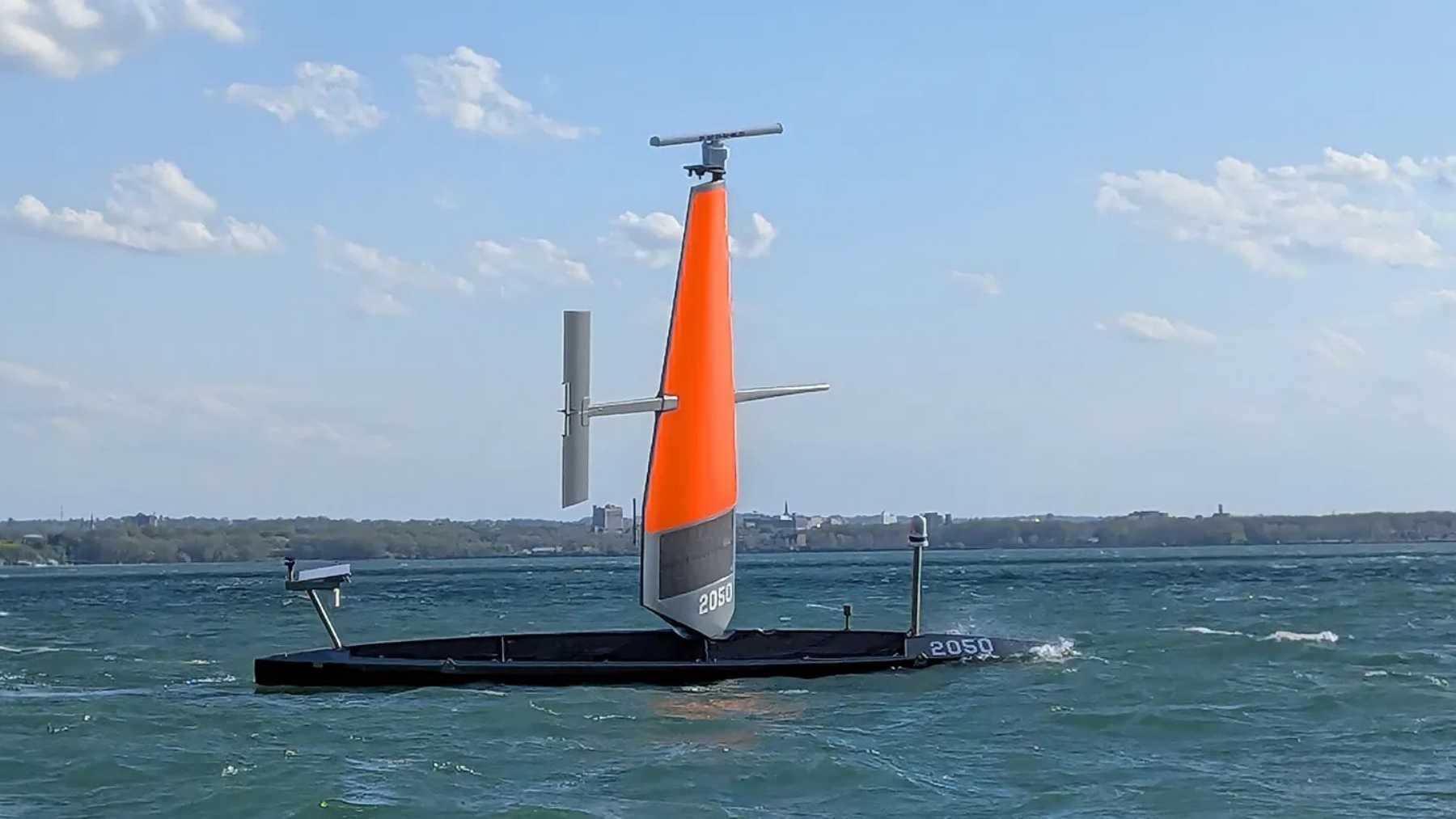

When the Coast Guard adds hardware to the Great Lakes, you probably picture another cutter, or a helicopter thumping over the harbor. The two newest assets working Lake Erie this summer are neither. They are bright orange, 33 feet long, carry nobody aboard, and the only thing sticking up out of the water is a tall sail. They are called sail drones, and for the first time the Coast Guard is using them on the Great Lakes to watch the northern border, help with rescues, and keep an eye out for the weapons and drugs that move across the water near the Canadian line.
The first two set sail out onto Lake Erie on April 27, the opening move in a much bigger rollout. Under a $15.5 million contract signed in March, the Alameda, California company Saildrone is putting 16 of its Voyager uncrewed surface vehicles to work across the Great Lakes and off the Northeast coast. The Coast Guard’s Great Lakes District confirmed the deployment will run from May through October. Then the drones come out of the water, because the one thing a robot sailboat still cannot beat on the Great Lakes is the ice.
Two drones on Lake Erie, with more on the way
What you can spot on Erie right now is only the visible edge of the program. The two orange Voyagers patrolling the lake are the start of a 16-vessel fleet spread across two of the toughest patrol regions the Coast Guard owns: the Great Lakes and the North Atlantic approaches off the Northeast. Saildrone frames the problem the way anyone who has looked at a map of the region would. The lakes are enormous, the commercial traffic is busy, the weather turns on you, and the maritime border with Canada runs for hundreds of miles. Crewed patrols can only be in so many places at once.
The scale is the whole point. The Great Lakes spread across more than 94,000 square miles of water, the largest freshwater system on Earth, and Lake Erie alone covers nearly 10,000 of them. You are not going to keep continuous eyes on that with cutters and helicopters that need fuel, crews, and somewhere to tie up at night. A Voyager can stay out for up to 100 days between service stops, which is the kind of math that makes an autonomous drone look cheap. The deployment is also seasonal by design. The drones go in around May and get pulled before the lakes start to ice over in the fall, which on Erie tends to happen early.
Mostly an electric motor with a very tall sail
Each drone is a Saildrone Voyager, a 33-foot hull with a bright orange wing that stands roughly 19 feet tall. Everyone, the Coast Guard included, calls them wind- and solar-powered sail drones, and that is true about where the energy comes from. There is no fuel tank and no crew. But Saildrone’s own Voyager spec sheet is more specific about how the thing actually moves: an electric motor does the primary work, the tall rigid wing is listed as auxiliary propulsion, and solar panels keep the batteries topped up. So calling it a sailboat is a little generous to the sail. It is closer to a long-endurance electric boat that uses the wind and the sun to stay out for months.
The sensor fit is where it earns its keep. Each Voyager carries high-resolution cameras, including a pan-tilt-zoom infrared unit for night work, advanced radar, and AIS receivers that read the transponders other vessels broadcast. A Starlink link carries the data back to shore in near real time. The whole platform is built to be highly visible and runs collision-avoidance AI, and it is watched continuously by human operators on land who can take manual control whenever they want it. The drone spots and reports. People decide what to do about it.
Weapons, drugs, and a very long border with Canada
The Coast Guard is upfront about what the drones are looking for. They monitor lake traffic, gather weather data for emergency response, track illicit activity, and help keep the maritime border secure. Saildrone puts the law-enforcement piece more bluntly: the Voyagers give the Coast Guard early warning of cross-border vessel movement and illicit operations, drug smuggling included. The sensors are focused solely on maritime domain awareness, which is the polite term for knowing who is on the water and whether they are in trouble or up to something.
Anthony Popiel, who coordinates unmanned autonomous systems for the Coast Guard, told Cleveland’s FOX 8 that the visibility is the value. If somebody gets in distress, he said, a drone in the area could “give us an alert much sooner than we might otherwise get.” Popiel also pointed out that the smuggling people associate with the Southeast happens on the Great Lakes too, and that when a drone catches something worth passing along, the Coast Guard can share it with police agencies or its Canadian partners through Saildrone’s data portal. The drones themselves stay well within U.S. waters. They are unarmed sensor platforms. The shooting, if it comes to that, is still a job for crewed boats, which is exactly the division of labor Saildrone is selling: keep the manned assets in reserve and send them only when a drone has flagged a real threat.
Saildrone has run this play before, just not here
None of this is Saildrone’s first rodeo, and that context matters for reading the “first.” The Great Lakes deployment builds on work the company has done alongside the Coast Guard since 2023 in the Southwest and Southeast, covering counter-drug and migrant interdiction, search and rescue, and illegal fishing enforcement. The U.S. Navy has put the same Voyager platform on counter-drug patrols in the Caribbean and the Pacific. Autonomous surface vessels are having a moment across the U.S. military, from Saronic’s larger autonomous warships on the surface to tethered drones built to guard seabed cables and pipelines, alongside the AI-piloted aircraft the Pentagon is funding. The orange Voyagers are the Great Lakes’ version of that shift.
Sail drones are not even new to these waters. Back in 2023, the U.S. Geological Survey used an earlier Saildrone model on Lake Erie to survey fish populations, circling the lake from summer into the fall. So Erie has hosted bright orange autonomous drones before. What changed in 2026 is who is running them and why. The science missions wanted to count walleye. The Coast Guard wants to watch the border. Same hull, very different job.
What it means if you boat Lake Erie
If you take a boat out on Erie this summer, you will probably run across one eventually, and the Coast Guard would rather you not panic or get curious. The drones are built to be highly visible, they are well lit at night, and the collision-avoidance system is designed to steer them clear of other vessels on its own. The Coast Guard still asks boaters to give them a wide berth rather than pull up alongside for a closer look.
The practical upshot is that there is now a low orange shape on the water that is not a buoy and not a boat, watching, recording, and beaming what it sees back to an operator on shore. It is patient in a way a crew never can be, and it does not need a coffee break.
So the northern border just picked up a persistent, unmanned set of eyes on water that is too big and too busy for cutters to cover all at once. Two drones on Erie now, 14 more coming across the lakes and the Atlantic approaches, all of it running on sun and wind and quietly feeding a screen somewhere on land. They will circle the lake into October. And then, for all the radar and the Starlink and the autonomy, they will get hauled out of the water, because the Great Lakes still shut the whole operation down the moment they freeze over.