
Pretty much every beach town in America has one. A retiree in a bucket hat, headphones on, sweeping a metal detector over the sand in the early morning and digging up bottle caps with the patience of a saint. It’s a harmless hobby, mostly.
Germany’s running its own version of that out in the Baltic Sea. Except the stuff buried down there can explode, and the metal detector has wings.
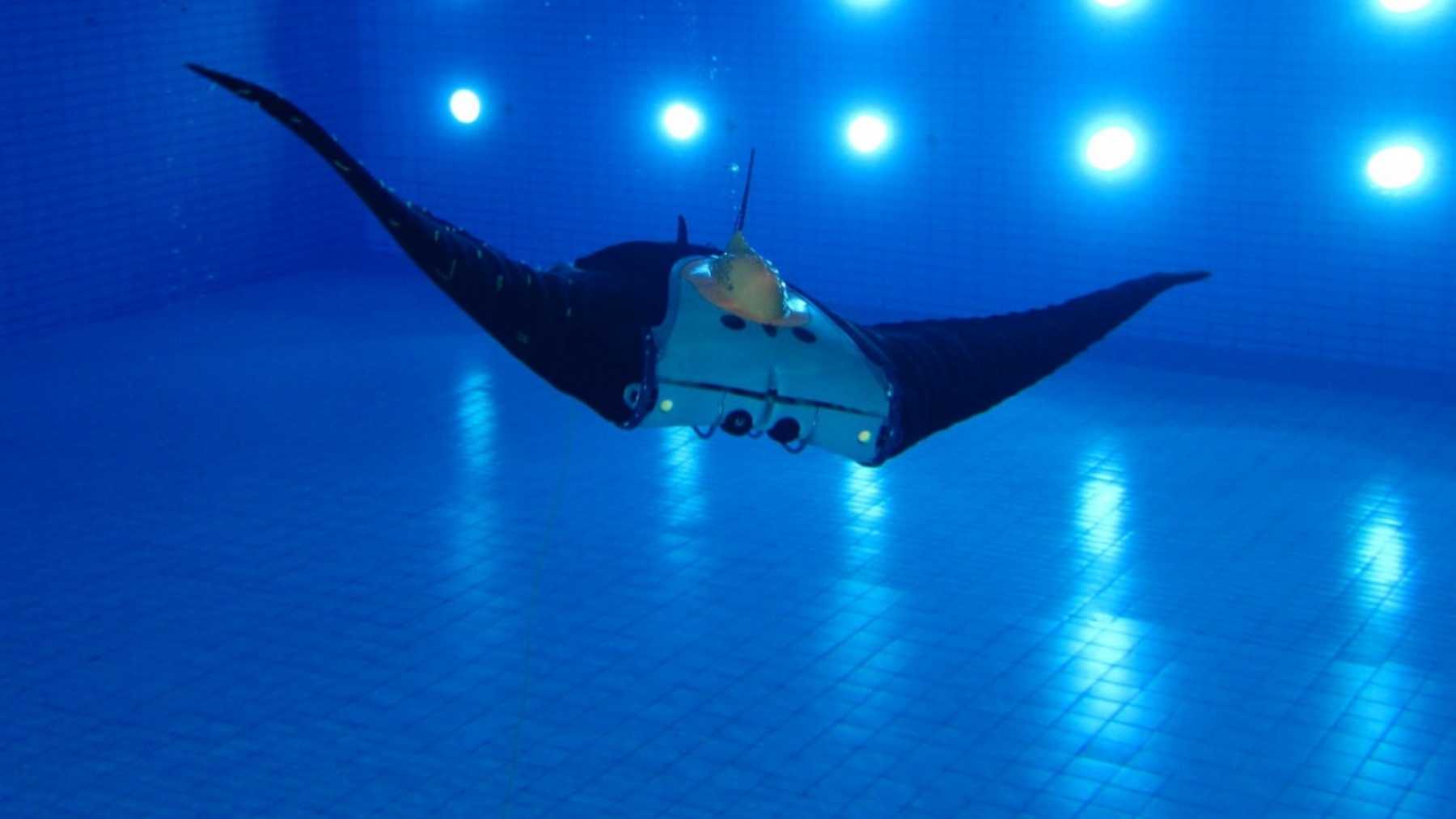
Researchers at Fraunhofer IZM teamed up with Berlin robotics company EvoLogics and a Rostock salvage outfit called Baltic Diver to test an underwater drone that looks and swims like a manta ray. Its wings span about 8.2 feet (2.5 meters) and they’re covered in small sensor modules. According to Fraunhofer, those sensors can pick out objects hidden up to about 20 inches (50 centimeters) down in the mud.
The tests ran at the Digital Ocean Lab, a Fraunhofer test range in the Baltic off Nienhagen, near Rostock. It’s about as big as 1,000 soccer fields, and it has two so-called UXO gardens (UXO stands for unexploded ordnance) where dummy munitions plus real bombs and mines that have been defused are spread across the bottom or buried in it. If that coastline sounds familiar, another drone was working the same stretch of water in late August.
So why does Germany need a robot manta ray?
Because its seas are full of old bombs. Germany’s environment ministry puts the total at roughly 1.8 million tons (1.6 million metric tons) of old munitions in German waters of the North Sea and the Baltic. That’s shells, mines, bombs and grenades from two world wars, a lot of it dumped at sea after World War II so nobody could use it again.
Some of it never even made it to the official dumping grounds. Fraunhofer says the crews hauling it often opened the hatches halfway there, because they wanted the dangerous cargo gone and were paid per load. If you’ve ever had a delivery job, you probably get the logic. You just really wish they hadn’t followed it.
Now the problem is rust. As the casings corrode, they get brittle and start leaking TNT and other toxic stuff into the water, and the ministry says some of those substances are already building up in mussels and fish. Once a casing rots away completely, Fraunhofer says a mine or grenade gets close to impossible to find. So there’s a clock running on all of this.
That’s where the drone comes in. An autonomous underwater vehicle, or AUV, is basically a robot sub that follows a programmed route by itself instead of being steered from a boat. EvoLogics’ Manta Ray moves by flapping its big pectoral fins like wings, and Fraunhofer says that makes it nimble enough to poke around tight, hard-to-reach spots. It also looks frankly a lot cooler than a torpedo, though I doubt that made it into the grant application.
Those wing sensors work like a beach metal detector
The sensors on the wings sit on the fins like buttons, each one in its own little housing, so the team can swap them out depending on what it wants to measure. Marcus Voitel, a research scientist at Fraunhofer IZM, likens the setup to the metal detector you’d take to the beach looking for lost coins.
If you’ve never taken one apart, a metal detector basically creates a magnetic field and waits for something to disturb it. Buried metal messes with that field, the detector notices, and the guy in the bucket hat starts digging.
Fraunhofer’s thinking is that you wouldn’t send just one. A whole swarm of these mantas could scan a big area of seabed on their own and flag anything ferromagnetic, which is the fancy word for metal a magnet sticks to, like iron and steel.
So how does it know it’s found a bomb?
It doesn’t. Karl-Friedrich Becker, one of Voitel’s colleagues, is refreshingly upfront about this. In Fraunhofer’s write-up, he admits the team still can’t tell whether a hit is real ammunition or whether “someone dropped an old iron beam.” Becker calls a hit a place to start investigating. He says other data and other technologies have to be added before anyone gets a clear picture. Anyone who’s watched the beach guy pull up his fourth bottle cap of the morning will understand.
I also couldn’t find a weight, a top speed or a battery figure for the drone anywhere in Fraunhofer’s material. The write-up doesn’t say when the Nienhagen tests happened or how many buried objects the manta actually flagged either. That’s a slightly odd set of details to leave out, and it makes it hard to judge how close this thing is to doing real work.
The TNT sniffer is a separate machine
Fraunhofer wants to stack different senses together, and the second one is a nose. Sebastian Geiger, a sensor systems engineer at Fraunhofer ICT near Karlsruhe, and his team built an electrochemical sensor that detects explosives dissolved in seawater. Geiger compares it to a bloodhound.
It isn’t on the manta. Right now it’s riding on a remotely operated vehicle, an underwater robot a pilot drives from the surface, though Fraunhofer says it could also be fitted to autonomous drones like the manta.
The method has a scary name, cyclic voltammetry, but the idea’s pretty straightforward. The unit pumps a water sample into its sensor head, runs a constantly changing voltage through it and measures the current very precisely. Each explosive reacts to that voltage in its own way, so the resulting curve works like a fingerprint.
According to Fraunhofer, it can detect TNT, plus the military explosives RDX and HMX, at concentrations down to a few micrograms per liter. A microgram is a millionth of a gram, and a liter is a bit more than a quart. It can also take a sample roughly every five minutes for more than 12 hours without coming up.
Geiger’s team tried it in Kiel Bay at Kolberger Heide, one of the biggest official munitions dumping sites, about 1.2 miles off the beach at Heidkate. Geiger says the munitions there cover about 2,965 acres (1,200 hectares) of seabed. The team approached the mines against the current, for the same reason a dog smells best with the wind in its face.
The catch is that it only works if the explosive is already leaking. A shell that’s still sealed won’t give off anything to sniff, which is why Fraunhofer wants sonar in the mix too.
Sascha Krohmann, the marine engineer who runs the Digital Ocean Lab for Fraunhofer IGD, is testing a side-scan sonar with Danish partners off the coast of Denmark. Side-scan sonar fires sound out to the sides and builds a picture of the seabed from the echoes. This one’s built into a sensor rig a ship tows across the bottom (so again, not the manta), and Krohmann says it covers about 650 feet in every direction, twice as far as conventional gear.
His team’s also made 3D images of roughly 20% of the unexploded ordnance it’s been studying, and it’s using them to train AI models. Down the line, those models could say what kind of shell or mine a find is, how badly it’s damaged and whether it can still go off. Get the metal sensors, the nose and the sonar working together on one platform and you’d arguably have a pretty useful machine. We’re not there yet, from the looks of things.
Germany still has to destroy what it finds
Finding the munitions is just step one. Germany’s already run pilot recoveries in the bays of Lübeck and Mecklenburg, and the ministry says they showed safe recovery is generally doable, while also exposing some real gaps.
According to GEOMAR, the ocean research center in Kiel, recovery work had to be halted for a while, and the munitions couldn’t be brought ashore as planned. A big share of what came up is now sitting in wet storage on the seabed, waiting for somewhere to destroy it. Which is a bit like moving your junk from the garage to the basement.
That somewhere’s supposed to be a floating disposal platform that destroys munitions right at sea. The federal government has put €100 million (about $115 million) into its emergency munitions program, and in July, environment minister Carsten Schneider presented a new federal competence center for munitions recovery at the Ocean Technology Campus in Rostock.
The platform itself hasn’t been built. When Germany’s environment ministry last updated it in July, the tender was still running, and the ministry expects the platform to start operating at the end of 2028.