
Every reactor you have ever heard of exists to boil something. Water into steam, steam into a turbine, turbine into a wire that ends at somebody’s house. Ask a nuclear engineer what a reactor is for and you get some version of that sentence.
The machine that ended a forty-year drought in American nuclear does none of it.
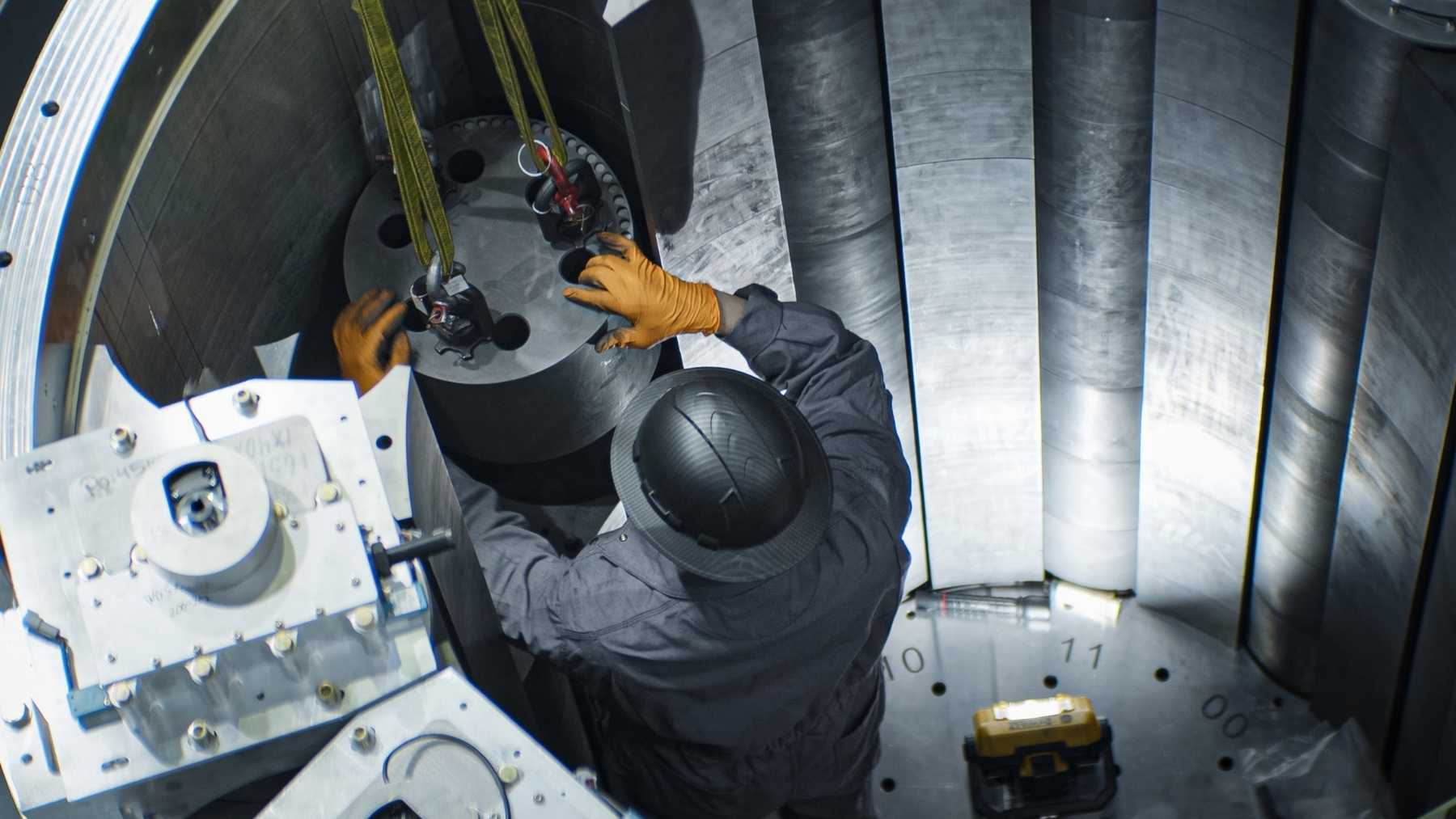
Antares Nuclear’s Mark-0 went critical at Idaho National Laboratory on June 4, and the Energy Department called it the first privately developed non-light-water reactor to reach criticality in the United States in more than four decades. It sat in a shielded pit below the floor of a steel shed at the lab’s Materials and Fuels Complex. It ran on less than 265 pounds (120 kilograms) of uranium for its entire operating life. It had no turbine, no cooling loop, and no mechanism of any kind for moving heat out of its own core.
The Energy Department wrote all of that down on a form in January, months before the reactor was allowed to switch on. The uranium inside it still belongs to the federal government. Antares is leasing it.
The federal filing lists the heat sink as not applicable
The document is a categorical exclusion determination, posting number DOE-ID-INL-25-037, approved by DOE-Idaho NEPA compliance officer Jason L. Anderson on January 26, 2026. It is the least glamorous piece of paper in this whole story and by far the most specific.
The filing describes a reactor “not equipped with power conversion or heat removal systems,” then puts a bounding number on every stage of its existence. Maximum thermal output and maximum electrical output are both entered as none anticipated. The heat transfer medium goes down as not applicable, on the grounds that the reactor does not include a heat transfer system at all, and the heat sink goes down the same way, because there is no thermal power to send anywhere.
Commissioning was capped at under six months. The operational phase was capped at under one month. Decommissioning gets under six months, and after shutdown the reactor sits and cools for 30 to 180 days before anyone is permitted to pull the fuel out of it.
Then there is the category the government filed it under. The Mark-0 cleared its environmental review as a B3.6 action, the exclusion covering small-scale research and development, laboratory operations and pilot projects. That same paragraph of federal regulation contains a carve-out excluding demonstration actions, defined as anything run at a scale that shows whether a technology would be viable commercially. The first new privately developed reactor to go critical in America in forty years went through the paperwork as a laboratory experiment, not as a demonstration of anything.
Under 265 pounds of uranium, and the Energy Department still owns it
The fuel is HALEU, high-assay low-enriched uranium, enriched to under 20% U-235 and packed into TRISO compacts. TRISO wraps every uranium kernel in successive layers of carbon and silicon carbide, so each particle carries its own containment shell into the core with it. BWX Technologies fabricated the compacts at its Specialty Fuels Fabrication plant in Lynchburg, Virginia, and Antares modeled the specification on the fuel BWXT built for Project Pele, the Army’s 1.5-megawatt transportable reactor.
No American company enriches HALEU at commercial scale yet. Centrus Energy’s 16-machine demonstration cascade in Piketon, Ohio has turned out a little over 2,030 pounds (920 kilograms) of it under a DOE contract, according to POWER magazine, and Antares needed under 265 pounds for the Mark-0.
None of the Mark-0 feedstock came from Piketon anyway. The Energy Department and the National Nuclear Security Administration covered it with government-held scrap material, and the terms sit in the same filing. Antares holds a right of use over leased material rather than owning it. Walk away from the agreement and the company forfeits that right, stays liable for accrued fees, and picks up the full cost of dispositioning anything it has already used. Antares also keeps responsibility for the material if it ends up classified as used nuclear fuel needing long-term storage, and the used fuel goes into an approved cask configured for transport until somebody identifies a final repository.
The fuel outlives the reactor. Once the Mark-0 is defueled, the same compacts go into storage and then into the Mark-1, the electricity-producing machine Antares plans to run in the same building in 2027.
The Army ran a nitrogen turbine in that same building in the 1960s
The test itself ran at INL’s Reactor and Critical Experiment facility inside the Materials and Fuels Complex, in building MFC-793, which on the site maps goes by Sodium Components Maintenance Shop. The high bay measures roughly 39 by 64 feet (about 12 by 20 meters), with a bridge crane whose hook tops out 32 feet up. The reactor went below floor level into a pit on the east side, the pit walls and floor handling shielding on the sides and underneath, with concrete blocks laid across the top while it operated.
Antares says the same building once housed ML-1, the Army’s first mobile nuclear reactor.
ML-1 came out of the Army Nuclear Power Program, and the World Nuclear Association records it as a 0.3-megawatt plant about the size of a standard shipping container, truck-mobile, air-transportable, and rated for a twelve-hour setup. Instead of raising steam, it pushed pressurized nitrogen at 1,200°F (650°C) through a closed-cycle gas turbine. The Army tested it in Idaho from 1962 to 1966 and never fielded it.
Antares’ Mark-1 will run a recuperated nitrogen closed Brayton cycle at under 300 psi, per POWER’s rundown of the commercial R1 design. Same working fluid, same cycle, same building, sixty years apart.
The heat pipes are the other half of it. Sealed tubes move heat out of a solid graphite core with nothing pumping inside them, which is also the route Westinghouse is taking with the eVinci, a 5-megawatt design built around the same sealed-tube trick. Antares uses sodium in its pipes. The Mark-0 never got to move any heat through them, because there was nowhere for that heat to go.
Criticality bought the company $470 million and its former regulator
Antares was founded in 2023 and runs facilities in Torrance, California, Idaho Falls, Idaho, and Aiken, South Carolina. It closed a $96 million Series B in December 2025. On July 27, fifty-three days after the Mark-0 went critical, it announced a $470 million Series C, $370 million of that equity and $100 million debt, co-led by Paradigm and Caffeinated Capital with Point72 Ventures, Shine Capital and Industrious Ventures taking part. Antares puts its total funding above $600 million.
The following day it announced a hire. Rian Bahran, who had served since January 2025 as the Energy Department’s deputy assistant secretary for nuclear reactors, running the federal portfolio for advanced reactor research, demonstration and deployment, joined Antares as chief nuclear officer. Bahran had appeared in Antares’ own April press release, speaking in his DOE capacity, welcoming the company’s safety approval.
The clock everyone is running against is Executive Order 14299, signed May 23, 2025. It directs the Secretary of Defense, through the Secretary of the Army, to commence operation of an Army-regulated nuclear reactor at a domestic military base no later than September 30, 2028. The Army launched its Janus Program in October 2025 to make that happen, and it now wants more than 20 reactors on its posts. The Air Force and the Defense Innovation Unit picked Antares in April 2026 to site a prototype at Joint Base San Antonio under the Advanced Nuclear Power for Installations initiative, targeting 2028 or earlier.
“We said criticality in 2026, electricity production in 2027, and power to the warfighter in 2028,” Antares CEO Jordan Bramble said on June 4.
Not everyone agrees the test proved what the Energy Department said it proved
INL director John Wagner drew the line himself, in public, the same week. He wrote that Antares hit zero-power criticality specifically, with the chain reaction sustained at essentially no measurable energy output, and put it flatly: “This is not electricity generation.” He also wrote that the distinction should not diminish what happened.
Edwin Lyman, director of nuclear power safety at the Union of Concerned Scientists, went considerably further in an email to the Associated Press, calling the milestone “a rudimentary first step” with no bearing on whether the Antares reactor turns out safe or commercially viable. Lyman also told the AP that the Energy Department’s statement about the test confirming the reactor can operate safely is false, and that more testing is needed. PBS NewsHour carried the AP report.
Bramble has described criticality as a stepping stone toward an electricity-producing prototype, which is close to what Wagner and Lyman are both saying about the physics, if not about anything else. The disagreement is over what a stepping stone entitles you to claim.
Three more reactors followed, and none of them sells a watt either
Valar Atomics took its Ward 250 critical in Utah on June 18. Deployable Energy’s Unity followed at Idaho on June 30, and Aalo Atomics cleared the bar at 12:20 a.m. on July 4 itself. Four machines made a three-reactor deadline, which is the sort of thing that happens when a president picks the date.
Full power is a different examination entirely, and one of them is sitting it right now. Radiant’s Kaleidos has to run 150 continuous hours at full power inside INL’s DOME facility with nobody touching it, then keep going for 60 effective full-power days. The Mark-0 was never asked to do anything remotely like that. Its exam was whether the control rods, the neutronics models and the supply chain behaved the way Antares’ computers said they would.
They did. That is the entire result, and it is a real one.
Antares announced Bahran’s hire on July 28, 2026, fifty-four days after the Mark-0 went critical. The Mark-1 goes into the same pit next year, on the same leased fuel, and it has to produce up to one megawatt with the nitrogen turbine bolted on.
 @billmosby ROOKIE2 months ago