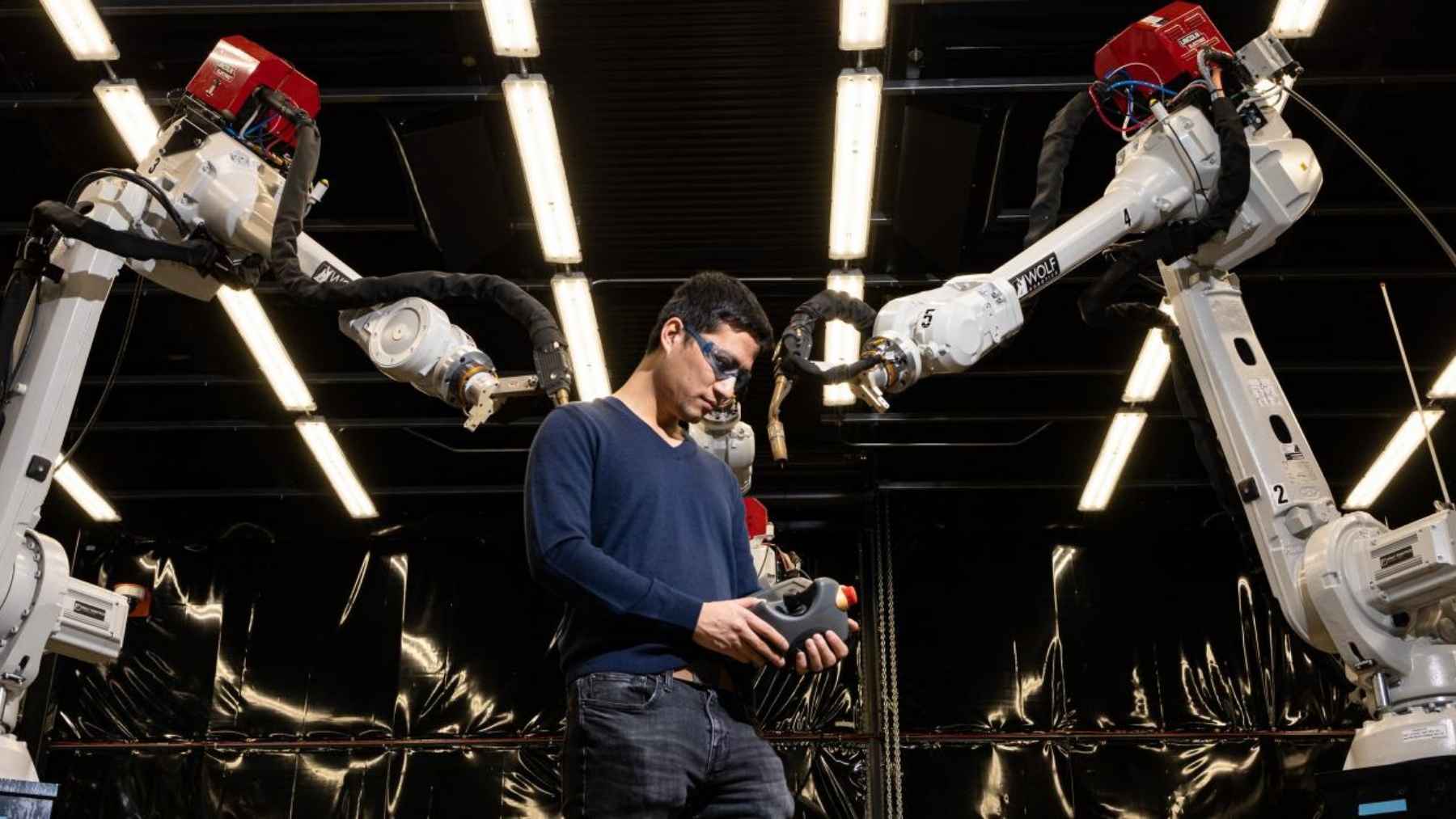

Every metal 3D printing story you’ve read runs on the same basic recipe: a machine deposits material, layer by layer, until the part exists. We ran one of those a couple of weeks ago, about three robotic arms at Oak Ridge National Laboratory welding a steel pressure vessel out of molten wire.
Now the same Tennessee lab has produced a nuclear reactor part by doing pretty much the opposite. The 3D-printed piece isn’t the finished part this time. It gets destroyed on purpose, and that’s the clever bit.
ORNL announced the process on August 24 together with A.J. Tuck Company, a Connecticut electroforming shop it partnered with under a research agreement.
Between them, they produced sealed nickel containers called HIP cans by growing metal onto 3D-printed plastic molds in a bath and then dissolving the molds in acid. In the first phase, the team made five of them without a single leak, and used one to press a 15.7-pound block of solid nickel.
So what exactly is a HIP can?
HIP stands for hot isostatic pressing, and the underlying idea has been around since the 1950s. You take metal powder, seal it inside a hollow container shaped like the part you want, and load the whole thing into a press that applies extreme heat and gas pressure from every direction at once.
The powder particles fuse together into a fully dense, solid piece of metal. The container doing the sealing is the HIP can, and it has exactly one job: keep the pressure out and the powder in. A can that leaks ruins the part.
Making the can, it turns out, is the annoying part. Conventional HIP cans get fabricated and welded together from several pieces, and the process tubes welded onto them are a common source of failure during pressing, according to ORNL. Every weld is another place where a leak can start, and for the complex geometries that advanced reactors need, those fabrication steps stack up fast.
So what’s the fix?
The mold gets dissolved on purpose
ORNL and A.J. Tuck’s workaround starts with a polymer form, 3D printed in the exact shape of the final component. That plastic form goes into an electrolyte bath, where electroforming (think electroplating, except the plated layer is the whole product) grows a dense nickel shell around it, 2 to 3 millimeters thick, or about a tenth of an inch.
Acid then dissolves the plastic out of the middle. The hollow nickel can that remains has no welds in it, and it is ready to be filled with metal powder, sealed and pressed into a solid part. The team also worked an integrated port into the design, so the welded-on process tubes disappear entirely.
“Electroforming allows us to rapidly create very detailed shapes with high precision,” said ORNL mechanical engineer Amiee Jackson in the lab’s announcement. She added that the process depends mostly on how thick the metal layer needs to be rather than how large the part is, which means several components can be batched in a single run.
A.J. Tuck, for what it’s worth, is not a nuclear company. The Brookfield, Connecticut shop has been electroforming since 1917, and by its own account got its start when a former Tiffany Studios lamp designer began growing his own lamps in a bath. A century later, that technique is going into reactor hardware, under a cooperative research and development agreement and a licensing deal the company and ORNL marked on August 20.
Phase 1 ended with five cans and zero leaks
The proof of concept is small, and I want to be upfront about that. In the first phase, the team electroformed five leak-free cylindrical cans, each 6 inches tall and 4 inches in diameter. One of them was filled with metal powder and consolidated into a 15.7-pound solid nickel component, the piece ORNL researcher Vanshika Singh is holding in the lab’s photos. Singh says the project shows electroforming can produce leak-free HIP cans for advanced nuclear applications, and that it could make these components easier to produce in the U.S.
Those are lab-scale objects. A reactor pressure vessel is measured in feet and weighed in tons, and ORNL hasn’t said when, or whether, a full-size vessel could come out of this process. Going from a 6-inch demonstration can to certified nuclear hardware is exactly the kind of jump that tends to eat years.
So why not print the metal directly?
You might reasonably ask why anyone bothers with a plastic middleman when metal 3D printers exist, and Oak Ridge itself is printing pressure vessels with them. ORNL’s answer comes down to cost and stress. Printing the form in polymer avoids the extreme temperatures of metal printing, which reduces strain and distortion in the material. Plastic printing is also cheaper on both material and equipment, allows rapid design changes, and needs less post-processing than metal systems.
Nuclear power provides roughly 20 percent of American electricity, and the heavy forgings reactors depend on come largely from facilities outside the United States, according to ORNL. Anyone planning a fleet of small modular reactors has to answer where the big metal parts come from, and right now the honest answer involves a lot of overseas capacity. We covered another version of that problem in the graphite blocks of an American reactor that all start in one French Alpine shop.
An impeller or a valve is next
Phase 2 is already underway. The team is now applying the process to a more complex geometry: an impeller (the spinning part that moves fluid through a pump or a turbine) or a valve relevant to nuclear systems. ORNL says the technology suits applications that need large, high-precision metal components, and it names reactor pressure vessels, valves and turbine systems specifically. An invention disclosure and a provisional patent have been filed.
ORNL published its results on August 24, and the American Nuclear Society’s Nuclear Newswire picked the story up on September 2. Counting the pressure vessel collaboration revealed on August 19, Oak Ridge has now shown two completely different ways to make reactor metal without a forge, announced five days apart. Frankly, that’s a pretty productive week for one lab in Tennessee.