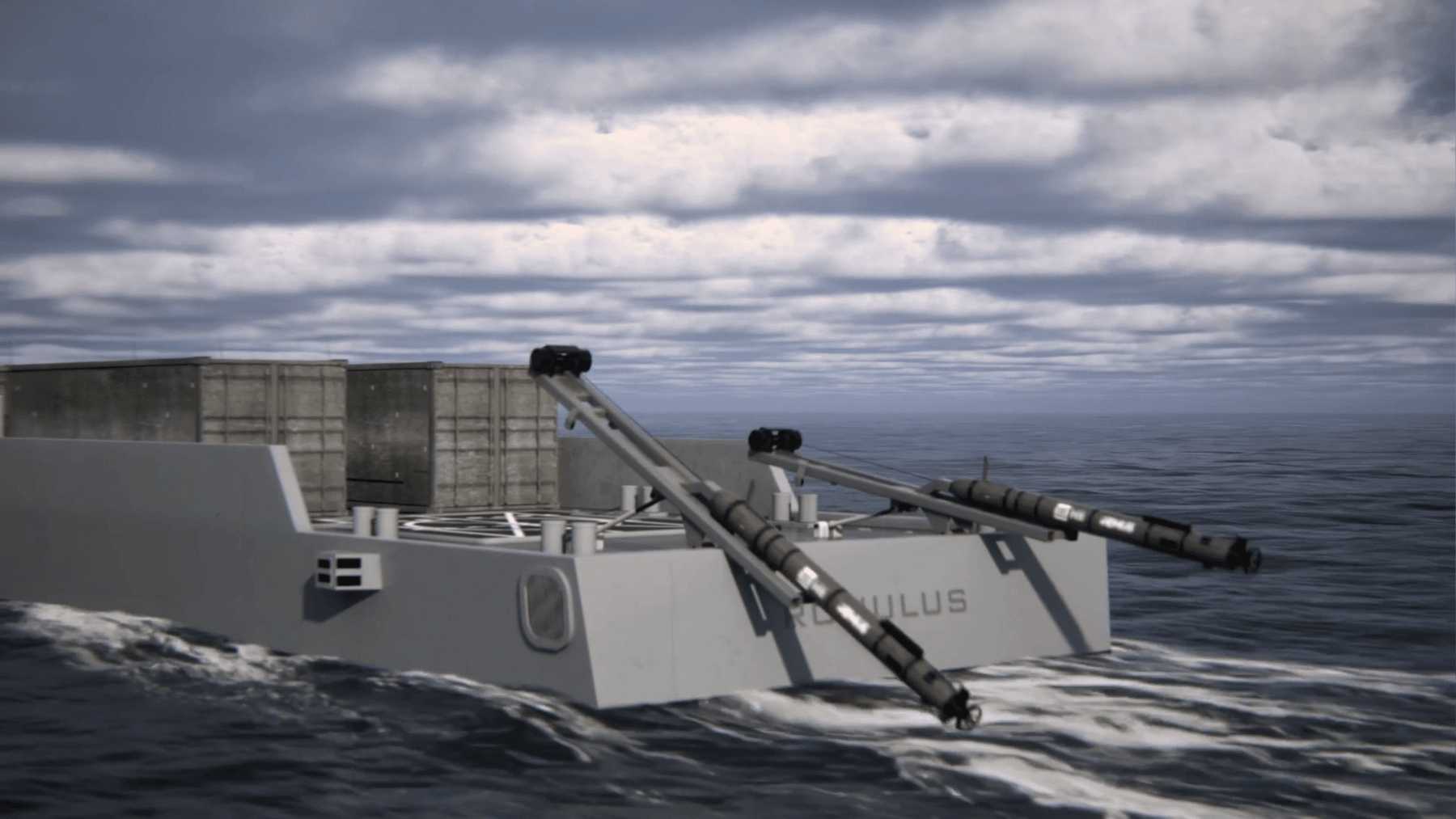

Two weeks ago we covered the 151-foot drone ship HII is welding together in a Louisiana crew-boat yard, a crewless mothership built to lower robot submarines over the side. That boat gets the coverage because it is enormous.
The first member of the ROMULUS family to clear a government exam, though, is the runt: a smaller aluminum interceptor called the Watcher, and the Pentagon office that ran the test has now put in writing that it can hunt down a moving ship by itself.
HII announced the milestone on August 11. The verdict came from the Defense Innovation Unit, which is essentially the office the Pentagon set up about a decade ago to buy technology that already exists instead of spending years inventing its own. DIU signed off on a prototype program called PRIME, short for Production-Ready, Inexpensive, Maritime Expeditionary, a name that tells you pretty much everything the Marine Corps wants from these boats.
So what did the Watcher have to prove?
In a memo to HII, DIU wrote that the boat showed it can cross hundreds of miles of contested water on its own, loiter in an assigned patch of ocean while watching for surface threats, and then sprint to intercept what the memo calls “a noncooperative, maneuvering vessel.” That is procurement language for a ship that is trying to get away from you. DIU says the Watcher demonstrated all three legs of that mission and met the program’s success metrics along the way.
The two test boats were delivered in December 2025 under a DIU contract for smaller drone vessels aimed at the Marine Corps. Between delivery and the memo, per Naval News, they ran through contractor demonstrations, government-led autonomy assessments, seakeeping and performance evaluations, and degraded-environment testing, which is the polite term for checking what a robot boat does when its links and sensors get ugly. HII says it was picked to build its answer out of a field of 116 solution briefs.
The Pentagon wrote the shopping list in 2024
DIU posted the PRIME solicitation in January 2024 under the Replicator umbrella, the Pentagon push to field cheap autonomous systems in large numbers. Per the solicitation text reported by Breaking Defense, the desired boat would cover 500 to 1,000 nautical miles in moderate seas with 1,000 pounds aboard, running on ordinary diesel. It would loiter for several days while keeping enough fuel to get home, then “sprint at 35 knots or faster in low sea states,” which works out to about 40 mph. Builders also had to show they could turn out at least 10 boats a month.
HII’s spec sheet for the finished boat reads like it was copied off that list. The company rates the Watcher for payloads up to 1,000 pounds and ranges up to 1,000 nautical miles, about 1,150 statute miles.
The hull comes from a fireboat yard
HII is the largest military shipbuilder in America, and it did not bend this aluminum itself. The hull comes from MetalCraft Marine, a Kingston, Ontario company founded in 1987 that has spent its whole life building fireboats, patrol boats and workboats, with a US yard across the water in Cape Vincent, New York.
If your city runs a fast aluminum fireboat, there is a decent chance these are the people who built it; Seattle’s Marine One is one of theirs. So the Marine Corps’ robot interceptor comes from the people who make fire trucks that float, which frankly makes more sense than it sounds, because fireboat work is all about speed, rough water and not breaking down at the worst possible moment.
MetalCraft general manager Mike Reed called the result a validation of the aluminum platform, engineered for the speed, seakeeping and strength the mission demands. Neither company published a hull length, by the way. I can’t find one anywhere in the announcement, and I’m not going to reverse-engineer a number out of the ROMULUS-25 model name, so we’ll call the boat small and leave it there.
This is not the first Watcher
The name has been on the water before, with most of the same cast. In the fall of 2020 the Coast Guard leased a crewless boat, also called the Watcher, and parked it off Oahu to guard a restricted stretch of ocean while missile testing was going on nearby. The hull was a MetalCraft build. The autonomy came from Spatial Integrated Systems, a Virginia Beach outfit that steered the boat by satellite from its own headquarters on the other side of the country. The demonstration ran 30 days straight, from October 7 to November 5, 2020, over roughly 20 square miles of Pacific, and the Coast Guard’s own report credits the boat with rules-of-the-road collision avoidance and an optimized search pattern. Coverage at the time said it came through the month needing two minor repairs.
Then HII bought the company.
The deal for SIS’s autonomy business closed on December 31, 2020, less than two months after the Hawaii demonstration wrapped, and about 50 employees came over. They joined HII’s unmanned systems operation under Duane Fotheringham, the same executive quoted in this August’s announcement.
Production is still a maybe
Before anyone writes headlines about the Marines ordering fleets of robot interceptors, read the memo the way a contracts lawyer would. DIU concluded that the results support a potential transition to production under an Other Transaction Authority agreement, and an OTA is basically the Pentagon’s fast lane around its own procurement paperwork, one that can move a successful prototype straight to a follow-on production award without a new competition. Potential is the operative word here. Nobody has ordered a production boat.
The Watcher also slots into a family HII is scaling hard. The company says its Louisiana line will eventually build ROMULUS hulls from about 20 to 190 feet, and the 151-foot vessel taking shape there was picked by the Navy in late May as one of seven candidate designs for its medium drone-ship program. The small end of the market is getting crowded too. We recently covered an 11-foot drone boat chasing a Pentagon interceptor prize with a drone launcher bolted to its deck, and the broader American push to field drone warships keeps pulling software companies in alongside the yards.
HII released DIU’s verdict on August 11, 2026, eight months after the two Watcher prototypes went in the water in December 2025.