
Molten salt turns up in a lot of advanced reactor pitches now, usually as the word that makes a design sound like the future. The chemistry underneath it is less flattering. Salt eats metal, picks up impurities and behaves differently once you irradiate it. A British startup spent August feeding that chemistry into a mass spectrometer inside a rented industrial unit outside Cambridge, England, before any uranium goes near the thing.
Cambridge Atomworks announced the opening on August 27. The address is Granta Park in Great Abington, a science park better known for AstraZeneca and Illumina, and the landlord is TWI, the welding and materials research organization that created the park in the first place.
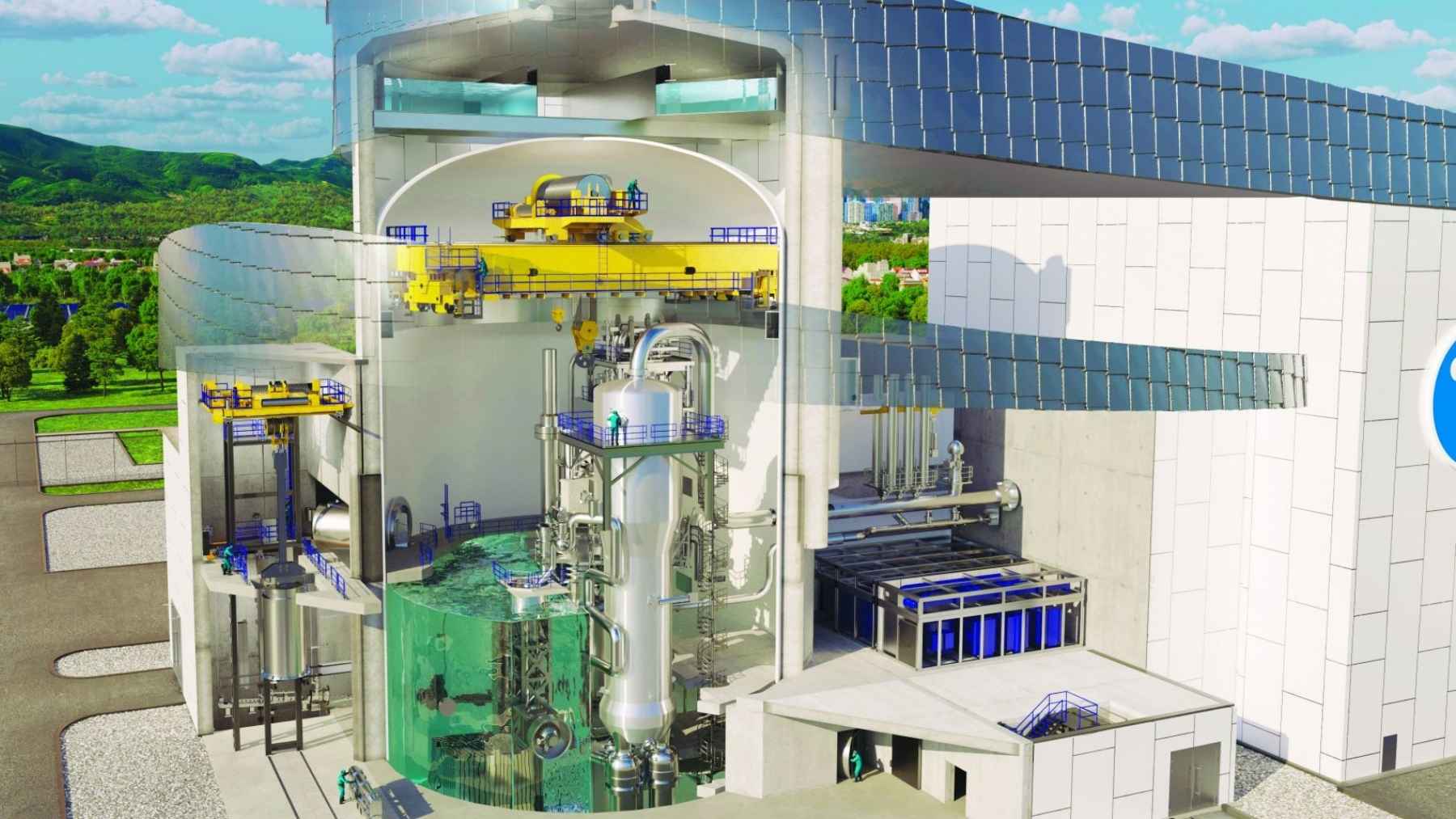
The reactor is called ODIN. Cambridge Atomworks describes it as a low-pressure, molten-salt-cooled, solid-fuel fission microreactor that fits inside a standard shipping container, carries its own power conversion and heat rejection, and runs with no grid connection at all. The customers it is aimed at are mines, islands and remote industrial sites where diesel currently wins by default.
ODIN is not running. What is running is a high-bay workshop, a chemistry lab and an air-cooling rig with no nuclear fuel anywhere in it.
The salt is the entire bet
A pressurized water reactor keeps its coolant liquid by squeezing it. That buys you a thick steel pressure vessel that a regulator has to sign off on, and Cambridge Atomworks calls the fidelity required for that qualification a major safety and cost concern. Every pound of that vessel also has to move if the reactor is going to be transportable.
Salt sidesteps the squeeze. It stays liquid at high temperature and close to atmospheric pressure, so the vessel never has to hold back a pressurized fluid. A lighter vessel is a vessel you can put on a truck.
Salt trades one problem for another. Hot fluoride and chloride salts attack the alloys around them, and picking the wrong one shows up as a hole in a pipe some years later, which is a bad way to find out.
The Granta Park lab points straight at that. Engineers there are characterizing the coolant on an STA-MS system, which runs thermogravimetric analysis, heat flow measurement and mass spectrometry on one sample at the same time. You heat the salt, and the instrument logs what it weighs, how much heat it absorbs and what gases come off, in a single run instead of three. Cambridge Atomworks says a corrosion rig follows, to run candidate alloys against hot fluid over time before anyone commits to a reactor vessel material. That order runs opposite to the American programs. Radiant and Westinghouse both built hardware first and are validating the physics now.
Copenhagen Atomics is chasing a similar coolant problem from the other end, with a thorium molten salt reactor that drops into a 40-foot container and a first criticality that has already slipped past 2028.
The fuel came out of a 1950s American program
Cambridge Atomworks skipped the novel fuel too. The company credits its fuel concept to General Atomics and the Atoms for Peace initiative of the 1950s, and says the US government handed that fuel to research reactors in more than 30 countries. That description matches General Atomics’ TRIGA line, which burns uranium zirconium hydride.
The hydride does the work. Hydrogen is the moderator, and in TRIGA fuel the hydrogen lives inside the fuel meat rather than in the coolant around it. Heat the fuel and that hydrogen kicks energy into passing neutrons, speeding them up and making them less likely to split anything. Reactivity falls as temperature rises, with no control rod moving and no operator involved.
General Atomics has been demonstrating that for decades. TRIGA reactors run at thermal power anywhere from under 0.1 megawatts to 16 megawatts, and get pulsed to 22,000 megawatts for an instant before damping themselves back down. 36 of them are still operating worldwide.
ODIN puts the fuel and the moderator in the same physical unit, which shrinks the core. The uranium is high-assay low-enriched, up to 20% enrichment.
What walk-away safe has to survive
Cambridge Atomworks describes ODIN as “walk-away safe in any deployment scenario,” which in practice means the reactor has to ride out losing every powered system at once.
Two mechanisms carry the load, neither with a pump. Natural convection keeps the molten salt moving through the primary circuit, because hot salt rises and cold salt sinks and that does not stop when the power does. Outside the vessel, a reactor vessel auxiliary cooling system pulls ambient air along the vessel walls by the same effect and carries decay heat into the atmosphere.
Air as the final heat sink changes where a reactor can go. No river, no lake, no coastline, no cooling pond. Mines in dry country become candidates.
The rig at Granta Park is the first physical test of any of it. Cambridge Atomworks installed a prototype air-cooling rig to test the passive vessel cooling system, says non-nuclear rigs are already built and under test, and says early results produced quantitative insight that complements its computer models. The company has published no figures from those runs.
Radiation does the other kind of damage to a coolant, and that testing is happening in the United States. The company says the radiation stability of its coolant salt is being determined through campaigns using accelerator, gamma and reactor sources at Idaho National Laboratory and at MIT’s Department of Nuclear Science and Engineering, and that those campaigns are under way.
American microreactors are already going critical
Westinghouse took its eVinci test reactor to zero-power criticality on August 24 at 10:39 a.m. Pacific, at the National Criticality Experiments Research Center inside the Nevada National Security Site, working with Los Alamos and Idaho National Laboratory. eVinci is a heat-pipe design rated at 5 megawatts electric and 15 megawatts thermal with a refueling cycle of eight years or more. The core that went critical is a one-fifth-scale version of the commercial machine, and it generated no electricity.
Radiant trucked its Kaleidos unit out of El Segundo, California in August and sent it more than 1,000 miles to the DOME test bed at Idaho National Laboratory. Kaleidos makes 1 megawatt electric, runs on TRISO fuel and helium, and faces a five-phase campaign that ends with 150 continuous hours at full power and nobody touching it. Radiant is targeting the third quarter of 2026 for the whole sequence, and the machine has not gone critical once.
Deployable Energy got its Unity Nuclear Battery critical at Idaho National Laboratory on June 30, according to the Department of Energy, roughly 150 days after the project started. Antares Nuclear got its Mark-0 critical at the same site on June 4.
Cambridge Atomworks has loaded fuel into nothing.
The design has changed hands once already
ODIN started as an American product. NANO Nuclear Energy, a New York company listed on the Nasdaq, hired Cambridge Atomworks in 2023 to design a transportable microreactor on an outsourced consulting basis. Cambridge Atomworks took it through a pre-conceptual review by the Department of Energy at Idaho National Laboratory in August 2023, and regulatory engagement with the Nuclear Regulatory Commission opened in October 2024.
NANO Nuclear then turned toward gas-cooled reactors for data centers and put ODIN up for sale. The letter of intent, announced September 17, 2025, priced the design and all its intellectual property at $6.2 million: $250,000 non-refundable up front, $5.95 million during 2026, plus low single-digit royalties on net sales if ODIN is ever commercialized. World Nuclear News reported in March 2026 that the British company had bought the intellectual property back, and Cambridge Atomworks now describes the buyback as complete on its own site.
Two agreements followed. Cambridge Atomworks signed a memorandum of understanding with Mott MacDonald on March 17, 2026, for nuclear engineering, safety and licensing support. In late June it signed a letter of intent with Chiltern Vital Group to put a prototype research facility at Berkeley Green Science and Technology Park in Gloucestershire, on land that used to be the Berkeley nuclear power station.
Berkeley is where the physics gets settled, and Ian Farnan, the company’s CEO, has said the plan afterward is to convert that prototype into a training facility, because Britain has none. The staff building the rigs at Granta Park came out of the University of Cambridge, Rolls-Royce’s submarine business and Moltex, a British molten salt startup.
The company’s own site still lists ODIN’s conceptual design stage as expected in the second quarter of 2026, and an off-grid deployment with an anchor customer in the mid-2030s.
Farnan said the Granta Park building gives his engineers “the space and height to build our demonstrator rigs.” That building opened on August 27, 2026. Westinghouse took the eVinci core critical three days earlier, at 10:39 in the morning, in the Nevada desert.
 dopindan ROOKIE2 months ago