
Flush a toilet in Phoenix, Mesa, Tempe, Scottsdale or Glendale and there’s a fair chance that water ends up as steam over the Sonoran Desert.
It goes first to the 91st Avenue treatment plant in west Phoenix. From there a concrete pipe runs 36 miles west, downhill most of the way, and feeds the Palo Verde Generating Station, where three reactors use it to cool their condensers. If you live in one of those five cities, you’re part of the cooling system for a nuclear plant.
Palo Verde doesn’t sit beside an ocean, a river or a lake, and it’s the only plant in the American fleet you can say that about. Sandia National Laboratories, which has modeled the plant’s water cycle with APS since 2017, says it’s the only one in the world.
The plant buys about 72,000 acre-feet a year. An acre-foot is what it takes to cover an acre of ground one foot deep, and that’s roughly 326,000 gallons, so the annual purchase works out near 23 billion gallons. Arizona’s Department of Water Resources puts the buy at 70,000 to 75,000 acre-feet.
What Phoenix charges for its sewage
The 2010 agreement with Phoenix, Mesa, Tempe, Scottsdale and Glendale priced the effluent at about $58 an acre-foot, then escalated it every year to roughly $300 by 2026. The contract’s own worked example assumes an average price of $328.50 for this year. It also came with $30 million up front, paid in four annual installments of $7.5 million starting in 2010. The cities are getting paid for water the plant never takes, too, because the committed quantity is 80,000 acre-feet a year and any shortfall triggers a non-usage fee. That fee ran at 20 percent of the water price through 2025, and from this year it’s 30 percent of the average annual price.
Run $300 against 72,000 acre-feet and the owners are handing the cities somewhere around $22 million a year for wastewater. Sandia priced the entire water operation, from January 2020 through the end of the current licenses, at about $1.5 billion.
I’d call that a strong deal for the cities.
They weren’t getting one in 1973. Back then the utilities held options on 35,000 acre-feet per planned reactor, kept alive for a dollar or two an acre-foot per year, with the effluent itself priced at 40 percent of Central Arizona Project water and capped at $30. Two landowners sued to stop the sale, arguing the cities had to send treated wastewater back down the riverbed for whoever was downstream. They didn’t win. The Arizona Supreme Court ruled that the cities could sell it.
Where the water goes after the condensers
Nothing leaves. That isn’t a figure of speech: Palo Verde is licensed for zero liquid discharge, so every gallon that shows up either evaporates or stays on the property for good. At full power the three units boil off about 45,000 gallons a minute through nine mechanical-draft cooling towers.
Every trip around a tower leaves the water saltier, since the water goes up as vapor and the salt stays behind. Palo Verde gets 25 to 30 trips, called cycles of concentration, before the salt starts threatening to scale up the condenser tubes. At that point roughly 600 gallons a minute per unit gets dumped out of the loop.
It lands in 650 acres of evaporation ponds, three of them, split into eight cells with liners that don’t last forever and get pulled on a schedule. It’s close to seawater by the time it arrives. The EPA capped total dissolved solids at 30,000 milligrams per liter to limit how much salt blows off the top of the towers.
So how much of what it takes in does the plant actually consume? Nearly all of it. There’s no river to send anything back to. Blowdown accounts for 4 to 5 percent, and the other 95 to 96 percent leaves as vapor over the desert. ADWR puts the pond share at about 3,000 acre-feet a year.
The water deal ends in 2050 and the reactors are meant to run to 2067
On March 13, 2026, APS filed a notice of intent with the NRC to apply for a second license renewal, with the application itself due late in 2027. That’s 2065 for Unit 1, 2066 for Unit 2 and 2067 for Unit 3.
The effluent contract expires in 2050.
Sandia’s paper puts it plainly: the plant doesn’t hold a contract for water from the 91st Avenue plant after 2050. The model the lab built with APS runs its projections out to December 31, 2067, and that’s the date Unit 3 would reach 80 years of operation.
I couldn’t find a plan for those 17 years. APS hasn’t published one I can turn up, and the March announcement about the license extension didn’t mention water at all. My guess is they renegotiate, since the pipe’s already in the ground and the sewage isn’t going to stop arriving. My other guess is that the 2050 price won’t resemble the 2010 price much.
Phoenix isn’t in a generous mood
Lake Mead and Lake Powell both hit record-low elevations in August 2026, after a record-low snowpack over the winter, and their combined storage is lower now than at any point since Powell began filling in 1963. Interior signed the record of decision for the post-2026 framework on August 21 and issued operating guidelines for 2027 and 2028. That’s the package replacing the rules the basin has run on since 2007.
About 40 percent of Phoenix drinking water comes off the Colorado through the Central Arizona Project, 58 percent from the Salt and Verde rivers and 2 percent from groundwater. The city said in July that it could move to a Stage 2 Water Warning by the end of the year, which would put conservation requests and possibly drought surcharges on your bill if you live there.
Effluent volume follows city water use. You don’t get sewage out of a city that isn’t getting water delivered to it first, so deliver less to Phoenix and less comes out the far end. Sandia also notes that the salinity of the effluent keeps climbing year over year, which costs the plant cycles and pushes more volume into the ponds.
Could another plant copy this?
Mostly no, and here’s the unglamorous reason: the rest of the American fleet got built next to water on purpose, and none of those plants need 36 miles of pipe and a softening plant to stay cool. Palo Verde doses the incoming effluent with lime, soda ash, carbon dioxide and acid to pull out calcium and magnesium before it goes anywhere near a condenser.
APS has shopped for cheaper water and hasn’t liked much of what it found. Sandia modeled swapping in brackish groundwater from a basin about 20 miles east, and it covered only about 3 percent of the cooling flow before the extra salt load started pushing more volume to the ponds. Dry cooling came out worse, because the projected water savings didn’t cover the hardware.
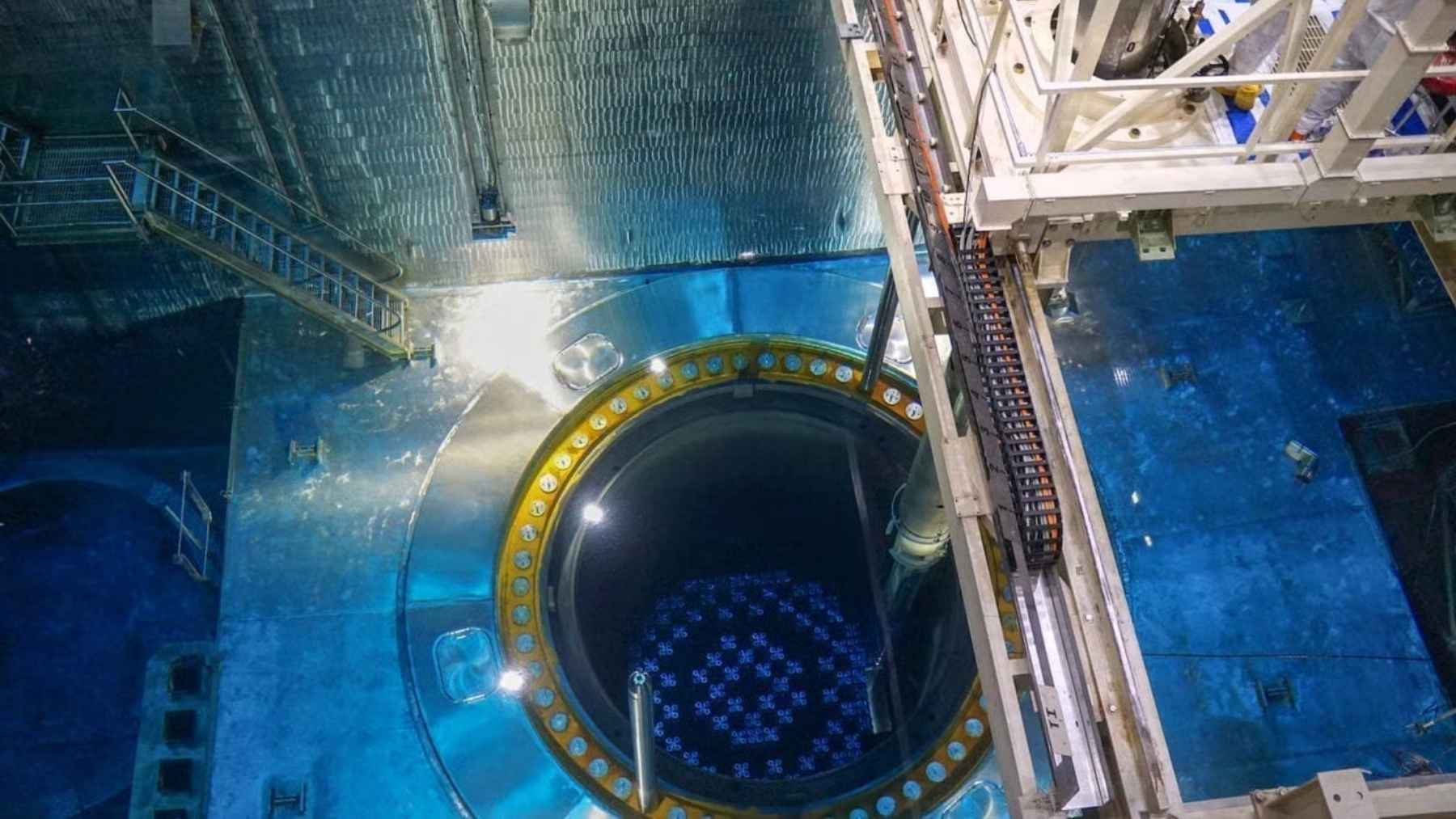
The reactors themselves stay boring, and that’s the goal. On August 15 a single fire alarm went off inside Unit 3’s containment and couldn’t be verified within half an hour, so the crew declared the lowest grade of NRC emergency, walked in, didn’t find smoke and ended the declaration two hours and 50 minutes later. All three units held 100 percent power throughout, which puts it a long way from the day three control rods dropped into a Florida core on their own, and Palo Verde also turned up this month on a Westinghouse list of 13 plants with acrylic paint on breaker springs.
There’s more paperwork on the water side than on the reactor side, anyway. Arizona’s environmental department opened comment in February on renewing the discharge permit for the supply pipeline, which allows up to 19.5 million gallons a day of treated wastewater to reach the Buckeye Canal and the Hassayampa River. That comment period closed on March 23, 2026. The effluent contract has 24 years left on it.
Image credit: Arizona Public Service / Palo Verde Generating Station