
Back in July a British company had one of its drone boats pushed out the back of an A400M and parachuted into the North Sea from 1,300 feet, four times in six days, using the same boat every time. That was the K3 Scout, a 28-foot hull the Royal Navy bought 20 of in March. If you saw that story, you saw the small one.
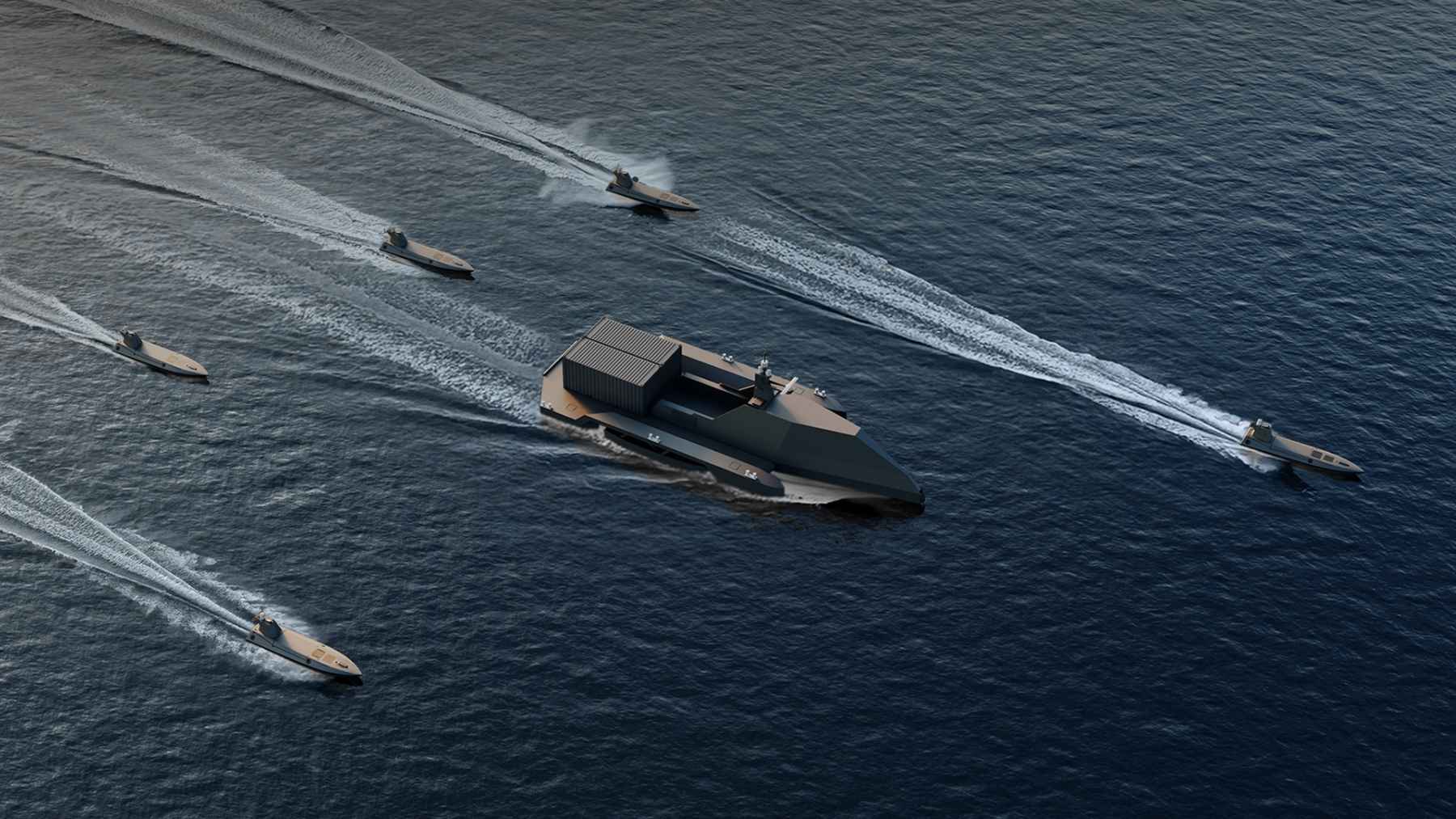
The same company has a 36-foot boat further down the catalog, and its own spec sheet calls that one a gunship. It’s the K5 Kraken. It’s also the boat Anduril has agreed to start building in the United States.
Kraken lists the K5 at 36 feet, 3 inches long, with an 8-foot, 4-inch beam and a draft of 29 and a half inches. Loaded to the max, it weighs 13,200 pounds, or about 6.6 tons. Two diesels on stern drives take it to 50 knots, roughly 58 mph, and the sheet claims 1,000 nautical miles at a 30-knot cruise, which is around 1,150 regular miles at 35 mph. Payload is 3,300 pounds. Endurance is listed at 30 days, mission dependent.
That last phrase is carrying some weight. A boat loitering on a picket line and a boat running 50 knots with a loaded deck won’t burn fuel at anything like the same rate, and Kraken doesn’t break out what 30 days assumes. You’ll see that caveat on almost every endurance figure in this business, so it isn’t a knock on Kraken specifically.
So what makes it a gunboat?
One thing first, because Kraken’s own page uses the word gunship. Over here that’s an AC-130 or an Apache, something that flies and shoots at the ground. A gunboat is a small hull with weapons bolted to it, and navies have run those since the age of sail. Nothing about the K5 leaves the water.
What makes it one is the list of jobs the company has drawn up. Kraken’s K5 platform page covers maritime strike, forward screening, anti-submarine warfare with towed arrays, counter-drone detect and defeat, infiltration and extraction, resupply, casualty evacuation, and something it files under “one-way strike missions,” which is the tidy way of saying the boat drives into a target and doesn’t come home.
If towed arrays are new to you, they’re strings of hydrophones dragged behind a hull on a long cable, far enough back that your own propellers stop drowning out whatever you’re trying to hear. Navies have pulled them behind crewed ships and submarines for decades. Hanging one off a 36-foot boat with nobody on board is newer, and I’d like to watch that one work, because a boat like this can sit in a bad neighborhood listening for weeks while the crewed ship stays somewhere else.
The deck is modular, and Kraken says the payload bays swap out in minutes, even with the boat forward deployed. Same hull hunts submarines one week and carries a strike package the next. That’s the pitch, and it’s a pretty good one if the swap really is that fast.
The spec sheet and the coverage don’t agree
Go looking for K5 numbers and you’ll come back with two sets of them. Kraken’s site says 36 feet, 50 knots, 3,300 pounds of payload, nobody on board. Several defense outlets, some of them publishing as recently as July, describe the same boat as a 49-footer with optional crew that hits 65 knots and carries 4,400 pounds.
So which is it?
I’ve used the manufacturer’s current page for every figure above, because it’s the company’s own and it’s the one live today. My guess is that the bigger numbers belong to an earlier K5 that got redrawn somewhere along the way, since one trade outlet was still calling the boat concept-stage in March and Crease described it as a production prototype a month later. I can’t confirm that, and Kraken hasn’t published anything explaining the gap. If you see 65 knots quoted somewhere, that’s where it comes from.
So why does Anduril want a British boat?
Anduril already makes uncrewed things that go in the water. Its Quonset Point plant in Rhode Island turns out Dive-LD undersea drones by the hundreds a year, with Dive-XL production going in on top of that. What it hasn’t had is a small fast boat that stays on the surface, and the Navy has been asking for one.
The requirement in Anduril’s own announcement is unusually specific: small drone boats carrying flexible payloads above 1,000 pounds, able to stay out a long time, coming off a production line fast. The company writes that current domestic offerings fall short, which is a fairly blunt thing to say about your own industry. Under the deal, Anduril builds the K5 and the bigger K7 Sabre at US facilities, integrates the payloads and its Lattice autonomy software, and handles sustainment afterward. Kraken keeps a parallel line running at home, with a separate hull variant for allied customers.
Anduril’s timing fits where the Navy has been heading anyway. The service canceled its Modular Attack Surface Craft program in March and opened a marketplace for medium drone boats instead, and Rear Adm. Christopher Alexander told a January symposium he expects close to half the surface force to be unmanned inside two decades, according to Breaking Defense.
The K3 is the one with receipts
Crease, who founded Kraken in 2020 with a group of people out of offshore powerboat racing, told Tectonic Defense in April that the K5 was at production prototype stage and that deliveries would begin inside two months. I went looking for the announcement that they’d started. I couldn’t find one.
Meanwhile the small boat keeps piling up paperwork. Twenty K3 Scouts went to the Royal Navy on a contract worth £12.3 million, series production started at Rheinmetall’s Blohm+Voss yard in Hamburg in April, and the airdrop trial dunked the same 28-foot hull four times without breaking it. The K5 has a photo, a spec sheet and a manufacturing agreement behind it. That’s more than most defense concepts get, but it’s a fair distance from 18 interceptors bolted to the deck of a boat that used to ram Russian warships.
Kraken also says its platforms are in use across multiple ongoing conflicts, without naming the conflicts or the roles, and I haven’t seen that stood up independently. It’s the sort of line I’d want confirmed before leaning on it, and you should probably treat “battle-tested” in any press release the same way.
Kraken closed a $175 million Series B in July at a valuation of about $1 billion, led by DTCP with the NATO Innovation Fund and Rheinmetall among the investors. For an outfit that was building race boats six years ago, that’s a quick trip.