
On Tuesday morning, April 28, 2026, in a forty-acre field outside Nashville, ten cows and their calves were doing what cows have been doing on the central Tennessee dirt for generations. They were chewing grass, lying in the shade, and scratching the occasional itch against whatever post happened to be standing nearby. The difference was the posts.
The posts were steel supports for rows of solar panels generating roughly five megawatts of electricity that Silicon Ranch sells to Middle Tennessee Electric, the rural cooperative that distributes power to homes in eleven counties around the Nashville metropolitan area. When the cows are grazing under a row of panels, a piece of software developed by Silicon Ranch flattens the panels close to horizontal so the cattle have headroom. When the cows are moved into the next paddock a few days later, the panels tilt back up and chase the sun. The Associated Press sent a reporter and a photographer to Christiana, Tennessee, that morning because the cows are the point of the project.
The thirty-year corn detour
To understand what is interesting about what is happening on these forty acres, it helps to remember what the same forty acres of American dirt, multiplied by tens of millions of acres across the Midwest, have spent the last twenty years doing.
The Renewable Fuel Standard, signed into law by President George W. Bush as part of the Energy Policy Act of 2005, requires a steadily rising volume of biofuel to be blended into the national gasoline supply. Almost all of that biofuel is corn-derived ethanol. The U.S. Department of Agriculture’s Economic Research Service estimates that roughly 40 percent of the U.S. corn crop now goes to ethanol, with the majority of that ethanol blended into gasoline sold at American pumps. Iowa, Illinois, Nebraska, and South Dakota, the states that decide the corn caucus calendar and the early presidential primary calendar simultaneously, are the political center of that system.
On March 25, 2026, EPA Administrator Lee Zeldin issued an emergency fuel waiver allowing nationwide summer sales of E15, gasoline blended with 15 percent ethanol, starting May 1. Under the Clean Air Act, the waiver lasts a maximum of 20 days at a time. EPA has already indicated it expects to keep extending the waiver through the summer. The decision was popular with both the bipartisan congressional Biofuels Caucus and with corn-state senators on both sides of the aisle. It extends the per-gallon corn footprint of the American gasoline supply at the exact moment the EV transition is changing how much gasoline Americans need.
The same forty acres, in other words, have been producing fuel for the reader’s Camry, F-150, or Civic for a generation. Every fill-up at a Speedway, a Casey’s, or a Buc-ee’s has carried a small share of the Iowa corn crop into the reader’s tank. The Tennessee farm is doing something different with the underlying dirt. The same acres can power the reader’s Tesla Model Y or Ford Lightning charging in the garage, with no fermentation, no distillery, no tanker delivery, and no stop at the pump in the middle.
The farmer math
The reason that pivot is becoming plausible is not climate ideology. It is the per-acre lease check.
Farmers leasing land for solar projects earn approximately $1,000 per acre, easily ten times what they would historically earn through traditional row-crop agriculture, said Ethan Winter, the national smart solar director at the American Farmland Trust. That income lets farmers diversify operations, pay down debt, and buy additional land. The political economy is the reverse of what most coastal observers assume: the people most interested in solar leases right now are not climate activists but the third-generation cattle and grain operators in rural Tennessee, Georgia, and the Carolinas, who are trying to keep family land in production at a moment when the rest of the math is breaking against them.
“Agriculture is in a really tough spot right now,” Winter told the AP, citing trade wars, climate extremes, rising input costs, and pressure to sell. “So maybe this is our moment where we can be helping states meet their energy needs and do that in a way that’s providing new opportunities for farmers.”
Why a cow under a solar panel is harder than a sheep
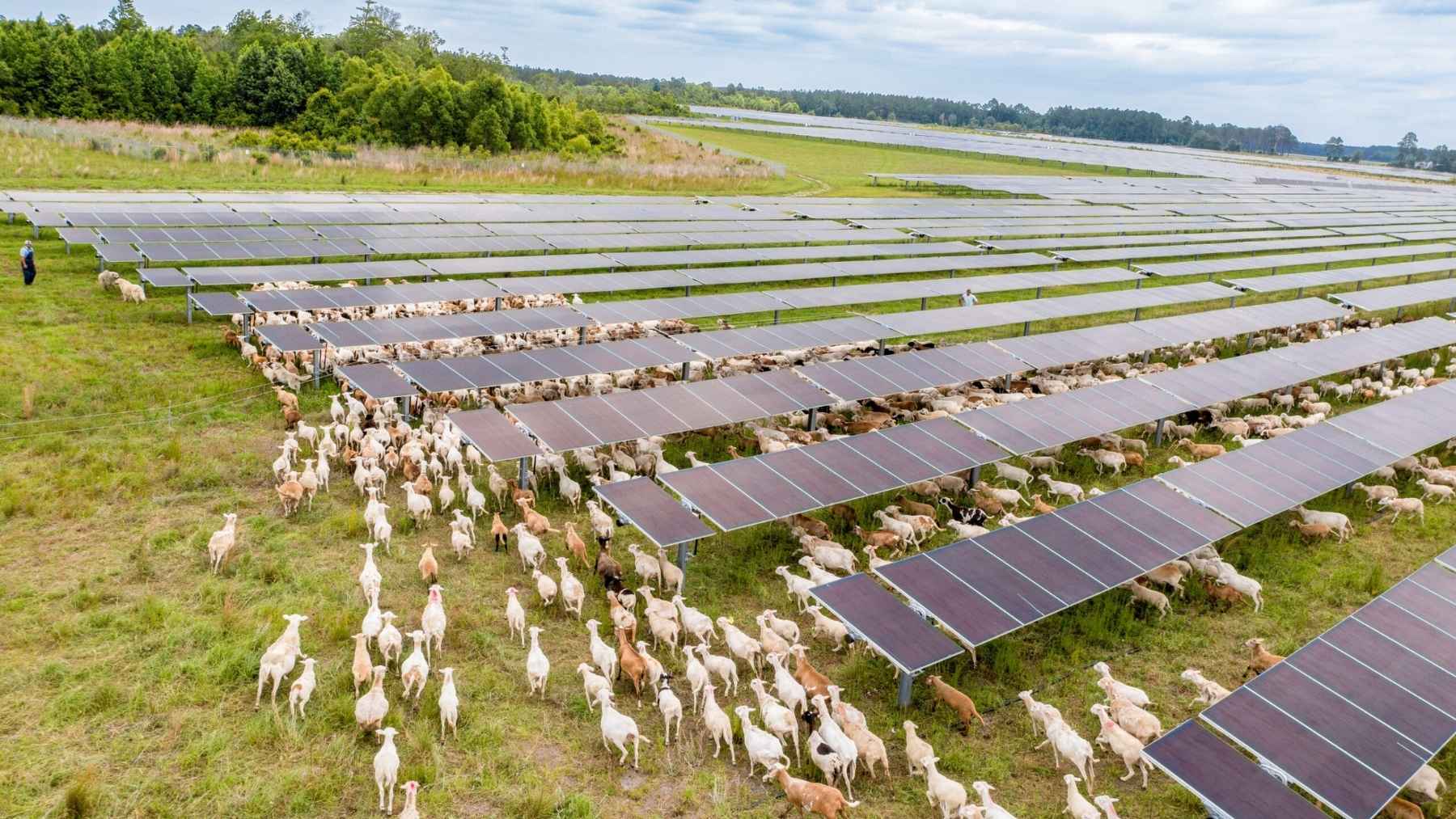
Most of the agrivoltaics work in the United States to date has been done with sheep. The American Solar Grazing Association tracked more than 130,000 acres of solar sites being grazed by sheep as of 2024, a figure that has continued to grow. Silicon Ranch alone has roughly 15,000 acres of pasture being grazed across its U.S. portfolio, mostly by sheep, since launching its regenerative energy program five years ago.
Cattle are harder. A full-grown cow can weigh over half a ton, and solar panels often pivot to a near-vertical angle to catch the morning and evening sun, leaving very little physical clearance underneath the array. Raising the panels permanently to accommodate cattle is cost-prohibitive because of the volume of steel involved. Silicon Ranch’s compromise was to raise the panels a little and then write the software that turns the panels close to horizontal when cattle are grazing the row directly underneath them. The cattle rotate between paddocks every few days. While they are in one paddock, the panels in the unoccupied paddocks operate normally and continue to feed the grid.
“We know it works,” Nick de Vries, Silicon Ranch’s chief technology officer, told the AP at the site. “But you need to prove it to other people.”
Kevin Richardson, the senior director of the American Solar Grazing Association, framed the broader question this way: the industry still has to overcome site-design challenges and develop the right economic incentives for ranchers before cattle agrivoltaics scales to anything like the size sheep grazing already has. “Once we have that, I think we’ll see more solar sites using cattle or multi-species grazing with sheep and cattle,” he said.
What the pasture is actually doing
The unexpected finding from the Tennessee site, and from the Silicon Ranch sheep portfolio more broadly, is that the pasture beneath solar panels is in some respects healthier than open pasture in the same climate. Pasture beneath panels retains more moisture, which makes it more drought-tolerant, said Anna Clare Monlezun, the rancher and rangeland ecosystem scientist working on the project. Grazing in the shade leaves the animals less prone to heat stress, which helps them gain more weight and drink less water during the summer.
“There are more win-wins than trade-offs,” Monlezun told the AP.
The independent research is starting to back that up. Taylor Bacon, a doctoral student at Colorado State University studying the ecological outcomes at solar grazing sites across the United States, told the AP that “solar is one of the most powerful tools we have for cutting emissions and is cost-competitive with fossil fuels. I think we’re starting to see enough research that, when you do it well, the land use can be more of an opportunity than a downside.”
The Iowa question
For the U.S. auto industry, the Tennessee farm is interesting because it represents a quiet third path through the transition. The first path is to extend the gasoline barrel with more ethanol, which is what EPA’s March emergency waiver is designed to do. The second path is to replace the gasoline barrel with imported lithium and an EV charging cable, which is what the Tesla showroom in Nashville sells. The third path uses the same American dirt, literally the same acres, to do both at once for as long as the transition takes. Whether Iowa, Illinois, and Nebraska decide to do that depends less on what the EPA says about E15 next summer than on what the per-acre lease check on a solar agreement looks like compared with a corn rotation in 2027 and 2028.
The Renewable Fuel Standard was written in 2005, when there was no commercially viable EV on the American market and Tesla was a venture-stage company that had not yet delivered a Roadster. The agrivoltaics business model did not exist. The grid did not have the absorption capacity for the scale of distributed solar that Silicon Ranch is now feeding into a Tennessee rural electric cooperative. The 2026 version of all three of those things is different. The political coalition that locked corn ethanol into federal law is still in place. The math that locked it in is starting to move.
What the cows are quietly proving
The Tennessee project is forty acres. It runs ten cows and their calves. It feeds one rural electric cooperative outside one mid-size American city. It is, as Silicon Ranch is willing to admit, a proof of concept. It will need years of operational data, multiple independent research collaborations, and a long catalogue of failed experiments at other sites before cattle agrivoltaics is something a Nebraska rancher or an Iowa corn grower will write into a long-term lease.
It is also the first time a major American solar developer has taken the cattle problem seriously and built the engineering to solve it. The same forty acres that fed the gasoline pump for a generation are now feeding both a herd and a transformer at the same time, and the cows do not seem to mind. The honest version of the headline is that nobody on this farm had to give up either one.
The next acre, somewhere in the Corn Belt, is the one that matters.