
Floating solar farms sit on two materials pretty much everywhere they exist. High-density polyethylene, the same plastic as your milk jug, makes the floats, and steel makes anything that has to hold a shape under load. The steel is steel.
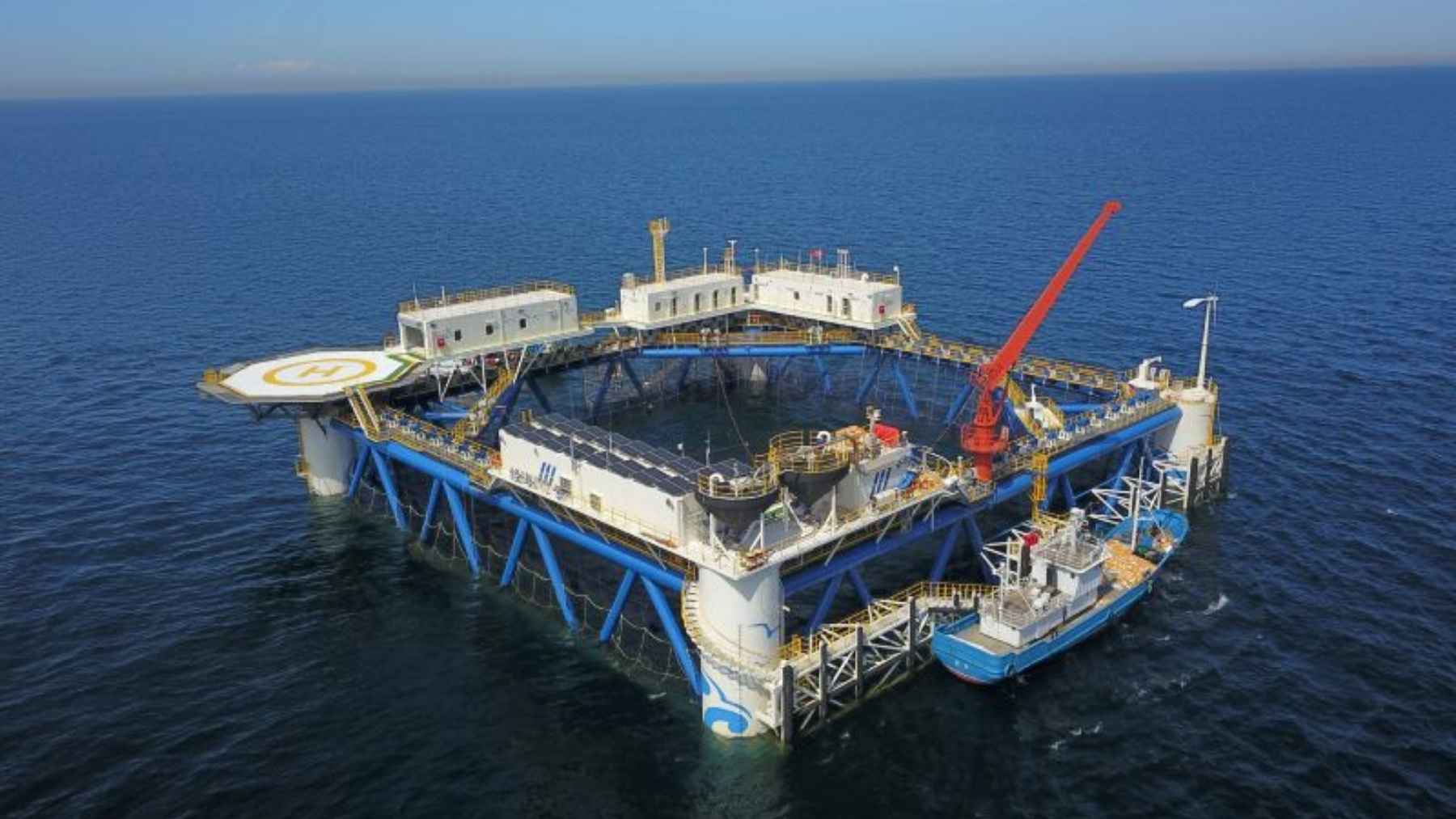
A shipyard in Yantai, China, spent this summer adding a third option: bamboo. Yantai CIMC Raffles Ocean Technology Group announced a 100-kilowatt floating solar platform named Jilin-2 in late June, built on tubes of wound bamboo composite instead of steel frames or plastic floats. Crews finished installing it at a demonstration base off the Shandong coast by early August, and the South China Morning Post reported the deployment on August 27.
The power already has a customer. CIMC Raffles routes the output into an integrated project producing hydrogen, ammonia and methanol at the site, per the June announcement. Your utility is not in the deal.
You probably have the same question every marine engineer asked: bamboo, in salt water, on purpose?
The tubes wind up like fishing rods, not fence posts
The tubes come out of a factory, not a grove. Beijing Forestry University developed prestressed, continuous fiber-reinforced bamboo pipes for the platform, and the load-bearing structure uses what Chinese industry calls third-generation bamboo-wound composite tubes, according to TaiyangNews. Winding lays continuous bamboo fiber around a form under tension and sets it in resin, which leaves the finished product closer to a fiberglass fishing rod than to anything holding up a tiki bar.
The CIMC Offshore Engineering Research Institute, the research arm of a yard better known for oil rigs, developed the platform with China Forestry Group Corporation and Beijing Forestry University. A drilling-rig builder, a state forestry company and a forestry school shared one set of drawings.
CIMC Raffles said the bamboo design “significantly reduces marine environmental impact” compared with conventional steel or high-density polyethylene structures. Chinese authorities credit the tubes with high strength, low weight, corrosion resistance and renewability, per the same TaiyangNews report.
Beijing cleared this lane years ago. Ten ministries signed opinions on accelerating the bamboo industry in 2021, and the National Development and Reform Commission followed with a 2023 three-year action plan to push bamboo as a substitute for plastic. Jilin-1, a 10-kilowatt bamboo prototype, went into the water in 2023 under the same partnership; Jilin-2 carries 100 kilowatts three years later, ten times the rating, and China Science Communication calls it the world’s first bamboo-based offshore solar platform in the 100-kilowatt class.
All 100 kilowatts go into making fuel
One hundred kilowatts is demonstration scale, and CIMC Raffles knows it. The company’s own steel semi-submersible from 2023 carries 400 kilowatts-peak on about 20,450 square feet of deck (1,900 square meters); Jilin-2 carries 100 kilowatts. CHN Energy’s array farther west along the same province’s coast runs to a full gigawatt, ten thousand times Jilin-2’s 100 kilowatts.
Nobody spent three years on composite tubes to sell 100 kilowatts of electricity. The platform earns its keep as a materials trial, and the output does something useful while the trial runs: it feeds hydrogen, ammonia and methanol production at the base. Electrolyzers turn the electricity into hydrogen, and downstream units turn hydrogen into ammonia and methanol, fuels that ship a lot more easily than hydrogen does.
CIMC Raffles co-runs that base with China’s National Photovoltaic Quality Inspection Center as a national offshore solar demonstration site, and the company lists offshore hydrogen production among the technologies it trials there. Solar-to-fuels at sea was already on the menu. The bamboo is the new part.
Shandong already drove 11,736 steel piles into the sea
CHN Energy brought the world’s largest open-sea solar plant to full grid connection off Dongying, on Shandong’s Bohai shore, in late December 2025. The HG14 project covers roughly 3,020 acres (1,223 hectares) of water about 5 miles (8 kilometers) offshore, in depths of 3 to 13 feet (1 to 4 meters). Its 2,934 steel truss platforms each measure about 197 by 115 feet (60 by 35 meters). Underneath them stand 11,736 steel piles. The bill came to roughly $1.2 billion, per pv magazine, and JinkoSolar built the modules with dual glass and POE encapsulation specifically against salt fog and seawater. CHN Energy says the fixed-pile design stands up to waves, tides, strong winds and seasonal sea ice.
Shandong’s 2022 offshore solar allocation lined up 10 sites totaling 11.25 gigawatts across six coastal cities, Yantai and Dongying both on the list. Every pile in that pipeline defaults to steel, and every float in the wider industry defaults to HDPE. Singapore bolted more than 30,000 plastic floats into the Johor Strait for a five-megawatt-peak array, and the barnacles moved in anyway.
Floating solar keeps producing strange hardware wherever land runs out. Taiwan parked a 181-megawatt array in an intertidal zone that settles onto the seabed twice a day, and a Bavarian gravel lake carries 2,600 panels standing bolt upright on underwater keels. Bamboo tubes slot straight into that family album.
The European Union, for its part, funds a Horizon Europe offshore floating solar project literally named BAMBOO, with a 5-megawatt North Sea demonstrator in the plan and no actual bamboo mentioned anywhere in the project description.
Raw bamboo gets eaten alive in seawater
Marine borers live in most saltwater environments, and untreated bamboo makes an easy meal: the plant carries no natural toxins against wood-boring organisms, and preservation specialists put the average natural durability of untreated bamboo under two years before anyone adds salt water. Researchers who study tropical harbors rate bamboo’s natural durability in seawater as low and call preservative treatment a requirement for marine use. Raw culms in the ocean are consumables.
Jilin-2’s tubes sit a long way from a raw culm. Resin seals the wound fiber away from the water, the material arrives engineered rather than harvested, and the manufacturer claims corrosion resistance for it. CIMC Raffles has not published aging data from the 2023 prototype, though. The company answered with hardware instead: it built the next one ten times bigger.
Storms will run their own test. Yantai’s corner of the Yellow Sea takes winter gales and the occasional typhoon remnant, and none of the announcements so far put a design load number on the bamboo structure.
CIMC Raffles gets a cheap experiment either way. A 100-kilowatt platform risks little, stress-tests a national materials policy in the most hostile environment available, and feeds a fuels project while it floats. A third Jilin, if the tubes hold, walks into a much easier meeting.
Jilin-1 opened the program at 10 kilowatts in 2023. Jilin-2 runs at 100, installed off Yantai by early August 2026 and reported deployed by the South China Morning Post on August 27.