
Reversing into a tight parking space looks easy right up until the walls get close. You get a camera, a few inches of margin on either side, and the option to pull out and try it again if you misjudge it.
HII builds an underwater drone that performs roughly that maneuver into the side of a nuclear submarine, several hundred feet down, in water where nobody can see anything and nobody is driving.
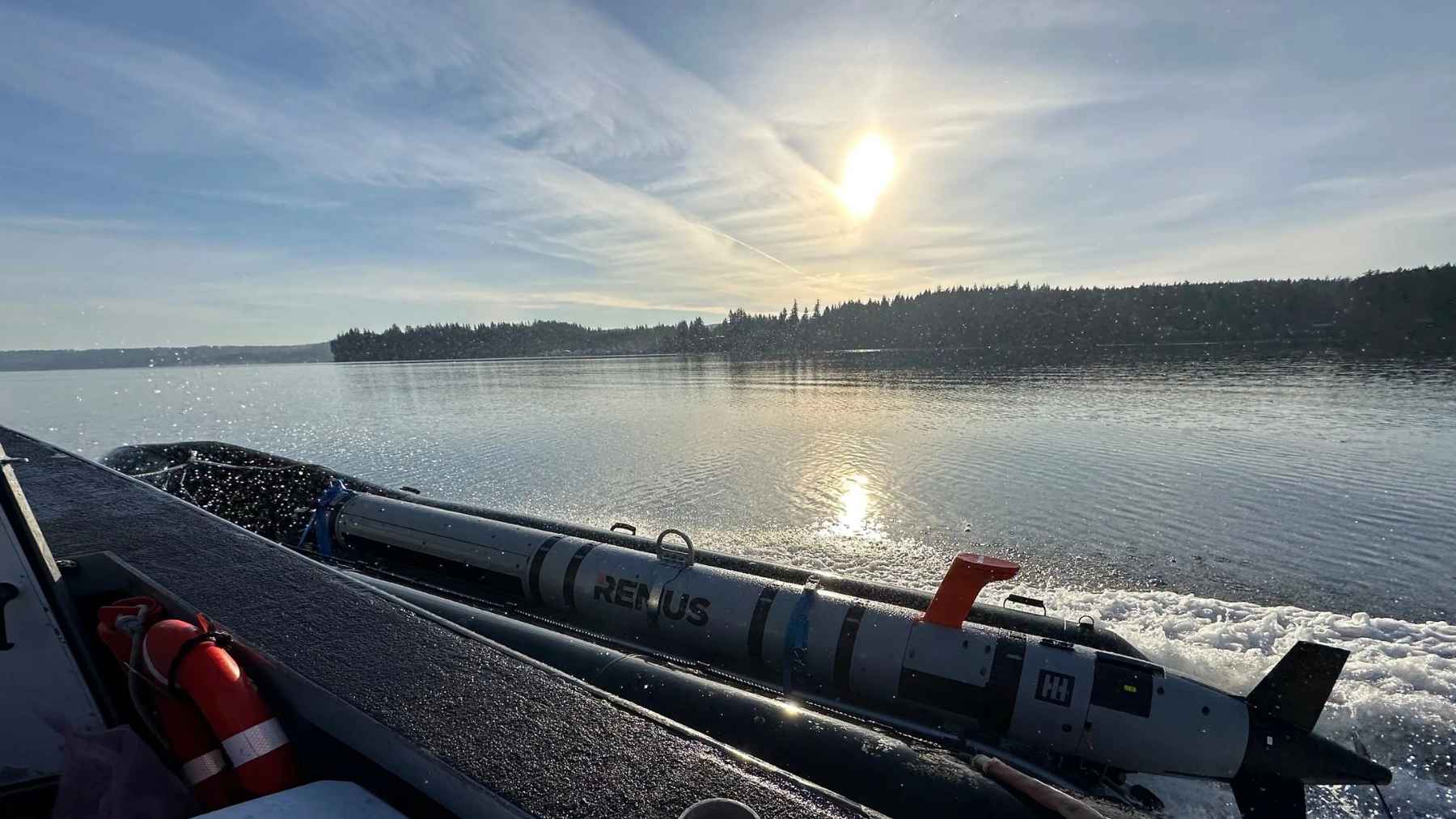
The machine is the REMUS 620 and the parking space is a 21-inch torpedo tube on a Virginia-class attack submarine. According to HII’s own spec sheet for the vehicle, the drone’s hull measures 32.4 centimeters across. That is 12.75 inches.
Which leaves about four inches of water on every side of it. The drone has to find that gap by itself, hold the alignment, and slide in without touching the walls of a tube built to hold a Mark 48 torpedo.
It goes in nose first and comes back out backwards
In October 2025, HII announced that a joint team from the company, the Woods Hole Oceanographic Institution and the Navy’s Naval Undersea Warfare Center Division Newport had gotten a second-generation 620 to dock itself inside a submerged Virginia-class torpedo tube at Seneca Lake, New York.
The drone swims into a container called a SAFECAP, short for shock and fire enclosure capsule, which sits inside the tube and babysits the vehicle’s lithium-ion batteries. On the way out, it does not turn around. It backs out of the tube and separates, a move the Navy calls a reverse swimout.
Worth being precise about what that test was, because the press releases are not. Seneca Lake is a Navy test facility with a torpedo tube and shutterway fixture in the water. It is not a submarine. Defense Daily noted at the time that the team used the fixture rather than an actual boat at that stage, and nothing HII has published since says otherwise.
The older REMUS 600, in its Yellow Moray configuration, has done the real version off Norway from the USS Delaware. We went through how badly that went the first time and how well it went the fourth a few weeks ago. The 620 has done it in a lake, against a fixture, which is still the step everybody else in this business is trying to reach.
The 110-hour battery costs five feet of drone
Here is the number that follows the REMUS 620 through every press release and defense trade write-up: 110 hours of endurance and 275 nautical miles of range, which HII calls the longest reach in its class.
Both figures are real. Neither one comes standard.
HII’s published data sheet breaks the vehicle into three battery configurations, and the headline numbers only belong to the biggest one. With a single 9.6 kWh battery module, the 620 is 105 inches long, weighs 414 pounds and runs 42 hours out to 110 nautical miles.
Add the third module and you get the brochure vehicle: 169 inches, 719 pounds, 110 hours, 275 nautical miles.
So the last 68 hours of endurance cost about five and a half feet of extra hull and 305 extra pounds of drone. That is the trade nobody puts in a headline.
It gets steeper once you bolt on the sensor that makes the drone useful for hunting mines. HII lists a sample fit with a Kraken synthetic aperture sonar as a wet payload, and in that configuration the two-battery vehicle drops to 50 hours and 132 nautical miles.
The three-battery version is not listed with that sonar at all. There is an N/A in the box, which in a spec sheet usually means the combination does not fit, does not balance, or does not exist yet.
None of this makes the 620 a bad machine. It makes it a machine with a length budget, and the tube it has to fit through does not get any longer.
Three fins, a 12-hour recharge and 8 terabytes of hard drive
The propulsion is a direct drive DC brushless motor turning a two-blade propeller, with a controllable speed of 2 to 8 knots. Steering comes from three independent control fins handling yaw, pitch and roll, which is what lets the thing hold an attitude precisely enough to thread a four-inch gap.
Depth rating is 600 meters, or 1,969 feet. For scale, the Navy publicly rates Virginia-class test depth at greater than 800 feet, so the drone can work considerably deeper than the submarine that carries it.
Navigation runs on an iXblue Phins C7 inertial system that HII rates at 0.05% of distance travelled. Run the arithmetic on a full 509-kilometer sortie and that is roughly 250 meters of accumulated drift, which is a fine result for open-ocean survey work and nowhere near good enough to find a 21-inch hole.
Which is why the data sheet also lists GPS, long baseline positioning and Doppler-aided dead reckoning alongside it, plus a WHOI acoustic modem. Getting home is a different navigation problem than getting there, and HII equips the vehicle for both.
Storage is 8 to 16 terabytes of solid state, with an externally removable option so a crew can pull the mission data without opening the vehicle. Recharge in the vehicle takes 12 hours, and the battery modules are identical and swappable, so a boat carrying spares does not have to wait for one.
A helicopter can drop it and it can carry drones of its own
Submarines are only one of the ways this thing gets into the water. HII lists deployment from amphibious ships, surface combatants, small crewed and uncrewed boats, and helicopters.
The company also says the 620 can act as a host platform, launching and operating other vehicles or payloads from underwater. A drone that a helicopter drops, that carries smaller drones, and that a submarine can swallow back through a torpedo tube is a genuinely odd shape for a piece of naval hardware, and it is the reason the vehicle keeps showing up in three different Navy conversations at once.
It is also not the only machine chasing that job. L3Harris is building the Iver4 900 under a separate Defense Innovation Unit award for the same torpedo-tube trick, and we went through that vehicle spec by spec when its contract landed. Different drone, different company, same hole in the same submarines.
The fastest-growing unit at HII is still a small one
HII reported second-quarter results on July 30, and the drone business shows up in them in a way the press releases do not prepare you for.
Mission Technologies, the division that builds REMUS, posted $760 million in quarterly revenue. That is down $31 million, or 3.9%, against the same quarter last year, with higher unmanned volumes only partly offsetting declines elsewhere. Full-year guidance for the division sits at $3.0 to $3.2 billion against $10.2 to $10.4 billion for shipbuilding.
Chief executive Chris Kastner was asked about the unmanned business on the call and called it “the fastest-growing business unit we have,” per Washington Technology’s account of his remarks, while describing the revenue itself as modest for now and declining to guess how large it gets.
The company also told investors it plans to spend on unmanned production capacity in the second half, which it expects to push Mission Technologies’ margin down to roughly 4% in the third quarter from 7.2% in the second.
That is a company paying now for volume later, which tends to be a decent signal about what management actually believes. It is also a reminder that a drone appearing in every naval trade publication this year sits inside a business that is a rounding error next to the yards welding submarine hulls.
What has not happened yet
No REMUS 620 has publicly docked into a torpedo tube on an actual submarine at sea. The Seneca Lake work was against a fixture, and HII has not announced the at-sea step since.
Neither of the two torpedo-tube contracts the Defense Innovation Unit handed out this spring carries a published value, a quantity or a delivery schedule, and neither company has volunteered one.
What is documented is narrower and more useful than the marketing: a 12.75-inch drone that finds a 21-inch hole in the dark, parks itself in a capsule and reverses out again, and gets its advertised 110 hours only when you make it fourteen feet long. Everything past that is still a lake in upstate New York and a spec sheet with an N/A in one of the boxes.